


Россия, Екатеринбург


СДЕЛАЙТЕ СВОИ УРОКИ ЕЩЁ ЭФФЕКТИВНЕЕ, А ЖИЗНЬ СВОБОДНЕЕ
Благодаря готовым учебным материалам для работы в классе и дистанционно
Скидки до 50 % на комплекты
только до
Готовые ключевые этапы урока всегда будут у вас под рукой
Организационный момент
Проверка знаний
Объяснение материала
Закрепление изученного
Итоги урока

Была в сети 27.10.2026 19:42

Сгонникова Евгения Михайловна
Учитель английского языка
 735
 86 001

Местоположение
Специализация
Урок по теме "Reported Speech"
Категория:
Английский язык
02.11.2021 20:03

Просмотр содержимого документа
«Урок по теме "Reported Speech"»

REPORTED SPEECH
Подзаголовок
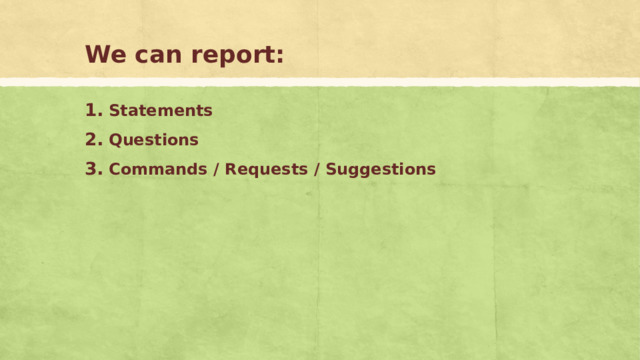
We can report:
- Statements
- Questions
- Commands / Requests / Suggestions

Reported Statements
To report statements we use a reporting verb ( say, tell, explain , etc.) followed by a that-clause. In spoken English that can be omitted.
He said, "I feel sick. " He said (that) he felt sick.
Pronouns and possessive adjectives change according to the context.
Direct speech Reported speech
He said, " I' ll lend you my laptop. " He said (that) he would lend me his laptop.

Time words and tenses can change as follows depending on the time reference:

When the reporting verb is in the past, the verb tenses change as follows:
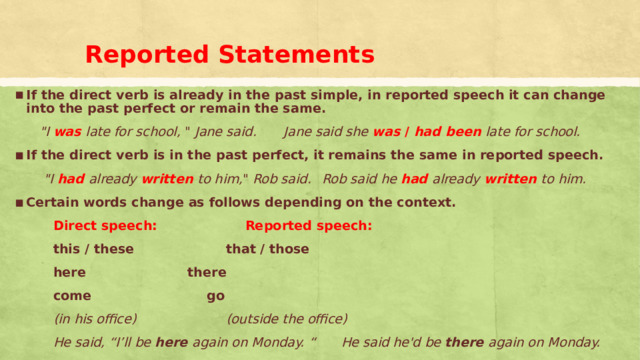
Reported Statements
- If the direct verb is already in the past simple, in reported speech it can change into the past perfect or remain the same.
"I was late for school, " Jane said. Jane said she was / had been late for school.
- If the direct verb is in the past perfect, it remains the same in reported speech.
"I had already written to him, " Rob said. Rob said he had already written to him.
- Certain words change as follows depending on the context.
Direct speech: Reported speech:
this / these that / those
here there
come go
(in his office) (outside the office)
He said, “I’ll be here again on Monday. “ He said he'd be there again on Monday.
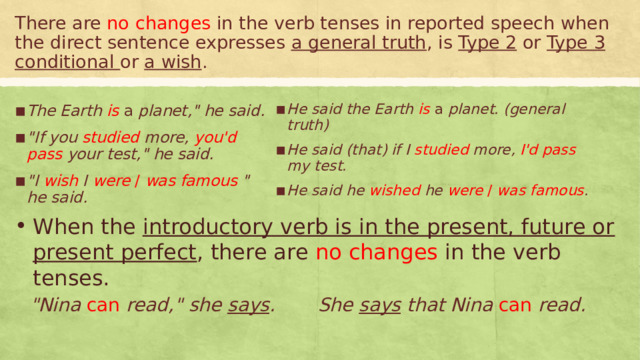
There are no changes in the verb tenses in reported speech when the direct sentence expresses a general truth , is Type 2 or Type 3 conditional or a wish .
- He said the Earth is a planet. (general truth)
- He said (that) if I studied more, I'd pass my test.
- He said he wished he were / was famous .
- The Earth is a planet," he said.
- "If you studied more, you'd pass your test," he said.
- "I wish I were / was famous " he said.
- When the introductory verb is in the present, future or present perfect , there are no changes in the verb tenses.
"Nina can read," she says . She says that Nina can read.

UP-TO-DATE REPORTING / OUT-OF-DATE REPORTING
The verb tenses can change or remain the same in reported speech when a sentence expresses something which is up to date or still true when we report it.
The verb tenses change when something is out of date or not true when we report it.
- "/'m travelling to England next week, " he said.
- "I'm travelling to England in January, " he said. (Now it's February.)
- "The Earth is flat," he said.
- He said he is travelling / was travelling to England next week. (up-to-date reporting - immediately reported after said)
- He said he was travelling to England in January. (The trip is over since it's February. out-of-date reporting)
- He said (that) the Earth was flat. (It isn't; not true.)
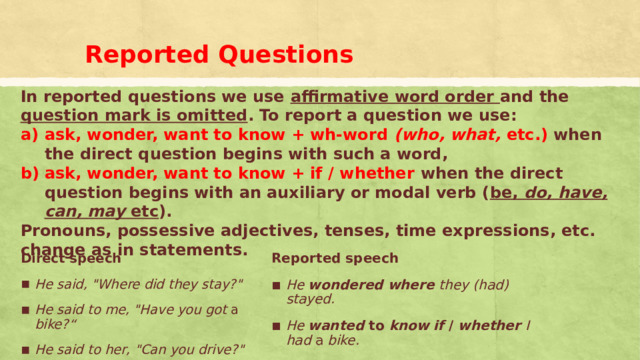
Reported Questions
In reported questions we use affirmative word order and the question mark is omitted . To report a question we use:
- ask, wonder, want to know + wh-word (who, what, etc.) when the direct question begins with such a word,
- ask, wonder, want to know + if / whether when the direct question begins with an auxiliary or modal verb ( be, do, have, can, may etc ).
Pronouns, possessive adjectives, tenses, time expressions, etc. change as in statements.
Direct speech
Reported speech
- He said, "Where did they stay?"
- He said to me, "Have you got a bike?“
- He said to her, "Can you drive?"
- He wondered where they (had) stayed.
- He wanted to know if / whether I had a bike.
- He asked her if / whether she could drive.
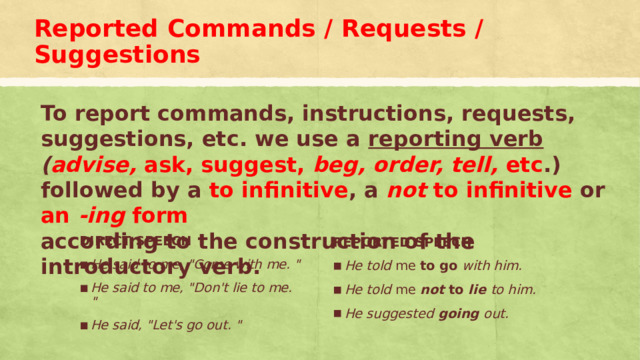
Reported Commands / Requests / Suggestions
To report commands, instructions, requests, suggestions, etc. we use a reporting verb ( advise, ask, suggest, beg, order, tell, etc .) followed by a to infinitive , a not to infinitive or an -ing form
according to the construction of the introductory verb.
DIRECT SPEECH
- He said to me, "Come with me. "
- He said to me, "Don't lie to me. "
- He said, "Let's go out. "
REPORTED SPEECH
- He told me to go with him.
- He told me not to lie to him.
- He suggested going out.









Вебинар для учителей

🎓 Свидетельство об участии ✨БЕСПЛАТНО!✨



