


Узбекистан, Ташкент


СДЕЛАЙТЕ СВОИ УРОКИ ЕЩЁ ЭФФЕКТИВНЕЕ, А ЖИЗНЬ СВОБОДНЕЕ
Благодаря готовым учебным материалам для работы в классе и дистанционно
Скидки до 50 % на комплекты
только до
Готовые ключевые этапы урока всегда будут у вас под рукой
Организационный момент
Проверка знаний
Объяснение материала
Закрепление изученного
Итоги урока

Была в сети 30.06.2020 16:55

Мухамедова Нигина Абдуджалаловна
учитель английского языка
 468
 115 000

Местоположение
Специализация
Zahiriddin Muhammad Babur
Категория:
Английский язык
22.06.2020 21:53

Просмотр содержимого документа
«Zahiriddin Muhammad Babur»

Zahiriddin Muhammad Babur – politician, warlord, poet.
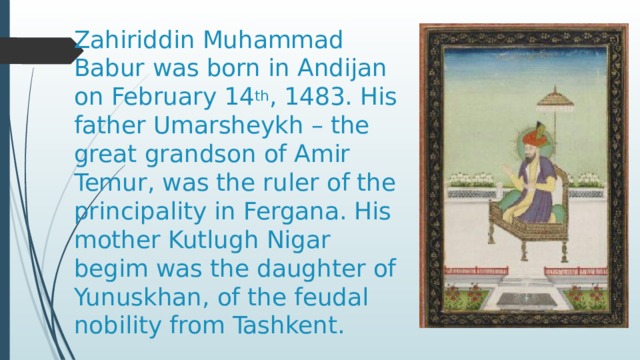
Zahiriddin Muhammad Babur was born in Andijan on February 14 th , 1483. His father Umarsheykh – the great grandson of Amir Temur, was the ruler of the principality in Fergana. His mother Kutlugh Nigar begim was the daughter of Yunuskhan, of the feudal nobility from Tashkent.

Babur spent his childhood years in Fergana valley and there is not the slightest doubt that he received his schooling in Andijan and that tuition was mainly in his native Uzbek language.

Babur’s social and philosophical outlook, his aesthetical and scientific interests developed under the influence of the great works of Mirza Ulugh-Beg, Alisher Navoi, Abd ar-Rahman Jami, Lutfi and other Eastern classical writers.

At the age of 12, after the death of his father in 1494, Babur ascended to throne and became the ruler of the Fergana principality. By that time the entire territory of Timur’s empire had been captured by the Shaibanids.

Babur undertook two campaigns against Samarcand (1498 and 1500-1501) to liberate the city from Shaibanikhan but failed to achieve success.

With a small group of followers and relatives Babur then moved to Kabul. Having settled down in Kabul, which was within the principality of his father Umarsheykh, Babur formed a new army and in 1519 marched on India.

It was only in April of 1526,following the victory over sultan Ibrahim Lodi at Panipat to the north of Delhi, that Babur created his vast state – the Empire of the Baburids. The city of Agra on the river Jamna became the capital of the new empire.

Babur was a great statesman, soldier, talented scholar, remarkable poet, a great connoisseur and patron of the arts . He lived a short life but left behind a considerable literary and scientific heritage. He wrote in his native Uzbek language and also in Persian-Tajik. All his works with the exception of essays on music and the art of war have reached us.

Babur was a great poet whose rubais (lyric quatrains) delight and inspire many people even today. He wrote one of the most famous oriental works in world literature: “Baburnama”.
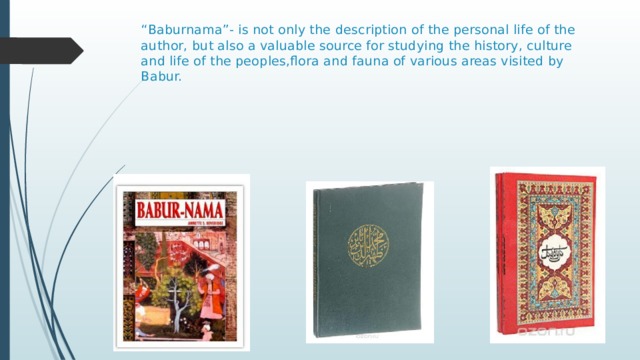
“ Baburnama”- is not only the description of the personal life of the author, but also a valuable source for studying the history, culture and life of the peoples,flora and fauna of various areas visited by Babur.
- When was Zahiriddin Mukhammad Babur born?
- Tell about Babur’s parent’s.
- Where did Zahiriddin Mukhammad Babur spend his youth and where was he educated?
- Who influenced on his interests development?
- When did Zahiriddin Mukhammad Babur become the ruler of the Fergana principality?
- When did Babur undertake the campaigns against Shaibanikhan.
- When did Babur formed a new army?
- When did Babur defeat Sultan Ibrahim Lodi?
- What city became the capital of the new empire of Baburids?
- What languages did he write in and what’s the most famous oriental works of Zahiriddin Mukhammad Babur in the world ?
Answers :
- 1. Zahiriddin Muhammad Babur was born in Andijan on February 14 th , 1483.
- 2. His father Umarsheykh – the great grandson of Amir Temur, was the ruler of the principality in Fergana. His mother Kutlugh Nigar begim was the daughter of Yunuskhan, of the feudal nobility from Tashkent.
- 3. Babur spent his childhood years in Fergana valley.
- 4. His interests developed under the influence of the great works of Mirza Ulugh-Beg, Alisher Navoi, Abd ar-Rahman Jami, Lutfi and other Eastern classical writers.
- 5. Babur become the ruler of the Fergana principality At the age of 12, in 1494.
- 6. Babur undertook two campaigns against Samarcand in1498 and in 1500-1501
- 7. Babur formed a new army in 1519.
- 8. babur defeat sultan ibrohim lodi in April of 1526.
- 9. The city of Agra on the river Jamna became the capital of the new empire.
- 10. He wrote in his native Uzbek language and also in Persian-Tajik. He wrote one of the most famous oriental works in world literature: “Baburnama”.








Вебинар для учителей

🎓 Свидетельство об участии ✨БЕСПЛАТНО!✨



