

Россия, Сергиев Посад


СДЕЛАЙТЕ СВОИ УРОКИ ЕЩЁ ЭФФЕКТИВНЕЕ, А ЖИЗНЬ СВОБОДНЕЕ
Благодаря готовым учебным материалам для работы в классе и дистанционно
Скидки до 50 % на комплекты
только до
Готовые ключевые этапы урока всегда будут у вас под рукой
Организационный момент
Проверка знаний
Объяснение материала
Закрепление изученного
Итоги урока

Была в сети 21.03.2025 13:55

Сержантова Жаннета Валерьевна
учитель английского языка
 338
 138 126

Местоположение
Специализация
Виртуальная экскурсия в Сергие Посад
Категория:
Английский язык
13.01.2020 10:41

Просмотр содержимого документа
«Виртуальная экскурсия в Сергие Посад»
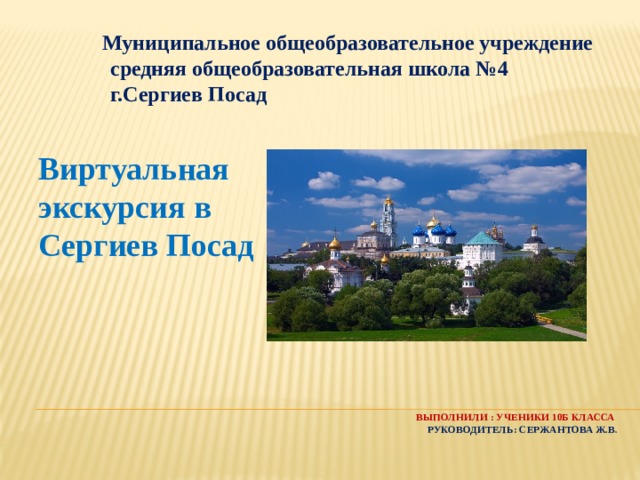
Муниципальное общеобразовательное учреждение средняя общеобразовательная школа №4 г.Сергиев Посад
Виртуальная экскурсия в Сергиев Посад
Выполнили : ученики 10Б класса Руководитель: Сержантова Ж.В .
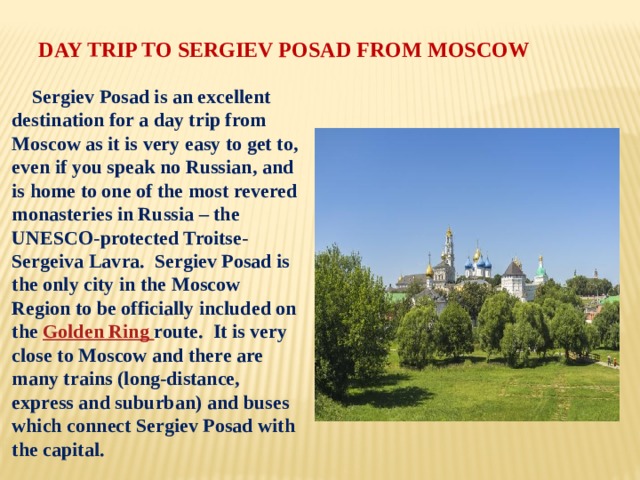
Day trip to Sergiev Posad from Moscow
Sergiev Posad is an excellent destination for a day trip from Moscow as it is very easy to get to, even if you speak no Russian, and is home to one of the most revered monasteries in Russia – the UNESCO-protected Troitse-Sergeiva Lavra. Sergiev Posad is the only city in the Moscow Region to be officially included on the Golden Ring route. It is very close to Moscow and there are many trains (long-distance, express and suburban) and buses which connect Sergiev Posad with the capital.
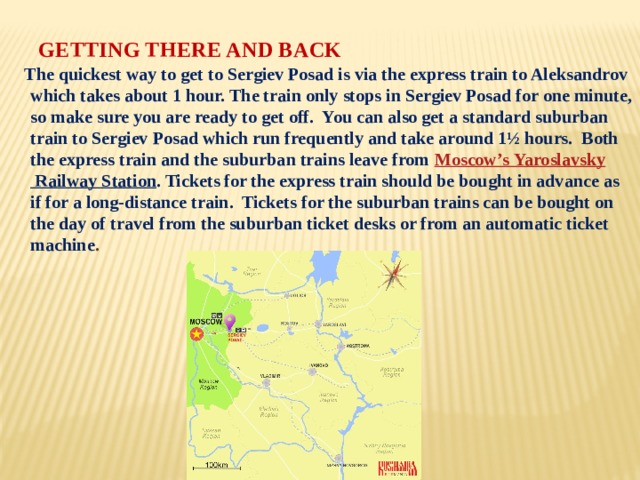
Getting There and Back
The quickest way to get to Sergiev Posad is via the express train to Aleksandrov which takes about 1 hour. The train only stops in Sergiev Posad for one minute, so make sure you are ready to get off. You can also get a standard suburban train to Sergiev Posad which run frequently and take around 1½ hours. Both the express train and the suburban trains leave from Moscow’s Yaroslavsky Railway Station . Tickets for the express train should be bought in advance as if for a long-distance train. Tickets for the suburban trains can be bought on the day of travel from the suburban ticket desks or from an automatic ticket machine .
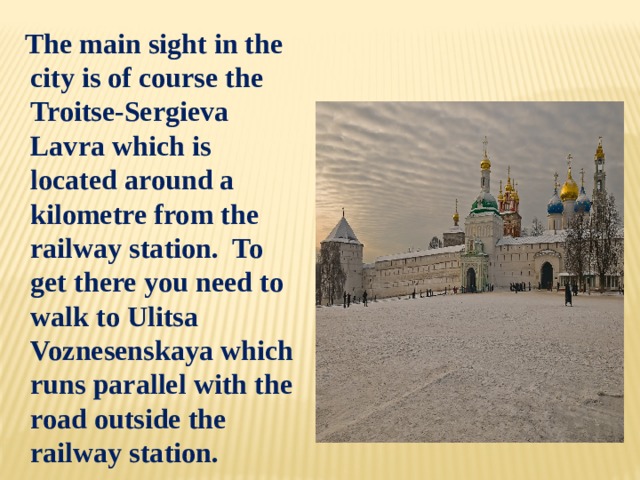
The main sight in the city is of course the Troitse-Sergieva Lavra which is located around a kilometre from the railway station. To get there you need to walk to Ulitsa Voznesenskaya which runs parallel with the road outside the railway station.
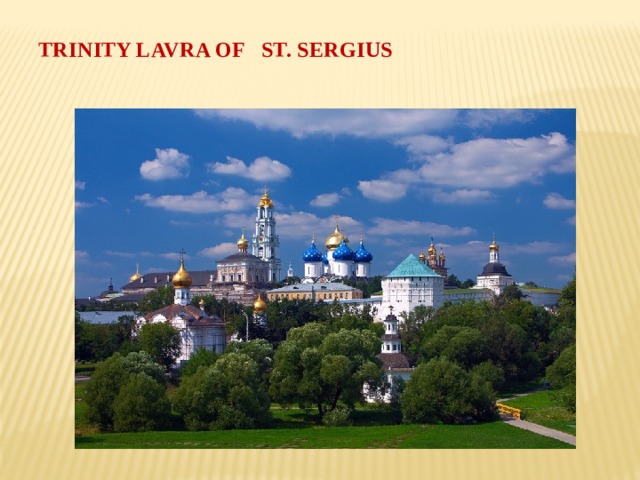
Trinity Lavra of St. Sergius
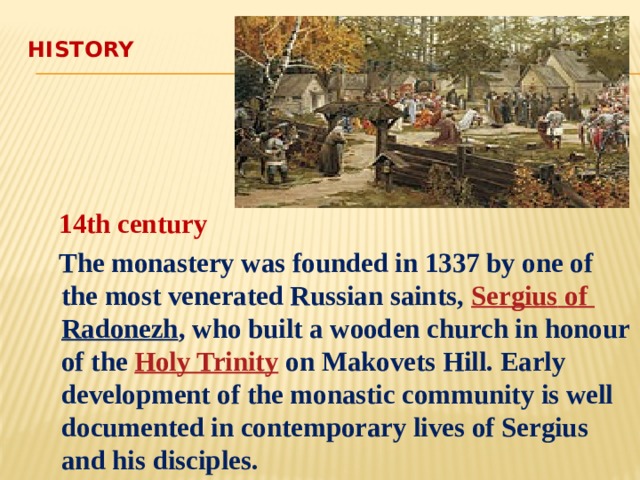
History
14th century
The monastery was founded in 1337 by one of the most venerated Russian saints, Sergius of Radonezh , who built a wooden church in honour of the Holy Trinity on Makovets Hill. Early development of the monastic community is well documented in contemporary lives of Sergius and his disciples.
15th century
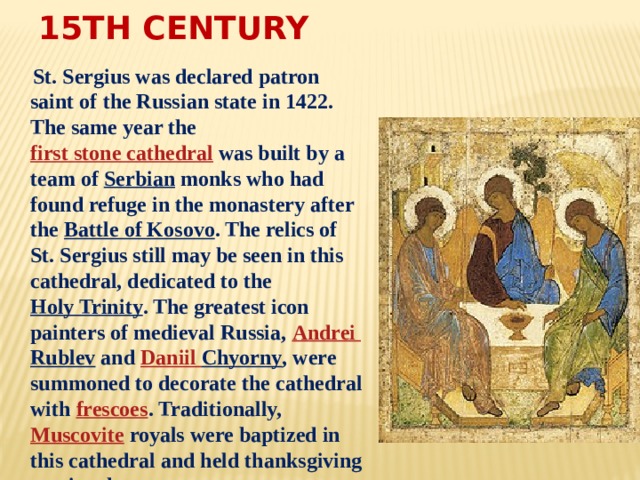
St. Sergius was declared patron saint of the Russian state in 1422. The same year the first stone cathedral was built by a team of Serbian monks who had found refuge in the monastery after the Battle of Kosovo . The relics of St. Sergius still may be seen in this cathedral, dedicated to the Holy Trinity . The greatest icon painters of medieval Russia, Andrei Rublev and Daniil Chyorny , were summoned to decorate the cathedral with frescoes . Traditionally, Muscovite royals were baptized in this cathedral and held thanksgiving services here.
16th century
It took 26 years to construct the six-pillared Assumption Cathedral , which was commissioned by Ivan the Terrible in 1559. The cathedral is much larger than its model and namesake in the Moscow Kremlin . The magnificent iconostasis of the 16th–18th centuries features Simon Ushakov 's masterpiece, the icon of Last Supper . Interior walls were painted with violet and blue frescoes by a team of Yaroslavl masters in 1684. The vault contains burials of Boris Godunov , his family and several 20th-century patriarchs.
As the monastery grew into one of the wealthiest landowners in Russia, the woods where it had stood were cleared and a village (or posad ) sprang up near the monastery walls. It gradually developed into the modern town of Sergiyev Posad. The cloister itself was a notable centre of chronicle-writing and icon painting. Just opposite the monastery walls St. Paraskeva's Convent was established, among whose buildings St. Paraskeva's Church (1547), Introduction Church (1547), and a 17th-century chapel over St. Paraskeva's well are still visible.
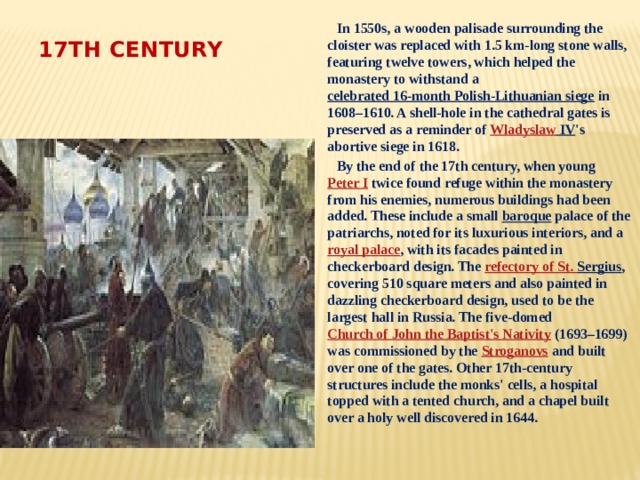
In 1550s, a wooden palisade surrounding the cloister was replaced with 1.5 km-long stone walls, featuring twelve towers, which helped the monastery to withstand a celebrated 16-month Polish-Lithuanian siege in 1608–1610. A shell-hole in the cathedral gates is preserved as a reminder of Wladyslaw IV 's abortive siege in 1618.
By the end of the 17th century, when young Peter I twice found refuge within the monastery from his enemies, numerous buildings had been added. These include a small baroque palace of the patriarchs, noted for its luxurious interiors, and a royal palace , with its facades painted in checkerboard design. The refectory of St. Sergius , covering 510 square meters and also painted in dazzling checkerboard design, used to be the largest hall in Russia. The five-domed Church of John the Baptist's Nativity (1693–1699) was commissioned by the Stroganovs and built over one of the gates. Other 17th-century structures include the monks' cells, a hospital topped with a tented church, and a chapel built over a holy well discovered in 1644.
17th century
18th and 19th centuries
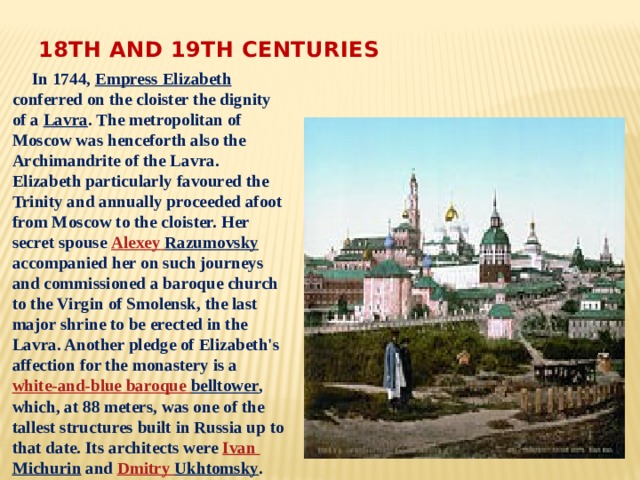
In 1744, Empress Elizabeth conferred on the cloister the dignity of a Lavra . The metropolitan of Moscow was henceforth also the Archimandrite of the Lavra. Elizabeth particularly favoured the Trinity and annually proceeded afoot from Moscow to the cloister. Her secret spouse Alexey Razumovsky accompanied her on such journeys and commissioned a baroque church to the Virgin of Smolensk, the last major shrine to be erected in the Lavra. Another pledge of Elizabeth's affection for the monastery is a white-and-blue baroque belltower , which, at 88 meters, was one of the tallest structures built in Russia up to that date. Its architects were Ivan Michurin and Dmitry Ukhtomsky .
20th century
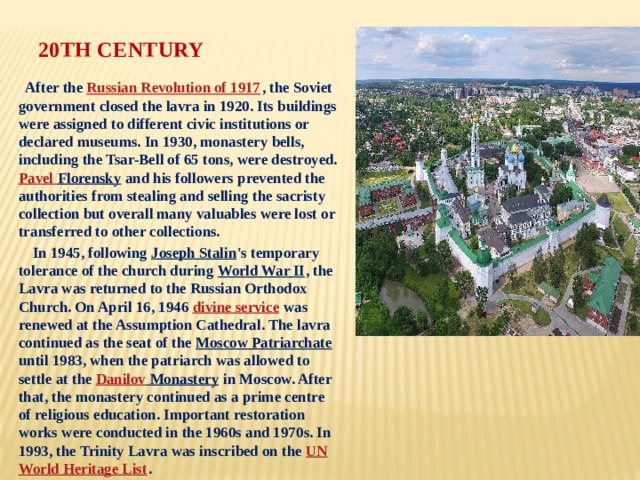
After the Russian Revolution of 1917 , the Soviet government closed the lavra in 1920. Its buildings were assigned to different civic institutions or declared museums. In 1930, monastery bells, including the Tsar-Bell of 65 tons, were destroyed. Pavel Florensky and his followers prevented the authorities from stealing and selling the sacristy collection but overall many valuables were lost or transferred to other collections.
In 1945, following Joseph Stalin 's temporary tolerance of the church during World War II , the Lavra was returned to the Russian Orthodox Church. On April 16, 1946 divine service was renewed at the Assumption Cathedral. The lavra continued as the seat of the Moscow Patriarchate until 1983, when the patriarch was allowed to settle at the Danilov Monastery in Moscow. After that, the monastery continued as a prime centre of religious education. Important restoration works were conducted in the 1960s and 1970s. In 1993, the Trinity Lavra was inscribed on the UN World Heritage List .
Souvenirs
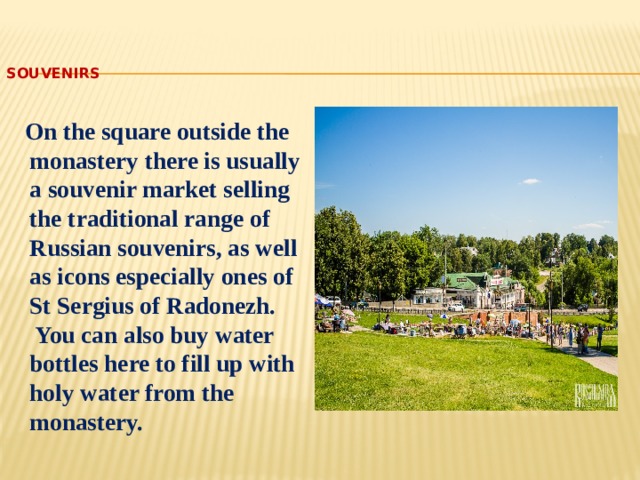
On the square outside the monastery there is usually a souvenir market selling the traditional range of Russian souvenirs, as well as icons especially ones of St Sergius of Radonezh. You can also buy water bottles here to fill up with holy water from the monastery.






Вебинар для учителей

🎓 Свидетельство об участии ✨БЕСПЛАТНО!✨



