Беларусь, Минск


СДЕЛАЙТЕ СВОИ УРОКИ ЕЩЁ ЭФФЕКТИВНЕЕ, А ЖИЗНЬ СВОБОДНЕЕ
Благодаря готовым учебным материалам для работы в классе и дистанционно
Скидки до 50 % на комплекты
только до
Готовые ключевые этапы урока всегда будут у вас под рукой
Организационный момент
Проверка знаний
Объяснение материала
Закрепление изученного
Итоги урока

Была в сети 11.08.2026 15:54

Абакунчик Юлия Сергеевна
учитель английского языка
 7 269
 8 165

Местоположение
Специализация
Урок английского языка по теме "Exploring Different Landforms and Their Characteristics" в 4 классе
Категория:
Английский язык
15.03.2025 19:11

Просмотр содержимого документа
«Урок английского языка по теме "Exploring Different Landforms and Their Characteristics" в 4 классе»
Lesson Plan: Exploring Different Landforms and Their Characteristics
Lesson Objectives:
1. Educational:
1. Reading: Understand and analyze texts about natural landscapes.
2. Vocabulary: Learn and use words describing nature (high, deep, dry, wet, cold, hot).
3. Speaking: Construct sentences and describe landscapes.
4. Listening: Comprehend information about nature through listening.
5. Writing: Write short descriptions and answer questions.
2. Developmental:
1. Critical Thinking: Analyze and compare different landscapes.
2. Cognitive Skills: Classify information and work with visual materials.
3. Communication: Work in groups, ask questions, and discuss topics.
3. Educational and Moral:
1. Interest in Nature: Introduce the diversity of landscapes and their unique features.
2. Tolerance: Explore nature in different countries and cultures.
3. Independence: Teach students to work on tasks independently.
4. Practical:
1. Application of Knowledge: Use vocabulary in spoken and written English.
2. Preparation for Future Learning: Lay the foundation for more advanced topics.
Materials Needed:
- Picture dictionary (from the file)
- Flashcards with images of deserts, oceans, mountains, jungles, and grasslands
- Whiteboard and markers
- Handouts with the texts and questions from the file
Lesson Outline:
1. Warm-Up Activity (5 minutes):
- Show flashcards with images of different landforms (deserts, oceans, mountains, jungles, grasslands).
- Ask students to name each landform and describe what they see in the images.
- Introduce the picture dictionary (high, deep, dry, wet, cold, hot) and explain the meanings of these words.
2. Guided Reading and Discussion (15 minutes):
- Distribute handouts with the texts about deserts, seas and oceans, mountains, jungles, and grasslands.
- Read each text aloud as a class, pausing to discuss key points:
- Deserts: Discuss the Sahara Desert and its extreme temperatures.
- Seas and Oceans: Talk about the diversity of marine life and the depth of oceans.
- Mountains: Explain the cold, windy conditions at high altitudes and mention Mount Everest.
- Jungles: Highlight the hot, wet climate and the biodiversity in jungles.
- Grasslands: Discuss the two seasons and the types of animals that live there.
- Encourage students to ask questions and share their thoughts.
3. Sentence Construction Activity (10 minutes):
- Write the following sentence starters on the board:
- "Mountains are..."
- "Oceans are..."
- "Deserts are..."
- "Grasslands are..."
- "Jungles are..."
- Ask students to complete the sentences using the descriptive words from the picture dictionary (high, deep, dry, wet, cold, hot).
- Example: "Mountains are high and cold."
4. Comprehension Check (10 minutes):
- Have students answer the questions from the handout:
1. What is the biggest desert in the world? Where is it?
2. What is the highest mountain in the world? Where is it?
3. Where is the biggest jungle in the world?
- Discuss the answers as a class to ensure understanding.
5. Wrap-Up and Review (5 minutes):
- Recap the key characteristics of each landform.
- Ask students to share one new thing they learned during the lesson.
- Encourage students to think about which landform they would like to visit and why.
Homework/Extension Activity:
- Ask students to choose one landform and draw a picture of it, labeling the key characteristics (e.g., "hot and dry" for deserts, "deep and wet" for oceans).
- Optional: Students can write a short paragraph describing their chosen landform using the descriptive words from the lesson.
Assessment:
- Participation in class discussions and activities.
- Accuracy of sentence construction using descriptive words.
- Correct answers to the comprehension questions.
This lesson plan aims to engage students in learning about different landforms through visual aids, reading, and interactive activities, helping them build vocabulary and comprehension skills in geography.
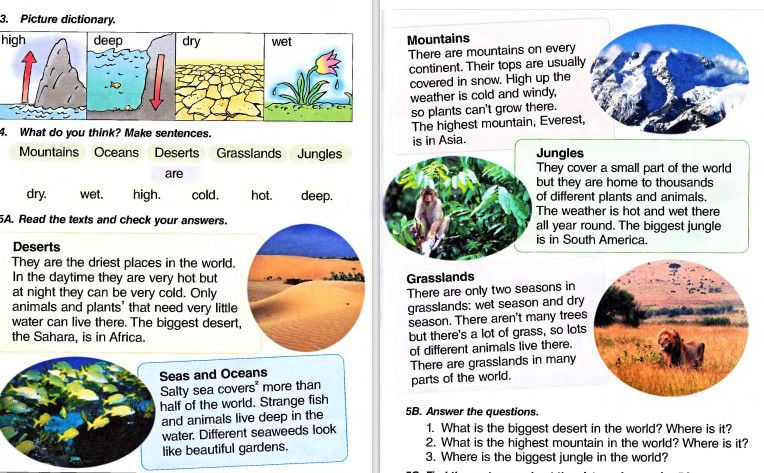
Handout from Magic Box 4
Here are additional comprehension tasks based on the material provided:
Comprehension Tasks:
Task 1: True or False
Read the following statements and decide if they are true (T) or false (F). Correct the false statements.
1. Deserts are the wettest places in the world.
2. The Sahara Desert is located in Africa.
3. Oceans cover less than half of the world.
4. The highest mountain, Everest, is in Asia.
5. Jungles have a cold and dry climate all year round.
6. Grasslands have only two seasons: wet and dry.
Task 2: Fill in the Blanks
Complete the sentences using the words from the text.
1. The __________ is the biggest desert in the world, and it is located in __________.
2. The __________ is the highest mountain in the world, and it is located in __________.
3. The biggest jungle is in __________.
4. In deserts, the temperature is very __________ during the day but very __________ at night.
5. __________ cover more than half of the world, and many strange fish and animals live __________ in the water.
6. Grasslands have a lot of __________, but there aren’t many __________.
Task 3: Matching
Match the landform with its correct description.
| **Landform** | **Description** |
|-----------------|---------------------------------------------------------------------------------|
| 1. Deserts | a. Home to thousands of different plants and animals; hot and wet all year. |
| 2. Oceans | b. Covered in snow at the top; cold and windy. |
| 3. Mountains | c. Driest places; very hot during the day and cold at night. |
| 4. Jungles | d. Two seasons: wet and dry; lots of grass and animals. |
| 5. Grasslands | e. Cover more than half of the world; deep and full of marine life. |
Task 4: Short Answer Questions
Answer the following questions in your own words.
1. Why can only certain animals and plants live in deserts?
2. What makes jungles different from grasslands?
3. Why do plants not grow on the tops of mountains?
4. What are some examples of animals that might live in grasslands?
5. How do oceans and seas support life?
Task 5: Compare and Contrast
Choose two landforms (e.g., deserts and jungles, mountains and grasslands) and write a short paragraph comparing and contrasting them. Use the following questions to guide your writing:
- How are their climates different?
- What types of plants and animals live there?
- What makes each landform unique?
Task 6: Multiple Choice Questions
Choose the correct answer for each question.
1. What is the main characteristic of deserts?
a) Wet and cold
b) Dry and hot
c) Covered in snow
2. Where is the biggest jungle located?
a) Africa
b) South America
c) Asia
3. What covers more than half of the world?
a) Deserts
b) Oceans
c) Grasslands
4. What is the weather like in jungles?
a) Cold and dry
b) Hot and wet
c) Windy and snowy
5. How many seasons do grasslands have?
a) One
b) Two
c) Four
Task 7: Draw and Label
Choose one landform and draw a picture of it. Label the following:
- Climate (e.g., hot, cold, wet, dry)
- Plants and animals that live there
- Any other important features (e.g., snow on mountains, seaweed in oceans)
Task 8: Group Discussion
In small groups, discuss the following questions:
1. Which landform would you like to visit and why?
2. What challenges might you face living in a desert or on a mountain?
3. How do you think climate change might affect these landforms?
These tasks are designed to reinforce students' understanding of the material while encouraging critical thinking, creativity, and collaboration. They can be adapted for individual, pair, or group work depending on the classroom setting.





Вебинар для учителей

🎓 Свидетельство об участии ✨БЕСПЛАТНО!✨