


Кыргызстан, Жалалабат


СДЕЛАЙТЕ СВОИ УРОКИ ЕЩЁ ЭФФЕКТИВНЕЕ, А ЖИЗНЬ СВОБОДНЕЕ
Благодаря готовым учебным материалам для работы в классе и дистанционно
Скидки до 50 % на комплекты
только до
Готовые ключевые этапы урока всегда будут у вас под рукой
Организационный момент
Проверка знаний
Объяснение материала
Закрепление изученного
Итоги урока

Была в сети 18.05.2020 04:53

Малабекова Сонунгул Кадыркуловна
Учитель английского языка
 692
 89 650

Местоположение
Специализация
The main problems in teaching reading and the ways to overcome them
Категория:
Английский язык
29.02.2020 12:15

Просмотр содержимого документа
«The main problems in teaching reading and the ways to overcome them»

Let me present my diploma work. My full name is Suyunbek kyzy Ainura. The title of my diploma work is
“ The main problems in teaching reading and the ways to overcome them”. It consists of two chapters’ introduction, conclusion and used literatures. The first chapter is about reading in general and the second chapter is about the problems in teaching reading and the ways to overcome them.

- The main problem in teaching reading; Students should read the text with interest, if they have no interest it will be boring and they stop reading
- Teachers have to give students not only whole text teacher may make them easy may be to make a shorter and to use a strategies to interest them
- Reading is about understanding written texts. It is a complex activity that involves both perception and thought. Reading consists of two related processes: word recognition and comprehension. Word recognition refers to the process of perceiving how written symbols correspond to one’s spoken language. Comprehension is the process of making sense of words, sentences and connected text. Readers typically make use of background knowledge, vocabulary, grammatical knowledge, experience with text and other strategies to help them understand written text.
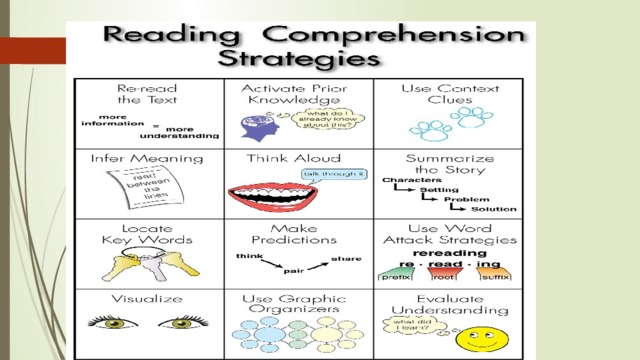


Strategies that can help students read more quickly and effectively include
- Previewing: reviewing titles, section headings, and photo captions to get a sense of the structure and content of a reading selection
- Predicting: using knowledge of the subject matter to make predictions about content and vocabulary and check comprehension; using knowledge of the text type and purpose to make predictions about discourse structure; using knowledge about the author to make predictions about writing style, vocabulary, and content
- Skimming and scanning: using a quick survey of the text to get the main idea, identify text structure, confirm or question predictions
- Guessing from context: using prior knowledge of the subject and the ideas in the text as clues to the meanings of unknown words, instead of stopping to look them up
- Paraphrasing: stopping at the end of a section to check comprehension by restating the information and ideas in the text

Sample pre-reading activities:
- :• Using the title, subtitles, and divisions within the text to predict content and organization or sequence of information
- • Looking at pictures, maps, diagrams, or graphs and their captions
- • Talking about the author's background, writing style, and usual topics
- • Skimming to find the theme or main idea and eliciting related prior knowledge
- • Reviewing vocabulary or grammatical structures
- • Reading over the comprehension questions to focus attention on finding that information while reading
- • Constructing semantic webs (a graphic arrangement of concepts or words showing how they are related)
- • Doing guided practice with guessing meaning from context or checking comprehension while reading

- When child makes a grammatical error, restate information using correct structures.
- Use higher order thinking questions (explain, describe, evaluate, compare).
- Engage in story telling.
- Make scrapbooks of events, favorite things, or collections (discuss with child).

- Thank you for your attention !




Вебинар для учителей

🎓 Свидетельство об участии ✨БЕСПЛАТНО!✨



