Россия, Бор

СДЕЛАЙТЕ СВОИ УРОКИ ЕЩЁ ЭФФЕКТИВНЕЕ, А ЖИЗНЬ СВОБОДНЕЕ
Благодаря готовым учебным материалам для работы в классе и дистанционно
Скидки до 50 % на комплекты
только до
Готовые ключевые этапы урока всегда будут у вас под рукой
Организационный момент
Проверка знаний
Объяснение материала
Закрепление изученного
Итоги урока
Была в сети 15.10.2026 23:23

Лопаткина Анастасия Николаевна
учитель английского языка
 31 479
 959

Местоположение
Специализация
Spotlight 8 Reported speech Module 6C
Категория:
Английский язык
20.04.2020 15:52

Просмотр содержимого документа
«Spotlight 8 Reported speech Module 6C»

Reported speech


Direct and Reported speech
Direct speech (Прямая речь)
Reported speech (Косвенная речь)
буквальная передача чьего-либо высказывания
передача прямой речи в виде пересказа
“ I work here as a waiter,” John said.
Jack said that he worked there as a waiter.
She says: “I phone my friends every day”.
She says that she phones her friends every day.

Первое правило
- Если глагол главного предложения (слова автора) употреблен в настоящем (Present) или будущем (Future) времени , то глагол придаточного предложения в косвенной речи остается в том же времени, в каком он был в прямой речи.
He says , “I have your T-shirt.” –
John says : “I live in New York.”
Он говорит: «У меня твоя футболка».
He says that he has my T-shirt. –
Bob says : “I am learning French.”
John says (that) he live in New York.
Он говорит, что у него моя футболка.
Bob says he is learning French.

Второе правило
- Если глагол главного предложения (слова автора) употреблен в прошедшем времени (Past) , то время глагола придаточного предложения прямой речи заменяется косвенной речью и действует правило согласования времен .
Boris said, "Ann, I want to have a rest."— Борис сказал: «Анна, я хочу отдохнуть».
Mother said, “ I go to work every day”
Boris told Ann that he wanted to have a rest.— Борис сказал Анне, что он хочет отдохнуть.
Fred said: ”I have done it.”
Mother said that she went to work every day.
Fred said he had done it.

Правило согласования времен
- Глаголы в прямой речи в форме Present Tense употребляются в косвенной речи в форме Past Tense . Present Simple → Past Simple Present Continuous → Past Continuous Present Perfect → Past Perfect Present Perfect Continuous → Past Perfect Continuous
“ I always drink coffee”, she said.
“ I am reading a book”, he explained. «Я читаю книгу», – пояснил он.
«Я всегда пью кофе», – сказала она
She said that she always drank coffee.
Kevin said: “I have been coughing for a week.
He explained that he was reading a book. Он пояснил, что он читает книгу.
Она сказала, что она всегда пьет кофе
” Kevin explained he had been coughing for a week.
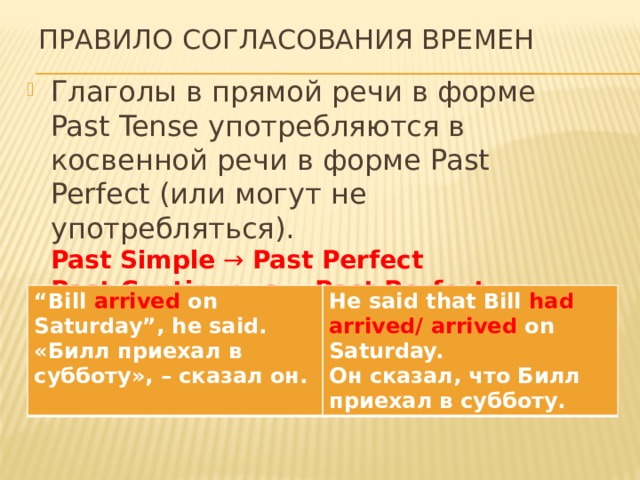
Правило согласования времен
- Глаголы в прямой речи в форме Past Tense употребляются в косвенной речи в форме Past Perfect (или могут не употребляться). Past Simple → Past Perfect Past Continuous → Past Perfect Continuous Past Perfect Continuous → Past Perfect Continuous
“ Bill arrived on Saturday”, he said. «Билл приехал в субботу», – сказал он.
He said that Bill had arrived/ arrived on Saturday.
Он сказал, что Билл приехал в субботу.

Правило согласования времен
- Глаголы в прямой речи в форме Past Perfect не изменяются. Past Perfect → Past Perfect
He said, “We had finished our work by five o’clock.”
Он сказал: «Мы окончили свою работу к пяти часам».
He said that they had finished their work by five o’clock.
Он сказал, что они окончили свою работу к пяти часам.

Правило согласования времен
- Глаголы в прямой речи в любом будущем времени переходят в соответствующее ему будущее в прошедшем в косвенной речи. Future Simple → Future Simple in the Past Future Continuous → Future Continuous in the Past Future Perfect → Future Perfect in the Past
“ She will come soon.” «Она скоро придет».
They told me that she would come in soon time. Они сказали мне, что она скоро придет.

Правило согласования времен
не действует в следующих случаях:
1) Если сказуемое в придаточном предложении выражает общеизвестное положение или факт :
The teacher told the children that the Earth is round. – Учитель сказал детям, что земля круглая.

Правило согласования времен
не действует в следующих случаях:
2) Если в придаточном предложении указано время совершения действия :
Linda said (that) she called her doctor two hours ago . – Линда сказала, что она звонила доктору два часа назад.

Правило согласования времен
не действует в следующих случаях:
3) В предложениях, в придаточных которых употребляется сослагательное наклонение :
He said that if he had time he would go to the pictures. – Он сказал, что, если бы у него было время, он сходил бы в кино.

Модальные глаголы
- В форме Past Tense меняются: shall → should will → would can → could may → might must → had to Но формы Past Tense от модальных глаголов could , would , should , might в косвенной речи сохраняются.
“ We will go home.” «Мы придем домой».
She said, “You could help my sister.”
She said that they would go home. Она сказала, что они придут домой.
She said that I could help her sister.

Запомни!
Глагол must заменяется в косвенной речи глаголом had, только когда must выражает необходимость совершения действия в силу определенных обстоятельств.

1. Direct Speech
My mother said, “ You must consult a doctor”.
Reported Speech
My mother said (that) I must consult a doctor.

2. Direct Speech
She said, " I must send him a telegram at once."
Reported Speech
She said (that) she had to send him a telegram at once.

УКАЗАТЕЛЬНЫЕ МЕСТОИМЕНИЯ И НАРЕЧИЯ ВРЕМЕНИ И МЕСТА В ПРЯМОЙ РЕЧИ ЗАМЕНЯЮТСЯ В КОСВЕННОЙ РЕЧИ ПО СМЫСЛУ ДРУГИМИ СЛОВАМИ, КАК И В РУССКОМ ЯЗЫКЕ.
today
that day
tonight
that night
yesterday
the day before/the previous day
tomorrow
the next day/the following day
ago
ago before
next Monday
the following Monday
last Friday
the previous Friday
the day before yesterday
two days before/two days earlier
now
then
this
that
these
those
here
there

Глаголы передающие косвенную речь:

Peter said, “ I ’ve lost my watch.”
Peter said (that) he had lost his watch.
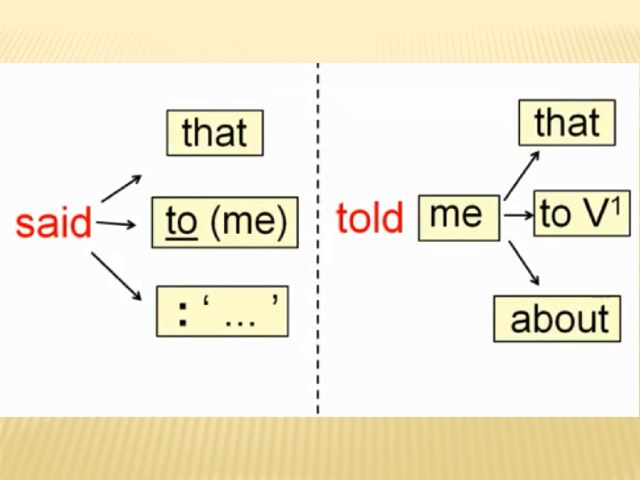

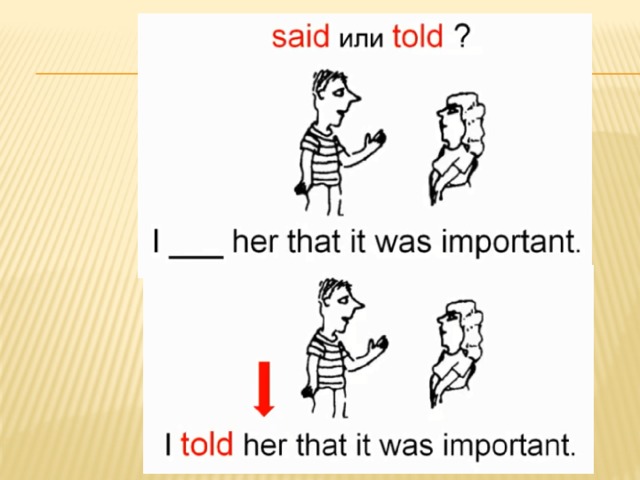
Say или tell
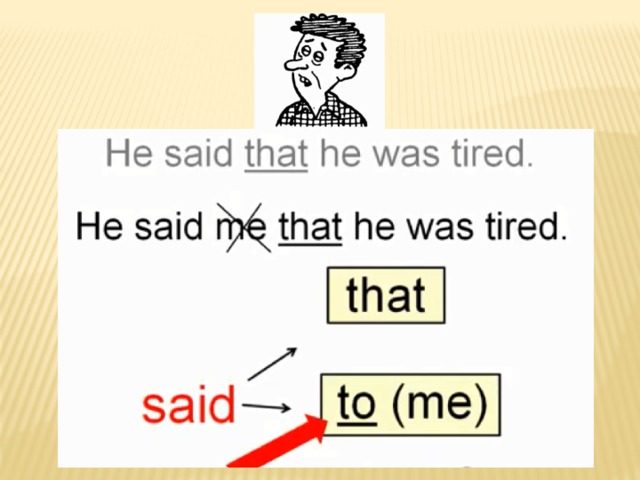
- SAY – при отсутствии личного дополнения
Jack said (that) he felt tired.
- SAY+ to+ дополнение, обозначающее адресата
Jack said to us (that) he felt tired.
- TELL + косвенное дополнение (кому)
Jack told us (that) he felt tired




Запомнить!!!!


Was or were?
were

Continue:
had

couldn’t

wouldn’t


Примеры:
He said, “I will do it tomorrow.”
- He said that he would do it the next day.
They say: «Annie, we read a lot of books».
- They tell Annie that they read a lot of books.
Mark says:» I don’t like computer games».
- Mark says that he doesn’t like computer games.
Melissa says: “I am a good cook”.
- Melissa says that she is a good cook.

1. She said, "I am reading."
She said that __________.
2. They said, "We are busy."
They said that __________.
3. He said, "I know a better restaurant."
He said that __________.
4. She said, "I woke up early."
She said that __________.
5. He said, "I will ring her."
He said that __________.
6. They said, "We have just arrived."
They said that __________.
7. He said, "I will clean the car."
He said that __________.
8. She said, "I did not say that."
She said that __________.
9. She said, "I don't know where my shoes are."
She said that __________.
10. He said: "I won't tell anyone."
He said that __________.

Вопросы в косвенной речи:

Вопросы в косвенной речи.
- В вопросах в косвенной речи соблюдается прямой порядок слов, т.е. сказуемое стоит после подлежащего. В общих вопросах перед придаточным предложением ставится if .
- e.g. Tom asked:”Do you like ice-cream?”
- Tom asked if I liked ice-cream.
Том спросил, люблю ли я мороженое.
- Robert asked: “Where is Peter?”
- Robert asked where Peter was.
Роберт спросил, где Питер.

Direct Speech
The manager says to Mike: “ Does your father work at a factory?”
Reported Speech
The manager asks Mike if his father works at a factory.

Direct Speech
The teacher said , " Did you read an English book last year ?“
Reported Speech
The teacher asked me if I had read an English book the year before ?“

Просьбы и приказания в косвенной речи.
- Повелительные предложения в косвенной речи вводятся обычно глаголами: to tell, to order, to ask, после которого употребляется инфинитив с частицей to (not to) .
- e.g. Robert:” Come in”.
- Robert asks to come in.
- Robert: ”Don’t come in”
- Robert asks not to come in.

Direct Speech
Kate said to her grandmother, " Help me to cook the soup, please!“
Reported Speech
Kate asked her grandmother to help her to cook the soup.

The boyfriend said , “ Take this book, please”.
Reported Speech
The boyfriend asked her girl to take that book.
Direct Speech








Вебинар для учителей
🎓 Свидетельство об участии ✨БЕСПЛАТНО!✨