Россия,


СДЕЛАЙТЕ СВОИ УРОКИ ЕЩЁ ЭФФЕКТИВНЕЕ, А ЖИЗНЬ СВОБОДНЕЕ
Благодаря готовым учебным материалам для работы в классе и дистанционно
Скидки до 50 % на комплекты
только до
Готовые ключевые этапы урока всегда будут у вас под рукой
Организационный момент
Проверка знаний
Объяснение материала
Закрепление изученного
Итоги урока

Была в сети 28.09.2021 22:30

Малышева Ольга Владимировна
Учитель английского и немецкого языков
 4 982
 13 193

Местоположение
Специализация
Презентация по теме: Professions
Категория:
Английский язык
10.12.2020 13:55

Просмотр содержимого документа
«Презентация по теме: Professions»

Professions
Every man to his trade
As is the workman, so is the work
If a job is worth doing, it’s worth doing well
Practice makes perfect
A cat in gloves catches no mice
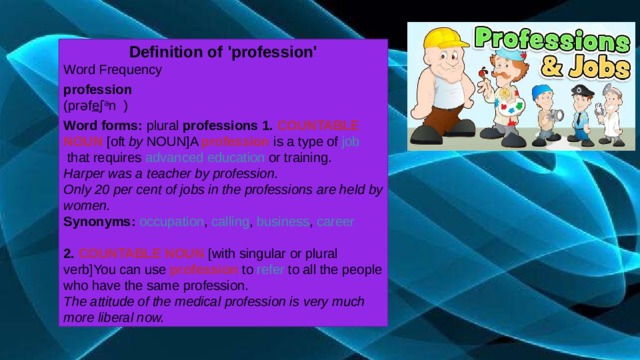
Definition of 'profession'
Word Frequency
profession
(prəf e ʃ ə n )
Word forms: plural professions 1. COUNTABLE NOUN [oft by NOUN ]A profession is a type of job that requires advanced education or training.
Harper was a teacher by profession.
Only 20 per cent of jobs in the professions are held by women.
Synonyms: occupation , calling , business , career
2. COUNTABLE NOUN [with singular or plural verb]You can use profession to refer to all the people who have the same profession.
The attitude of the medical profession is very much more liberal now.
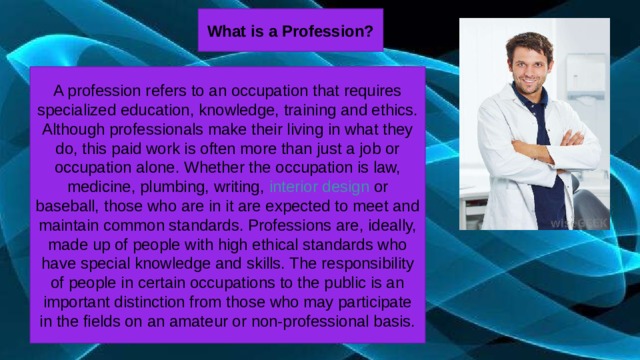
What is a Profession?
A profession refers to an occupation that requires specialized education, knowledge, training and ethics. Although professionals make their living in what they do, this paid work is often more than just a job or occupation alone. Whether the occupation is law, medicine, plumbing, writing, interior design or baseball, those who are in it are expected to meet and maintain common standards. Professions are, ideally, made up of people with high ethical standards who have special knowledge and skills. The responsibility of people in certain occupations to the public is an important distinction from those who may participate in the fields on an amateur or non-professional basis.

A profession is an activity that requires long and special training. Moreover, in most cases, the development of specialization occurs at the theoretical level, and the application of the acquired knowledge is carried out already in the process of work. This is the relationship between profession and work (professional activity).

What are the professions?
Currently, there are more than a thousand specializations and areas of training and work. Each of them is unique in its own way and requires specific ideas and skills. All professions can be divided into sectors (by industry and scientific affiliation): economic, technical, construction, educational, psychological, etc. Regardless of the field of activity, each profession involves performing specific duties, knowledge of the chosen industry and the specifics of the work, the presence of certain ideas and skills within the specialty. In fact, without a professional education, you will not be able to master the desired profile or direction.
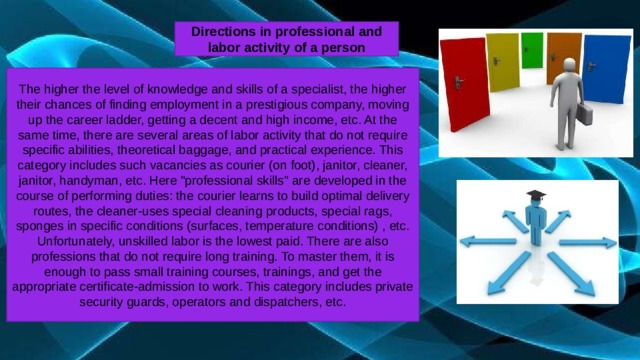
Directions in professional and labor activity of a person
The higher the level of knowledge and skills of a specialist, the higher their chances of finding employment in a prestigious company, moving up the career ladder, getting a decent and high income, etc. At the same time, there are several areas of labor activity that do not require specific abilities, theoretical baggage, and practical experience. This category includes such vacancies as courier (on foot), janitor, cleaner, janitor, handyman, etc. Here "professional skills" are developed in the course of performing duties: the courier learns to build optimal delivery routes, the cleaner-uses special cleaning products, special rags, sponges in specific conditions (surfaces, temperature conditions) , etc. Unfortunately, unskilled labor is the lowest paid. There are also professions that do not require long training. To master them, it is enough to pass small training courses, trainings, and get the appropriate certificate-admission to work. This category includes private security guards, operators and dispatchers, etc.

Any specialty is an applied field, even if the researcher has devoted his life to science, Humanities, etc.
In any case, he will have to perform certain duties at work, conduct any activities/actions/experiments to get a specific result.

“ The future belongs to those who learn more skills and combine them in creative ways.” ― Robert Greene, Mastery
Choosing the right career can be difficult, but having a defined career direction will help you with getting a job . But with a little hard work, some planning, and some serious self-reflection, you can set yourself on a path towards a fruitful, fulfilling career that can provide for you and your family.

- If you want to be a music star, consider going into audio engineering or music composition. These careers are easier to pursue and you will be much more likely to succeed and provide for yourself in the future.
- For example, if you want to be an actor, consider going into media broadcasting. You can get a degree in communications or work your way up the chain of command in a local news or other television studio.
- For instance, if you want to travel the world, consider becoming an airline steward or stewardess. This is a great way to make a living and pursue your dream of traveling the globe.
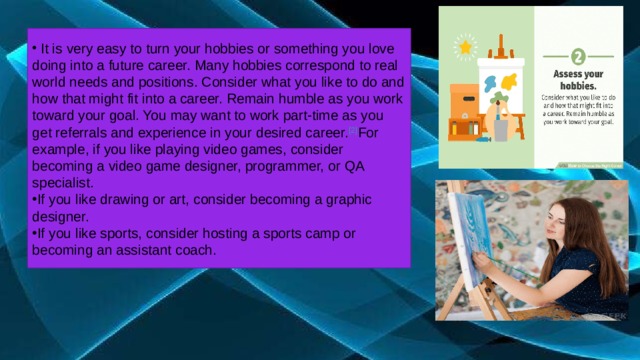
- It is very easy to turn your hobbies or something you love doing into a future career. Many hobbies correspond to real world needs and positions. Consider what you like to do and how that might fit into a career. Remain humble as you work toward your goal. You may want to work part-time as you get referrals and experience in your desired career. [2] For example, if you like playing video games, consider becoming a video game designer, programmer, or QA specialist.
- If you like drawing or art, consider becoming a graphic designer.
- If you like sports, consider hosting a sports camp or becoming an assistant coach.

- Consider what you enjoy or enjoyed in school.
Academic subjects translate well into future careers but may require more schooling than other types of careers. Your favorite class in high school could very well launch you into your future career but you have to be willing to work for it.
For example, if you loved chemistry, you could look forward to a future career as a lab technician or a pharmacist.
- If you liked English class, consider becoming an editor or a copywriter.
- If you enjoyed math, consider becoming an actuary or an accountant.

- Ask someone if you don't know.
Sometimes it’s hard for us to see the areas in life where we excel. If you don’t think you’re good at anything, ask your parents, other family members, friends, or teachers what they think you’d be good at. Their ideas might surprise you!
Your friends and family can also help you network and get you in touch with people in your chosen field. You can also join a Meet Up to meet others that are involved with the work you hope to do.

When you're considering a career change, ask yourself questions like...
- What salary do I need to maintain the lifestyle that I want?
- Where do I want to live, and what type of commute works for me?
- How many hours do I want to work?
- Do I want to work on short-term or long-term projects?
- What are my strengths, skills, and gifts?
- What do I love to do? What brings me joy?
- What's meaningful and important to me, and what impact do I want to have on the world?
How to Become a Successful Professional
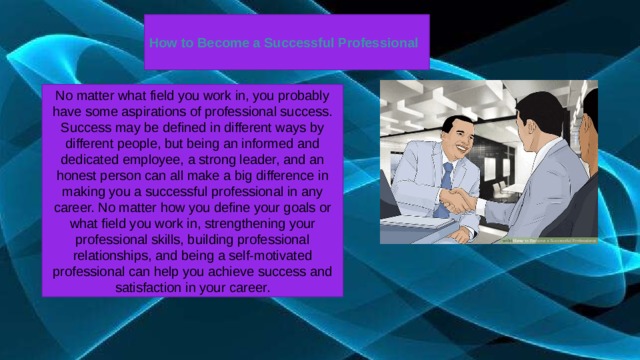
No matter what field you work in, you probably have some aspirations of professional success. Success may be defined in different ways by different people, but being an informed and dedicated employee, a strong leader, and an honest person can all make a big difference in making you a successful professional in any career. No matter how you define your goals or what field you work in, strengthening your professional skills, building professional relationships, and being a self-motivated professional can help you achieve success and satisfaction in your career.

- Exercise communication skills . Communication skills will help you in any professional arena, and may even benefit your personal life as well. How you communicate can affect the first impression others have of you, and may make or break your professional opportunities. Resist saying the first thing on your mind. Instead, try waiting 5 seconds or so, and if you still think your input is relevant and contributes to the conversation, then voice your idea.
- If you're naturally shy or soft-spoken, challenge yourself to be more vocal and active in conversations.
- Be aware of yourself—not just your appearance (which is important), but also your words, your tone, and your body language .
- Understand your conversational objective(s) before you join a conversation.
- Be empathetic towards others. If someone (a customer, a coworker, a manager, etc.) is having a hard time, be understanding of their struggles. Put yourself in that person's place and try to think about what you might want to hear in that moment.
Just make sure to remain professional and appropriate for your role.

Work on interpersonal skills.
Interpersonal skills are essential if you want to be part of any professional team. The ability to get along with others and work collaboratively is an important part of any business, no matter what professional field you work in.
Be mindful of whom you're speaking with, and how you might be coming across, in every interaction with others.
- Accept that you may not agree with others all the time, and they may not always agree with you. That's okay—you can find ways to compromise, or agree to disagree. Just don't try to argue or fight with others, as this may result in hurt feelings and fractured professional relationships. Offer constructive criticism that contains alternative options, if necessary.
- Ask a trusted colleague to give you feedback on your interpersonal skills. Let them know that you're trying to develop your skills and would like to know how you come across to others.

Building Professional Relationships
Offer help without being asked.
An easy way to stand out to your colleagues and superiors is by offering help without being asked for it. If you're practicing empathy and working on your leadership skills, you should be able to notice when others are having a hard time on a project. Most people you work with will help when they're asked, but offering your assistance before anyone else has to ask will set you apart from your peers. Don't just offer general or vague help. Take note of what others are working on or struggling with and offer specific ways to assist on that project.

Take responsibility for your actions.
Taking responsibility for your actions cuts both ways: don't be modest about your accomplishments (though don't showboat, either), but you also need to take responsibility for your mistakes. Don't try to pass the blame, and don't be overly defensive about your mistakes. Simply accept that a mistake was made, acknowledge what you should have done differently, and use the incident as a learning experience. Trying to blame others for your mistakes may make you feel slightly better about yourself in the moment, but your coworkers or employees will resent you for passing the blame, and your supervisors/managers may lose respect for you if they're privy to what you're doing.
- While it's important to take responsibility for your errors, it's also important that you don't beat yourself up over them. Try to find the lesson of what you can do different next time, and move on.
Be self-motivated.
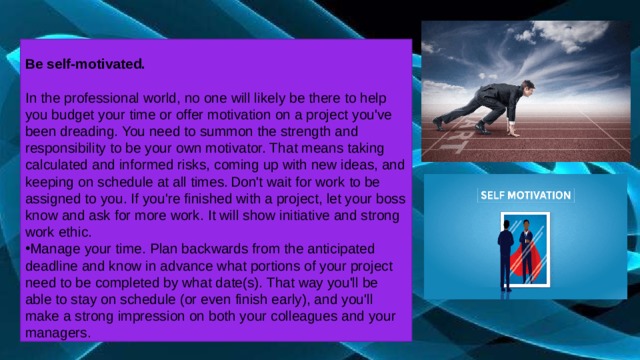
In the professional world, no one will likely be there to help you budget your time or offer motivation on a project you've been dreading. You need to summon the strength and responsibility to be your own motivator. That means taking calculated and informed risks, coming up with new ideas, and keeping on schedule at all times. Don't wait for work to be assigned to you. If you're finished with a project, let your boss know and ask for more work. It will show initiative and strong work ethic.
- Manage your time. Plan backwards from the anticipated deadline and know in advance what portions of your project need to be completed by what date(s). That way you'll be able to stay on schedule (or even finish early), and you'll make a strong impression on both your colleagues and your managers.

Learn to ask.
Whether you're asking for help, asking for clarification, or asking for a promotion, you've got to be willing and able to ask. Opportunities rarely come without any effort, and the same is true of professional opportunities. If you're unclear on a manager's instructions for a project, ask for clarification. If you need help with a project, ask someone whose work you trust if they can take a look at the plans with you. If you want a promotion or a raise, you've got to work up the nerve to ask for it. There's seldom any harm in asking. If you work with reasonable people, you'll probably get a reasonable response.
- Asking for things, including asking for more responsibility or additional projects, will not only boost your reputation—it can also make you feel more fulfilled by your work.
- .

Make SMART goals.
- Goals are important to better yourself, both in your personal life and your professional life.
They give you something to work toward and they help fill your work and your life with greater purpose. But it's important that you make goals that are both beneficial and attainable. That's where it may be helpful to create and strive for S.M.A.R.T. goals, an acronym for Specific, Measurable, Achievable, Results-focused, and Time-bound. Specific goals: be simple and clear with what it is you hope to accomplish. For example, instead of vaguely wanting to do better at work, have a clear goal in mind, like getting a raise or a promotion.
- Measurable goals: as you create your goals, be sure that they can be measured. That way you will have a clear idea of whether or not you've accomplished your goal. For example, if your goal is work-related, you may want to measure your goal by whether or not your salary or responsibilities have increased.
- .
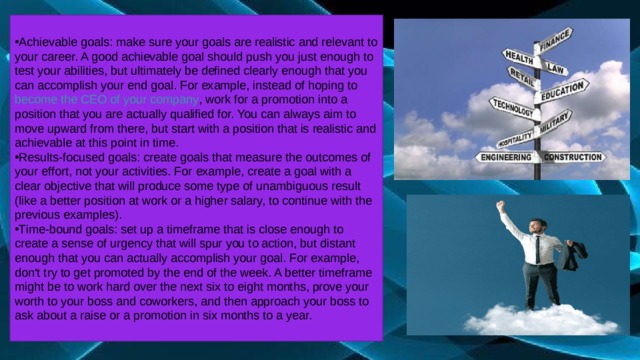
- Achievable goals: make sure your goals are realistic and relevant to your career. A good achievable goal should push you just enough to test your abilities, but ultimately be defined clearly enough that you can accomplish your end goal. For example, instead of hoping to become the CEO of your company , work for a promotion into a position that you are actually qualified for. You can always aim to move upward from there, but start with a position that is realistic and achievable at this point in time.
- Results-focused goals: create goals that measure the outcomes of your effort, not your activities. For example, create a goal with a clear objective that will produce some type of unambiguous result (like a better position at work or a higher salary, to continue with the previous examples).
- Time-bound goals: set up a timeframe that is close enough to create a sense of urgency that will spur you to action, but distant enough that you can actually accomplish your goal. For example, don't try to get promoted by the end of the week. A better timeframe might be to work hard over the next six to eight months, prove your worth to your boss and coworkers, and then approach your boss to ask about a raise or a promotion in six months to a year.

Conclusion
Choosing the right path and finding the perfect job isn’t always easy. Many people reach a crossroads at different stages in life, and it doesn’t matter what age you are or what jobs you’ve had in the past. Selecting a new career path should be a carefully thought-out process.
Some people work their entire lives in one industry. Others are unsettled before landing on a job that is right for them. Unfortunately, there is no guarantee that all the research and experience in the world will make you love your job after you’ve been involved in it for a while. Other times, it’s more to do with not liking the people in the company than disliking the actual job.
It’s far too easy to jump into a career headfirst without the taking the right precautionary steps. By staying in one career for a long time, you’ll learn more, develop relationships, and can become hugely successful. So, take the time to consider all of the factors before taking the plunge.
Once you have a basic idea about a career that interests you, create a roadmap. It’s not cliché to combine your dreams with reality. If you have the right resources in place, it’s possible to find a fulfilling career that will last for years or even your entire career.








Вебинар для учителей
🎓 Свидетельство об участии ✨БЕСПЛАТНО!✨