


, Махачкала


СДЕЛАЙТЕ СВОИ УРОКИ ЕЩЁ ЭФФЕКТИВНЕЕ, А ЖИЗНЬ СВОБОДНЕЕ
Благодаря готовым учебным материалам для работы в классе и дистанционно
Скидки до 50 % на комплекты
только до
Готовые ключевые этапы урока всегда будут у вас под рукой
Организационный момент
Проверка знаний
Объяснение материала
Закрепление изученного
Итоги урока

Была в сети 20.11.2025 23:26

Кандишова Алина Джабраиловна
учитель английского языка
 477
 113 879

Местоположение
Специализация
Презентация "Florence Nightingale"
Категория:
Английский язык
03.12.2019 18:57

Просмотр содержимого документа
«Презентация "Florence Nightingale"»

Florence Nightingale
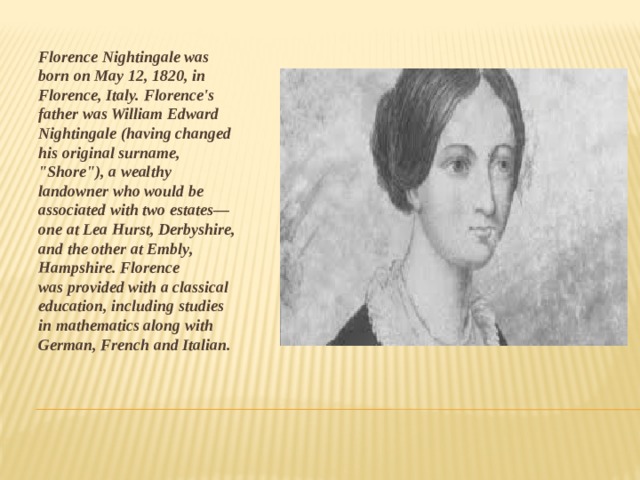
Florence Nightingale was born on May 12, 1820, in Florence, Italy. Florence's father was William Edward Nightingale (having changed his original surname, "Shore"), a wealthy landowner who would be associated with two estates—one at Lea Hurst, Derbyshire, and the other at Embly, Hampshire. Florence was provided with a classical education, including studies in mathematics along with German, French and Italian.
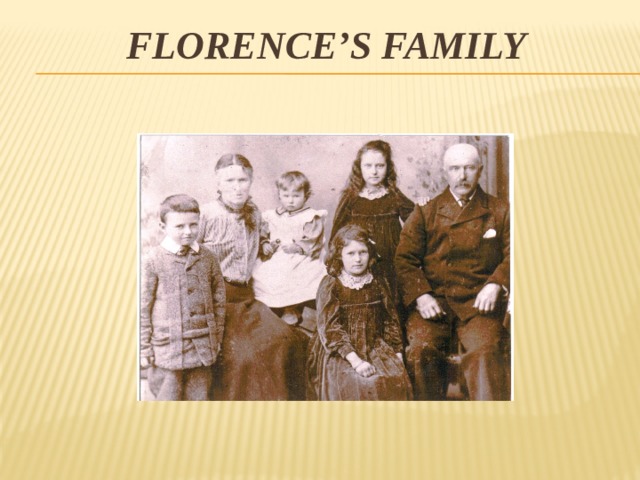
Florence’s family
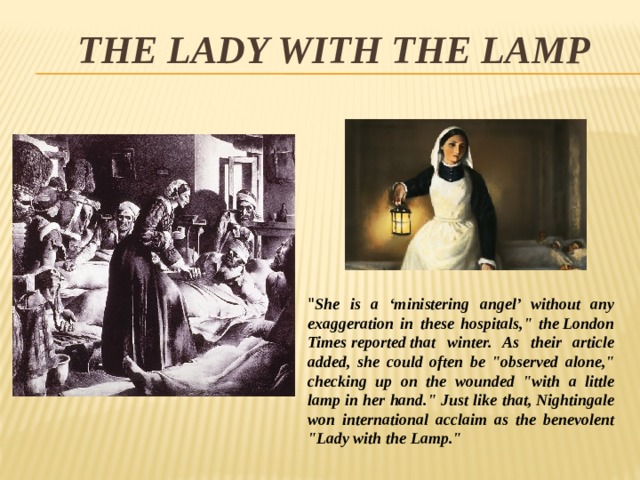
The Lady with the Lamp
" She is a ‘ministering angel’ without any exaggeration in these hospitals," the London Times reported that winter. As their article added, she could often be "observed alone," checking up on the wounded "with a little lamp in her hand." Just like that, Nightingale won international acclaim as the benevolent "Lady with the Lamp."

The school for nursing

SHE BECAME THE FIRST WOMAN TO BE INDUCTED INTO THE ORDER OF MERIT.
Established in 1902, this high British honor was created by King Edward VII to recognize individuals who “have rendered exceptionally meritorious services ... towards the advancement of the Arts, Learning, Literature, and Science.” Nightingale earn the accolade in 1907; no other woman would be awarded the honor again until biochemist Dorothy Hodgkin followed suit 58 years later.

A statue of Florence Nightingale by the 20th century war memorialist Arthur George Walker stands in Waterloo Place, Westminster, London, just off The Mall. There are three statues of Nightingale in Derby – one outside the Derbyshire Royal Infirmary (DRI), one in St Peter's Street, and one above the Nightingale-Macmillan Continuing Care Unit opposite the Derbyshire Royal Infirmary. A pub named after her stands close to the DRI. The Nightingale-Macmillan continuing care unit is now at the Royal Derby Hospital, formerly known as The City Hospital, Derby.

The Florence Nightingale Museum at St Thomas' Hospital in London reopened in May 2010 in time for the centenary of Nightingale's death. Another museum devoted to her is at her sister's family home, Claydon House, now a property of the National Trust.
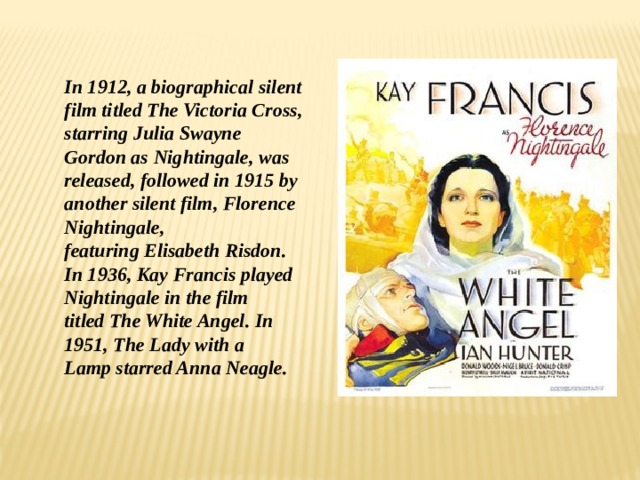
In 1912, a biographical silent film titled The Victoria Cross, starring Julia Swayne Gordon as Nightingale, was released, followed in 1915 by another silent film, Florence Nightingale, featuring Elisabeth Risdon. In 1936, Kay Francis played Nightingale in the film titled The White Angel. In 1951, The Lady with a Lamp starred Anna Neagle.
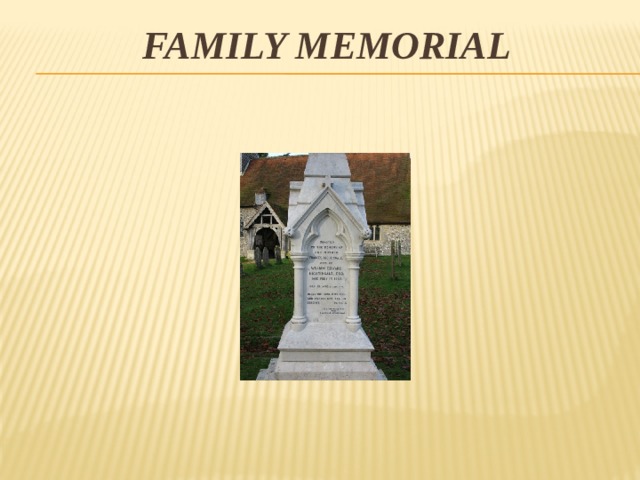
Family memorial




Вебинар для учителей

🎓 Свидетельство об участии ✨БЕСПЛАТНО!✨



