Россия,


СДЕЛАЙТЕ СВОИ УРОКИ ЕЩЁ ЭФФЕКТИВНЕЕ, А ЖИЗНЬ СВОБОДНЕЕ
Благодаря готовым учебным материалам для работы в классе и дистанционно
Скидки до 50 % на комплекты
только до
Готовые ключевые этапы урока всегда будут у вас под рукой
Организационный момент
Проверка знаний
Объяснение материала
Закрепление изученного
Итоги урока

Была в сети 28.09.2021 22:30

Малышева Ольга Владимировна
Учитель английского и немецкого языков
 4 963
 13 197

Местоположение
Специализация
Presentation. 6th grade. Leo Tolstoy
Категория:
Английский язык
18.02.2021 19:00

Просмотр содержимого документа
«Presentation. 6th grade. Leo Tolstoy»
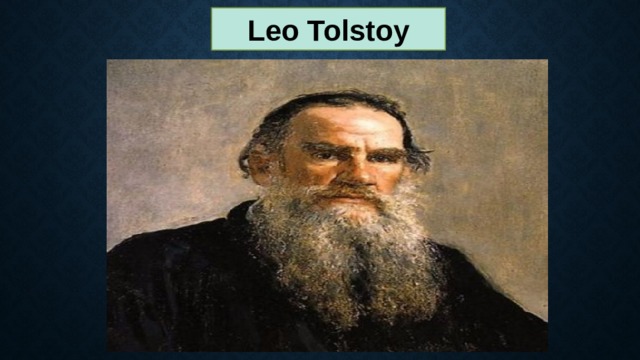
Leo Tolstoy

Leo Tolstoy is one of the most famous writers and philosophers in the world. His views and beliefs formed the basis of a whole religious and philosophical movement, which is called Tolstoyism. The literary legacy of the writer was 90 volumes of fiction and nonfiction works, diary notes and letters, and he was repeatedly nominated for the Nobel Prize in Literature and
the Nobel Peace Prize.
"Fulfill all that you have determined
to be fulfilled»
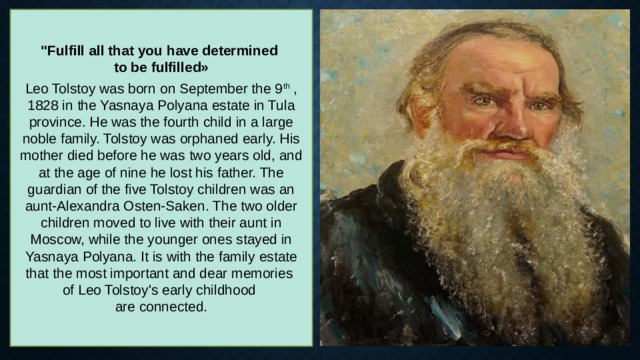
Leo Tolstoy was born on September the 9 th , 1828 in the Yasnaya Polyana estate in Tula province. He was the fourth child in a large noble family. Tolstoy was orphaned early. His mother died before he was two years old, and at the age of nine he lost his father. The guardian of the five Tolstoy children was an aunt-Alexandra Osten-Saken. The two older children moved to live with their aunt in Moscow, while the younger ones stayed in Yasnaya Polyana. It is with the family estate that the most important and dear memories
of Leo Tolstoy's early childhood
are connected.
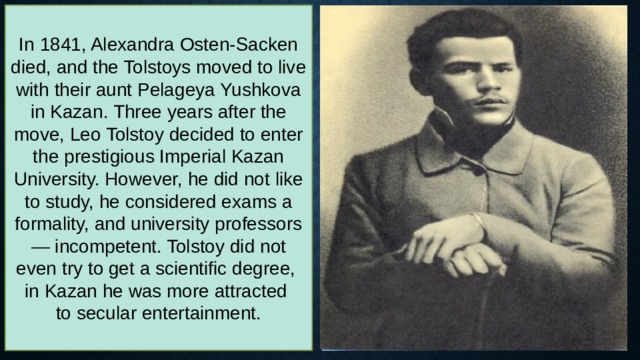
In 1841, Alexandra Osten-Sacken died, and the Tolstoys moved to live with their aunt Pelageya Yushkova in Kazan. Three years after the move, Leo Tolstoy decided to enter the prestigious Imperial Kazan University. However, he did not like to study, he considered exams a formality, and university professors — incompetent. Tolstoy did not even try to get a scientific degree,
in Kazan he was more attracted
to secular entertainment.
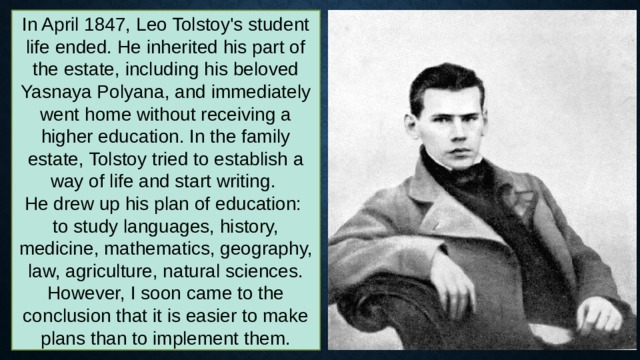
In April 1847, Leo Tolstoy's student life ended. He inherited his part of the estate, including his beloved Yasnaya Polyana, and immediately went home without receiving a higher education. In the family estate, Tolstoy tried to establish a way of life and start writing.
He drew up his plan of education:
to study languages, history, medicine, mathematics, geography, law, agriculture, natural sciences. However, I soon came to the conclusion that it is easier to make plans than to implement them.
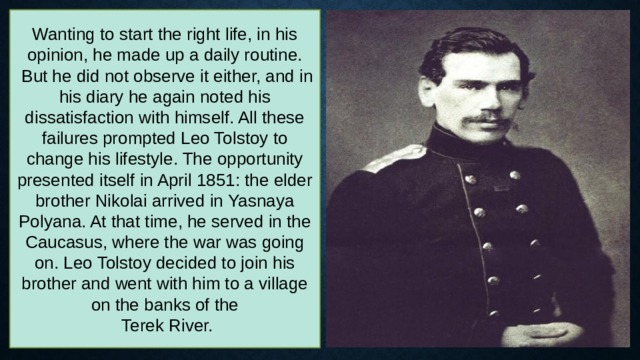
Wanting to start the right life, in his opinion, he made up a daily routine.
But he did not observe it either, and in his diary he again noted his dissatisfaction with himself. All these failures prompted Leo Tolstoy to change his lifestyle. The opportunity presented itself in April 1851: the elder brother Nikolai arrived in Yasnaya Polyana. At that time, he served in the Caucasus, where the war was going on. Leo Tolstoy decided to join his brother and went with him to a village on the banks of the
Terek River.
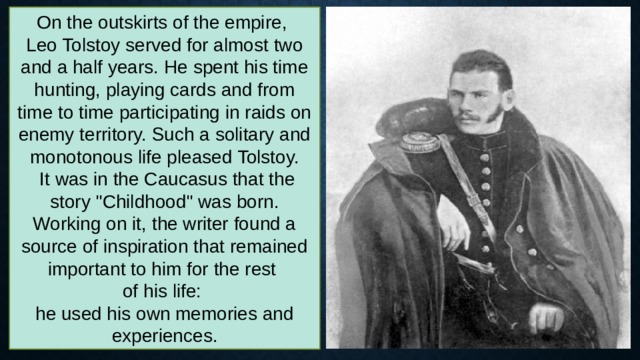
On the outskirts of the empire,
Leo Tolstoy served for almost two and a half years. He spent his time hunting, playing cards and from time to time participating in raids on enemy territory. Such a solitary and monotonous life pleased Tolstoy.
It was in the Caucasus that the story "Childhood" was born. Working on it, the writer found a source of inspiration that remained important to him for the rest
of his life:
he used his own memories and experiences.
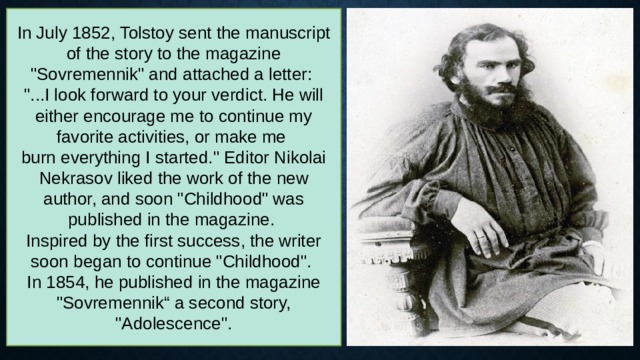
In July 1852, Tolstoy sent the manuscript of the story to the magazine "Sovremennik" and attached a letter:
"...I look forward to your verdict. He will either encourage me to continue my favorite activities, or make me
burn everything I started." Editor Nikolai Nekrasov liked the work of the new author, and soon "Childhood" was published in the magazine.
Inspired by the first success, the writer soon began to continue "Childhood".
In 1854, he published in the magazine "Sovremennik“ a second story, "Adolescence".

"The main thing is literary works»
At the end of 1854, Leo Tolstoy arrived in Sevastopol — the epicenter of military operations. Being in the thick of things, he created the story "Sevastopol in the month of December". Although Tolstoy was unusually frank about the battle scenes, the first Sevastopol story was deeply patriotic and celebrated the bravery of Russian soldiers. Soon Tolstoy began working on a second story — "Sevastopol in May".
By that time, his pride in the Russian army was gone. The horror and shock that Tolstoy experienced on the front line and during the siege of the city strongly influenced his work.
Now he wrote about the senselessness of death and the inhumanity of war.

In 1855, from the ruins of Sevastopol,
Tolstoy went to St. Petersburg.
The success of the first Sevastopol story gave him
a sense of purpose:
"My career is literature, - to write and write!
From tomorrow I work all my life or give up everything, rules, religion, decency — everything."
In the capital, Leo Tolstoy finished "Sevastopol in May" and wrote "Sevastopol in August 1855" — these essays completed the trilogy.
And in November 1856, the writer finally left the military service.

Thanks to true stories about the Crimean War, Tolstoy entered the St. Petersburg literary circle
of the magazine "Sovremennik". During this period, he wrote the story "Blizzard", the story "Two Hussars", and finished the trilogy with the story "Youth". However, after a while, relations with the writers from the circle deteriorated: "I'm sick of these people, and I'm sick of myself." To unwind, at the beginning of 1857, Leo Tolstoy went abroad. He visited Paris, Rome, Berlin, Dresden:
he got acquainted with famous works of art, met with artists, watched how people live in European cities.
The journey did not inspire Tolstoy: he created the story "Lucerne", in which he described his disappointment.
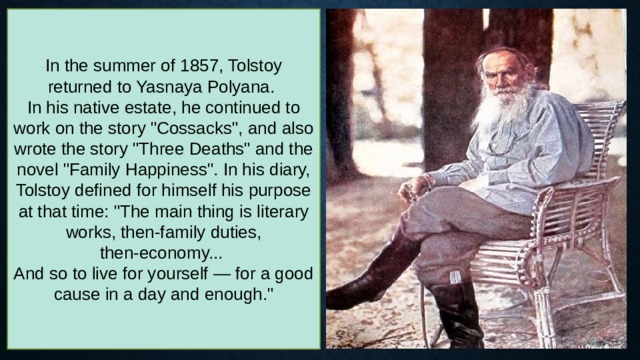
In the summer of 1857, Tolstoy returned to Yasnaya Polyana.
In his native estate, he continued to work on the story "Cossacks", and also wrote the story "Three Deaths" and the novel "Family Happiness". In his diary, Tolstoy defined for himself his purpose at that time: "The main thing is literary works, then-family duties,
then-economy...
And so to live for yourself — for a good cause in a day and enough."
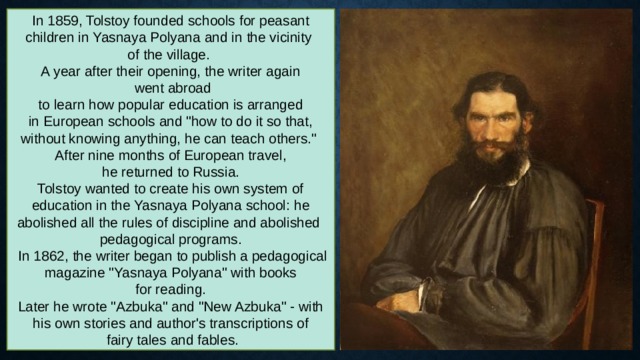
In 1859, Tolstoy founded schools for peasant children in Yasnaya Polyana and in the vicinity
of the village.
A year after their opening, the writer again
went abroad
to learn how popular education is arranged
in European schools and "how to do it so that, without knowing anything, he can teach others."
After nine months of European travel,
he returned to Russia.
Tolstoy wanted to create his own system of education in the Yasnaya Polyana school: he abolished all the rules of discipline and abolished
pedagogical programs.
In 1862, the writer began to publish a pedagogical magazine "Yasnaya Polyana" with books
for reading.
Later he wrote "Azbuka" and "New Azbuka" - with his own stories and author's transcriptions of
fairy tales and fables.
"To love and be so happy»
In Tolstoy's artistic work at this time there
was a crisis.
In his diaries, he increasingly expressed dissatisfaction with life: "Indecision, idleness, longing, the thought of death.
We need to get out of this. One course of treatment.
The effort to work on yourself."
In 1862, Leo Tolstoy found a way out of his despondency:
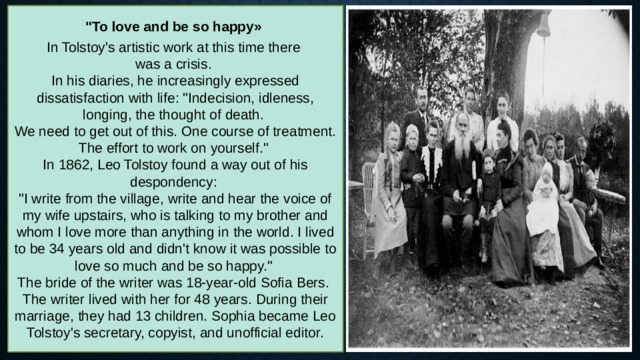
"I write from the village, write and hear the voice of my wife upstairs, who is talking to my brother and whom I love more than anything in the world. I lived to be 34 years old and didn't know it was possible to love so much and be so happy."
The bride of the writer was 18-year-old Sofia Bers.
The writer lived with her for 48 years. During their marriage, they had 13 children. Sophia became Leo Tolstoy's secretary, copyist, and unofficial editor.
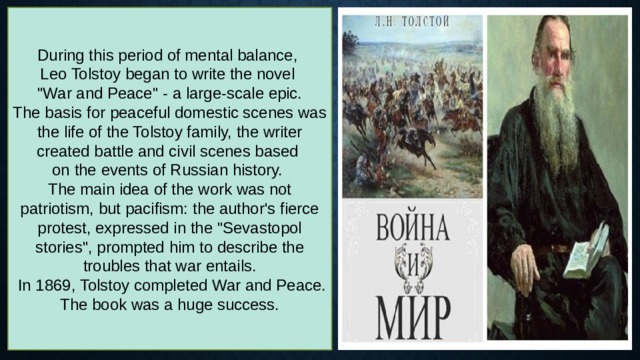
During this period of mental balance,
Leo Tolstoy began to write the novel
"War and Peace" - a large-scale epic.
The basis for peaceful domestic scenes was the life of the Tolstoy family, the writer created battle and civil scenes based
on the events of Russian history.
The main idea of the work was not patriotism, but pacifism: the author's fierce protest, expressed in the "Sevastopol stories", prompted him to describe the troubles that war entails.
In 1869, Tolstoy completed War and Peace. The book was a huge success.
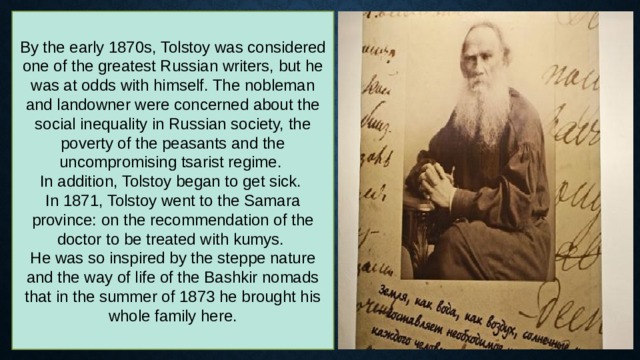
By the early 1870s, Tolstoy was considered one of the greatest Russian writers, but he was at odds with himself. The nobleman and landowner were concerned about the social inequality in Russian society, the poverty of the peasants and the uncompromising tsarist regime.
In addition, Tolstoy began to get sick.
In 1871, Tolstoy went to the Samara province: on the recommendation of the doctor to be treated with kumys.
He was so inspired by the steppe nature and the way of life of the Bashkir nomads that in the summer of 1873 he brought his whole family here.

Samara became a refuge and a source
of inspiration for the writer. After a family trip, he again took up the novel "Anna Karenina", which he began in the spring of 1873. Tolstoy both loved and hated this work, which became very personal for him: "My Anna bored me like a bitter radish... but do not tell me anything bad about her, or, if you want, with ménagement (with caution. - Ed.),
she is still adopted.»
In 1877, Tolstoy finished
"Anna Karenina".
It was a dark novel-it did not have the idyll that was present in the finale of
"War and Peace".
"Be content with little and do good
to others»
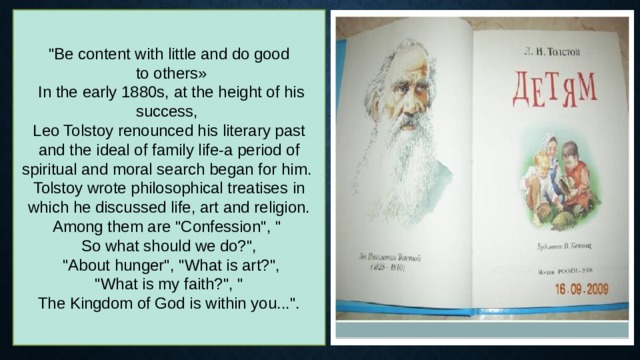
In the early 1880s, at the height of his success,
Leo Tolstoy renounced his literary past and the ideal of family life-a period of spiritual and moral search began for him.
Tolstoy wrote philosophical treatises in which he discussed life, art and religion. Among them are "Confession", "
So what should we do?",
"About hunger", "What is art?",
"What is my faith?", "
The Kingdom of God is within you...".
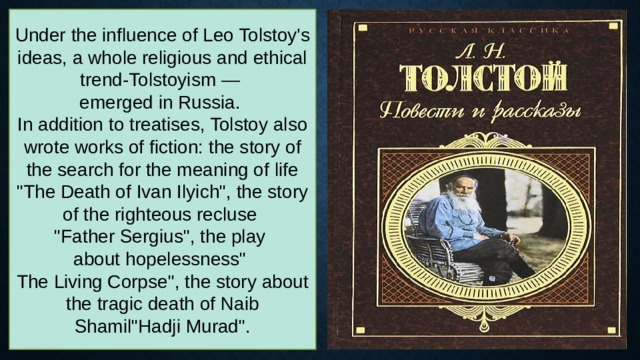
Under the influence of Leo Tolstoy's ideas, a whole religious and ethical trend-Tolstoyism —
emerged in Russia.
In addition to treatises, Tolstoy also wrote works of fiction: the story of the search for the meaning of life "The Death of Ivan Ilyich", the story of the righteous recluse
"Father Sergius", the play
about hopelessness"
The Living Corpse", the story about the tragic death of Naib Shamil"Hadji Murad".
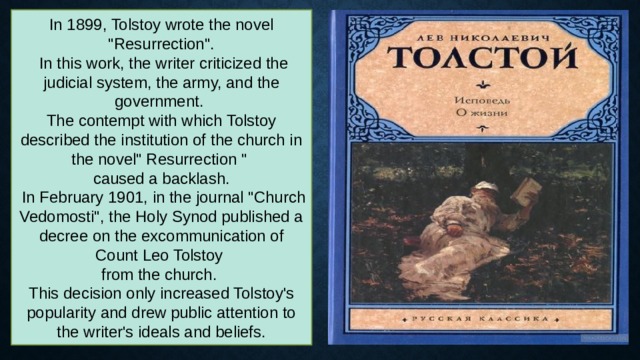
In 1899, Tolstoy wrote the novel "Resurrection".
In this work, the writer criticized the judicial system, the army, and the government.
The contempt with which Tolstoy described the institution of the church in the novel" Resurrection "
caused a backlash.
In February 1901, in the journal "Church Vedomosti", the Holy Synod published a decree on the excommunication of Count Leo Tolstoy
from the church.
This decision only increased Tolstoy's popularity and drew public attention to the writer's ideals and beliefs.

Tolstoy's literary and social activities became known abroad.
The writer was nominated for the Nobel Peace Prize in 1901, 1902 and 1909 and for the Nobel Prize in Literature
in 1902-1906.
Tolstoy himself did not want to receive the award and even told the Finnish writer Arvid Jarnefelt to try to prevent the award, because "if it happened... it would be very unpleasant to refuse."
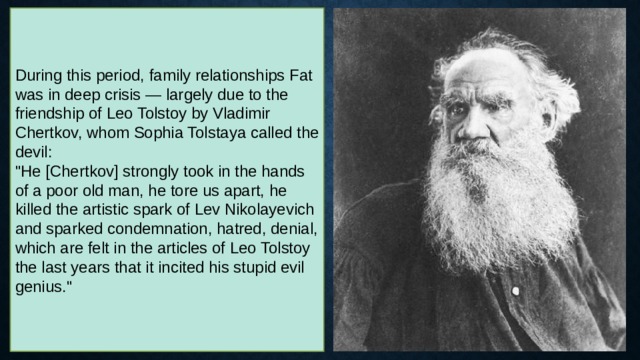
During this period, family relationships Fat was in deep crisis — largely due to the friendship of Leo Tolstoy by Vladimir Chertkov, whom Sophia Tolstaya called the devil:
"He [Chertkov] strongly took in the hands
of a poor old man, he tore us apart, he killed the artistic spark of Lev Nikolayevich and sparked condemnation, hatred, denial, which are felt in the articles of Leo Tolstoy the last years that it incited his stupid evil genius."

Tolstoy himself was burdened by the life of a landowner and a family man. He sought to bring his life in line with his beliefs and in early November 1910 secretly left the
Yasnaya Polyana estate.
The road was too much for the elderly man: on the way, he became seriously ill and was forced to stop at the house of the caretaker of the Astapovo railway station. Here the writer spent the last days of his life. Leo Tolstoy died on November 20, 1910.
The writer was buried in
Yasnaya Polyana.






Вебинар для учителей
🎓 Свидетельство об участии ✨БЕСПЛАТНО!✨