

Россия,


СДЕЛАЙТЕ СВОИ УРОКИ ЕЩЁ ЭФФЕКТИВНЕЕ, А ЖИЗНЬ СВОБОДНЕЕ
Благодаря готовым учебным материалам для работы в классе и дистанционно
Скидки до 50 % на комплекты
только до
Готовые ключевые этапы урока всегда будут у вас под рукой
Организационный момент
Проверка знаний
Объяснение материала
Закрепление изученного
Итоги урока

Была в сети 28.09.2021 22:30

Малышева Ольга Владимировна
Учитель английского и немецкого языков
 4 963
 13 197

Местоположение
Специализация
Presentation 3rd grade. Animals
Категория:
Английский язык
12.12.2020 15:17

Просмотр содержимого документа
«Presentation 3rd grade. Animals»

Animals
We are responsible for those, who have been tamed
Antoine de Saint-Exupéry

Classification of animals
There is a large number of animals in the world,
so many that it is impossible to list them all.
However, there are a few methods to classify them.
Animals are multicellular i.e. organisms with multiple cells which grow to take a particular shape. Usually, all animals, whether wild or pets, can move independently and without any support.
They consume other living organisms for food. They get their name from the Latin term animal , which means soul .
In biological terms, the word animal means all categories which belong to the Kingdom Animalia , which includes creatures which range from humans to insects.
Classifying animals basically means dividing them into two main groups – vertebrates and invertebrates .
Vertebrates have a backbone, while invertebrates are those which don’t. In all, there are more than 800,000 animal species in the Kingdom Animalia and most of them are included in the phylum of Arthropod i.e. invertebrates.
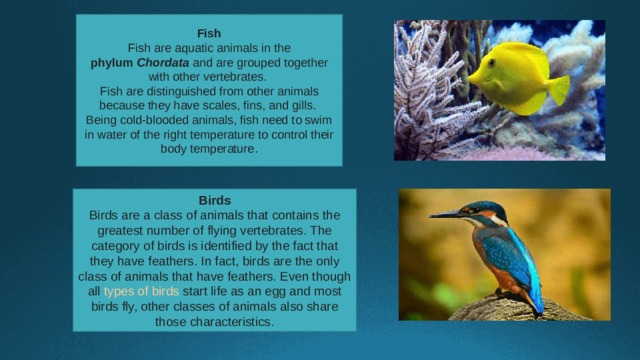
Fish
Fish are aquatic animals in the phylum Chordata and are grouped together with other vertebrates.
Fish are distinguished from other animals because they have scales, fins, and gills.
Being cold-blooded animals, fish need to swim in water of the right temperature to control their body temperature .
Birds
Birds are a class of animals that contains the greatest number of flying vertebrates. The category of birds is identified by the fact that they have feathers. In fact, birds are the only class of animals that have feathers. Even though all types of birds start life as an egg and most birds fly, other classes of animals also share those characteristics.
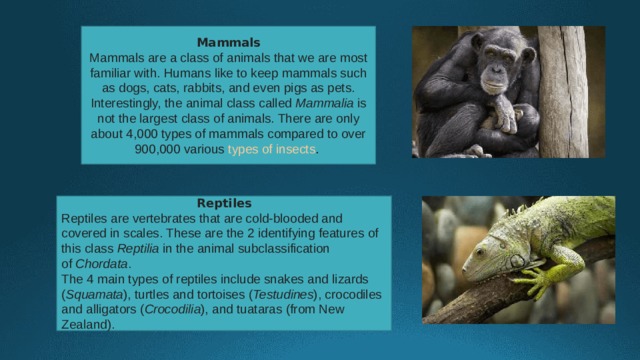
Mammals
Mammals are a class of animals that we are most familiar with. Humans like to keep mammals such as dogs, cats, rabbits, and even pigs as pets. Interestingly, the animal class called Mammalia is not the largest class of animals. There are only about 4,000 types of mammals compared to over 900,000 various types of insects .
Reptiles
Reptiles are vertebrates that are cold-blooded and covered in scales. These are the 2 identifying features of this class Reptilia in the animal subclassification of Chordata .
The 4 main types of reptiles include snakes and lizards ( Squamata ), turtles and tortoises ( Testudines ), crocodiles and alligators ( Crocodilia ), and tuataras (from New Zealand).

Amphibians
Animals in the class Amphibia are a type of animals with gills (like a fish) and lungs (like reptiles). The 3 subclasses of amphibians are frogs and toads ( Salientia ), salamanders and newts ( Caudata ), and blindworms (caecilians).
From the class of amphibians, types of frogs make up the majority of water-loving animals. There are over 4,000 species of animals classed as amphibians.
The name ‘amphibian’ comes from the Greek meaning “both kinds of life.” This refers to the unique ability of amphibious creatures to live in water and on land. Even though there are some mammals such as seals that also live on land and water, they are not amphibians. Even though they have gills, fish are not a type of amphibian either.
Invertebrates
Invertebrates are a class of animals that don’t have a backbone. This diverse range of animals can include arthropods such as insects, as well as mollusks, worms, jellyfish, snails, and squid. This group of animal species is so large that some estimate it contains around 97% of the animals in the world. One of the largest phyla (plural of phylum) of all the invertebrates is arthropods. These are a group of cold-blooded animals that can be everywhere where you live. Although you may not think of insects as animals, mosquitoes, spiders , butterflies, caterpillars , mites, and ticks are all types of invertebrates that are anthropoid animals.

Most Endangered Animals
For some species, time on planet Earth is running out. Human beings are the greatest threat to the survival of endangered species with poaching, habitat destruction and the effects of climate change causing a lot of the problems.
Gorillas
Gorillas are fascinating creatures that share 98.3% of their DNA with humans! They are capable of feeling emotions like we do and even behave like us sometimes – did you know they can laugh?
There are two species, the Eastern Gorilla and the Western Gorilla, and they both have two subspecies.

Rhinos
The name Rhinocerous comes from two Greek words Rhino and Ceros, which when translated into English mean nose horn! It’s a very fitting name, don’t you think? Unfortunately, though, poaching for their distinctive horns is their biggest threat. They are used in Traditional Chinese medicine and displayed as a status symbol and demonstration of wealth.
Sea turtles
Next on our endangered species list are sea turtles. Two species of sea turtle are critically endangered on the IUCN Red List of Threatened Species: Hawksbill Turtles and Kemps Ridley Turtles. Leatherback sea turtles are classified as Vulnerable, though the population is decreasing and several subpopulations are facing extinction.
Hunting is one of the biggest threats to sea turtles, with poachers targeting their eggs, shells, meat and skin. They are also at risk from habitat loss, bycatch, and pollution as well as climate change.

Saola
The Saola is one of the rarest large mammals on Earth.
It was first discovered in 1992 in the Annamite Range in Vietnam, an event so exciting it was hailed as one of the most spectacular zoological discoveries of the 20th century.
The Saola is elusive and so rarely seen it’s known as the Asian unicorn! Population numbers are hard to determine with any accuracy, but it is considered critically endangered, and it is one of the rarest large terrestrial mammals on Earth.
North Atlantic right whale
It was whalers that gave the North Atlantic right whale its name. They are gentle giants that stay close to coasts and spend a lot of time at the surface skim feeding on zooplankton, all of which makes them an easy target and the ‘right whale to hunt’. They were almost wiped out by hunters after their meat and oil-rich fat known as blubber, and are now one of the most endangered large whales. There are currently only around 400 of them left, and only about 100 breeding females. They are now protected, and hunting is illegal, but population recovery is slow.

Tooth-billed pigeon
Following the example of their relative the extinct dodo, tooth-billed pigeons are disappearing at an alarming rate. They only live on Samoa and there are currently 70 to 380 left in the wild, with no captive populations to aid conservation efforts. Very little is actually known about tooth-billed pigeons. They are elusive and very rarely seen.
In the past hunting has played a big part in their decline and has killed thousands of individuals. It is illegal today, but tooth-billed pigeons are still killed accidentally during hunts for other species. Currently, one of their main threats is habitat loss. Large areas of their home have been cleared to make space for agriculture, destroyed by cyclones or taken over by invasive trees. They are also at risk of predation from invasive species, including feral cats.

Gharial
Gharials are fish-eating crocodiles from India. They have long thin snouts with a large bump on the end which resembles a pot known as a Ghara, which is where they get their name. They spend most of their time in freshwater rivers, only leaving the water to bask in the sun and lay eggs.
Unfortunately, Gharial numbers have been in decline since the 1930s and, sadly, this large crocodilian is now close to extinction. There are only around 100 to 300 left in the wild. Their decline is due to several issues, though all human-made. Habitat loss, pollution and entanglement in fishing nets pose some of the biggest threats, along with poachers that target them for use in traditional medicine.
Kakapo
Kakapos are nocturnal ground-dwelling parrots from New Zealand, and yet another example of an animal brought to the edge of extinction by humans. They are critically endangered with only around 140 individuals remaining, each one with an individual name.
They were once common throughout New Zealand and Polynesia but now inhabit just two small islands off the coast of southern New Zealand. One of the main threats to Kakapos is predation from introduced species such as cats and stoats that hunt using scent. A kakapo’s natural reaction is to freeze and blend in with the background when threatened.

Amur Leopard
Unfortunately, Amur leopards are one of the world’s most endangered big cats. They are as Critically Endangered on the IUCN Red List of Threatened Species, and between 2014 and 2015, there were only around 92 Amur leopards left within their natural range. That number is now estimated to be less than 70.
Like all species on our endangered list, humans are their biggest threat. Their beautiful coats are popular with poachers as are their bones which they sell for use in traditional Asian medicine. They are also at risk from habitat loss due primarily to natural and human-made fires. Climate change is also changing Amur leopard habitat and leading to a decrease in prey availability.
Vaquita
The vaquita is both the smallest and the most endangered marine mammal in the world. It has been classified as Critically Endangered by the IUCN since 1996, and in 2018, there were only around 6 to 22 vaquitas left. The latest estimate, from July 2019, suggests there are currently only 9.
Their biggest threat is from the illegal fishing of totoaba, a large fish in demand because of its swim bladder. Vaquitas accidentally end up entangled in the gillnets set for totoaba and drown because they can no longer swim to the surface to breathe.

Greatest Animal Facts
The loudest animal in the world is a mere 2 cm long, prawn.
The Pistol Shrimp is capable of snapping it’s claw shut so rapidly, that it creates a bubble which collapses to produce a sonic blast, louder than a Corncode’s sonic boom.
The worlds deadliest animal isn’t a shark, bear or tiger, but something far smaller – the mosquito. According to the World Health Organization, 725,000 people are killed each year from mosquito-borne diseases, such as Malaria, dengue fever and yellow fever.

A Blue Whales tongue can weigh as much as a car, or a small adult elephant.
A Blue Whales tongue can weigh approx. 2.7 tonnes, or 6,000 – 8,000 pounds (2,720 – 3,630 kg).
A Rhinoceros‘s horns are made of ‘keratin’, the same type of protein that makes up hair and fingernails.
Some species of Rhinos have two horns, while others just have a single horn.

Giraffes are the tallest land animal in the world, reaching heights of 19ft (5.8 m). The ostrich is the world’s tallest bird. It can grow up to 9 feet (2.7m) tall.
Over 2 metres (7ft) of a giraffes total size is its famously long neck, which helps it reach leaves in tall trees.
The Giant Pacific Octopus has 3 hearts, 9 brains and blue blood.
They are also able to change their colour and texture to camouflage themselves in a blink of an eye.

Dolphins use toxic pufferfish to ‘get high’.
Dolphins deliberately handle pufferfish causing them to release toxins as a defence mechanism. These toxins can be deadly in high doses, but also have a narcotic effect – and are a powerful hallucinogenic, which dolphins appear to enjoy.
Roosters prevent themselves from going deaf due to their own loud crowing, by tilting their head backs when they crow, which covers their ear canal completely, serving as a built-in ear-plug.
A study showed that their crowing averages over 100 decibels, which is roughly the same as running a chainsaw.

The pangolin is able to roll up into an armour-plated ball, so lions can’t eat them.
If only this worked for poachers, who simply pick them up when they roll into a ball.
Koalas can sleep for up to 22 hours a day.
They need more sleep than most animals, because their diet of eucalyptus leaves contain toxins, are very low in nutrition, and high in fibrous matter – so they take a large amount of energy to digest!

A group of parrots is known as a pandemonium.
And the collective noun for porcupines, is a prickle .
Panda’s must eat 25 – 90 pounds (12-38 kg) of bamboo every day to meet their energy needs.
This is because bamboo contains very little nutritional value, so they have to eat it in vast quantities to survive. Although the giant panda possess the digestive system of a carnivore, they have evolved to depend almost entirely on bamboo.

Importance of Animals in Human Life
There are a number of reasons why animals are important to human beings. The main reason is that animals benefit us personally, socially and economically.
Human uses of animals. include both practical uses, such as the production of food and clothing, and symbolic uses, such as in art, literature, mythology, and religion.
Animals used in these ways include fish, crustaceans, insects, molluscs, mammals and birds.
Since the time of our cavemen ancestors, there have been interactions between humans and animals.
Animals can be our friends, companions, protectors, benefactors and comforters.
Research studies indicate that people who own pets and have close bond with them have higher self-esteem. They are also generally happier and healthier .

Animals provide many other benefits to humans. Insulin, a hormone in our body which controls the amount of sugar absorbed by our blood, could not be artificially produced previously. It had to be derived from cows and pigs. Nowadays, even though animal insulin has largely been replaced by artificial human insulin, the former is still available on prescription. Trained guide dogs are available to serve as loyal companions and ‘pairs of eyes’ for the blind. In the past, hunters took along hunting dogs to track, sniff out and catch wild game. When night fell, the canines were the hunters’ companions and protectors.
In rehabilitation centres, animals are used to help the sick recover.
For instance, petting a pony helps to lift a sick child’s spirit.

Throughout history, animals have helped humans. We use animals to work for us. In the agricultural sector, oxen pull ploughs before seeds are planted in the soil. We use horses for transportation purposes. They pull carriages and covered wagons for us. Even though oxen and horses are rarely used for farming and travelling purposes respectively today, the horses are still being used for riding and racing. They are also used to participate in contests in order to win awards. Farmers depend on animals such as cattle, poultry, sheep, goats, among others, for their livelihood. They sell the animals’ meat, milk and eggs to earn money. In the fishing industry, although the use of modern equipment and technology have replaced the use of animals to catch fish, fishermen in some parts of the world still use animals like dolphins, otters and cormorants for the purpose.
Another indirectly way in which animals help us is that they assist in the reproduction of a variety of fruit and vegetable crops, which are an important part of our healthy diet. Without animals to help disperse seeds and pollinate plants, many of them would have become extinct.

Why we should protect wild animals
Wild animals play an important role in balancing our ecosystem and stabilizing natural processes. In fact, our lives would not be possible without animals and plants. They make up flora and fauna that are essential for our food, clothes, clean water, soil and oxygen.

Throughout the development of our world, oceans and rivers have provided us with fish; plants gave us fruits and vegetables; forests provided us with wildmeat; ecosystems took care of our clean water and weather.
Moreover, we started domesticating wild animals to make them our livestock . These animals would provide us with food and clothes . We trained wild canines to hunt and guard us , they developed over the years to become dogs.
Wild birds, bats, squirrels and bees enable fruit trees fertilization process and the production of seeds . By helping pollination process wild animals ensure that we have forests and woodlands. And from these forests we are able to built houses for shelter , furniture for comfort living. We also use the wood to make a fire and keep us warm, to build ships to cross oceans and make books to carry knowledge. Wildlife helps us to make it possible easier.

We need to make sure that animals around us are safe, healthy and productive, because we rely on animals for food , labor and companionship .
Furthermore, animals play significant role in insect population control . Also, animals improve aesthetics of the earth in general. If there were no animals on our planet, for instance, the world would not be as colorful and different as it is today.








Вебинар для учителей

🎓 Свидетельство об участии ✨БЕСПЛАТНО!✨



