


Россия, Видное


СДЕЛАЙТЕ СВОИ УРОКИ ЕЩЁ ЭФФЕКТИВНЕЕ, А ЖИЗНЬ СВОБОДНЕЕ
Благодаря готовым учебным материалам для работы в классе и дистанционно
Скидки до 50 % на комплекты
только до
Готовые ключевые этапы урока всегда будут у вас под рукой
Организационный момент
Проверка знаний
Объяснение материала
Закрепление изученного
Итоги урока

Была в сети 26.05.2026 21:20

Емельянова Наталия Ивановна
учитель английского языка
 2 907
 24 807

Местоположение
Специализация
Открытие Америки
Категория:
Английский язык
09.06.2019 11:26

Просмотр содержимого документа
«Открытие Америки»
Who discovered America?
МБОУ Видновская СОШ № 6
Ленинского района, Московской области
Предмет « Английский язык»
Выполнила учитель английского языка
Емельянова Наталия Ивановна
2019
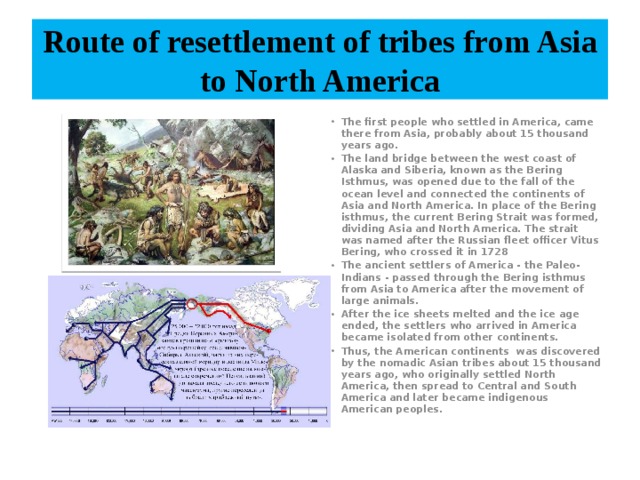
Route of resettlement of tribes from Asia to North America
- The first people who settled in America, came there from Asia, probably about 15 thousand years ago.
- The land bridge between the west coast of Alaska and Siberia, known as the Bering Isthmus, was opened due to the fall of the ocean level and connected the continents of Asia and North America. In place of the Bering isthmus, the current Bering Strait was formed, dividing Asia and North America. The strait was named after the Russian fleet officer Vitus Bering, who crossed it in 1728
- The ancient settlers of America - the Paleo-Indians - passed through the Bering isthmus from Asia to America after the movement of large animals.
- After the ice sheets melted and the ice age ended, the settlers who arrived in America became isolated from other continents.
- Thus, the American continents was discovered by the nomadic Asian tribes about 15 thousand years ago, who originally settled North America, then spread to Central and South America and later became indigenous American peoples.
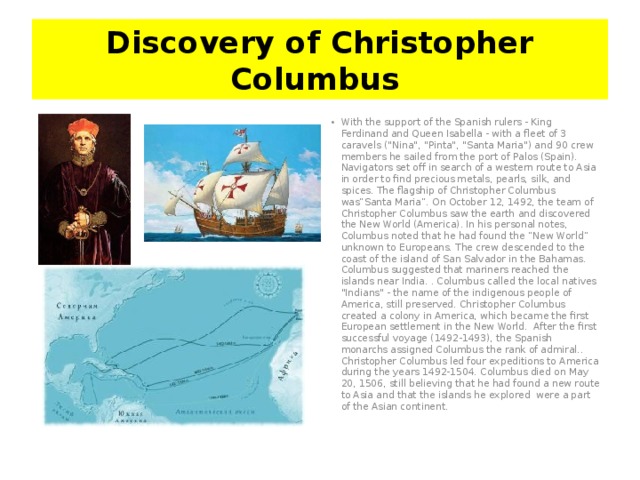
Discovery of Christopher Columbus
- With the support of the Spanish rulers - King Ferdinand and Queen Isabella - with a fleet of 3 caravels ("Nina", "Pinta", "Santa Maria") and 90 crew members he sailed from the port of Palos (Spain). Navigators set off in search of a western route to Asia in order to find precious metals, pearls, silk, and spices. The flagship of Christopher Columbus was“Santa Maria”. On October 12, 1492, the team of Christopher Columbus saw the earth and discovered the New World (America). In his personal notes, Columbus noted that he had found the “New World” unknown to Europeans. The crew descended to the coast of the island of San Salvador in the Bahamas. Columbus suggested that mariners reached the islands near India. . Columbus called the local natives "Indians" - the name of the indigenous people of America, still preserved. Christopher Columbus created a colony in America, which became the first European settlement in the New World. After the first successful voyage (1492-1493), the Spanish monarchs assigned Columbus the rank of admiral.. Christopher Columbus led four expeditions to America during the years 1492-1504. Columbus died on May 20, 1506, still believing that he had found a new route to Asia and that the islands he explored were a part of the Asian continent.
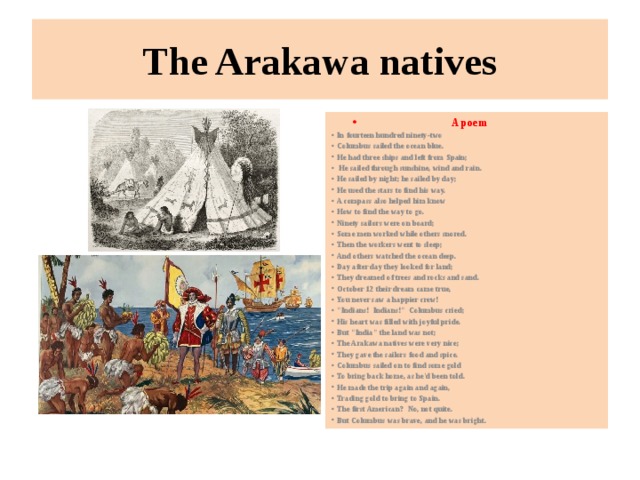
The Arakawa natives
- A poem
- In fourteen hundred ninety-two
- Columbus sailed the ocean blue.
- He had three ships and left from Spain;
- He sailed through sunshine, wind and rain.
- He sailed by night; he sailed by day;
- He used the stars to find his way.
- A compass also helped him know
- How to find the way to go.
- Ninety sailors were on board;
- Some men worked while others snored.
- Then the workers went to sleep;
- And others watched the ocean deep.
- Day after day they looked for land;
- They dreamed of trees and rocks and sand.
- October 12 their dream came true,
- You never saw a happier crew!
- "Indians! Indians!" Columbus cried;
- His heart was filled with joyful pride.
- But "India" the land was not;
- The Arakawa natives were very nice;
- They gave the sailors food and spice.
- Columbus sailed on to find some gold
- To bring back home, as he'd been told.
- He made the trip again and again,
- Trading gold to bring to Spain.
- The first American? No, not quite.
- But Columbus was brave, and he was bright.
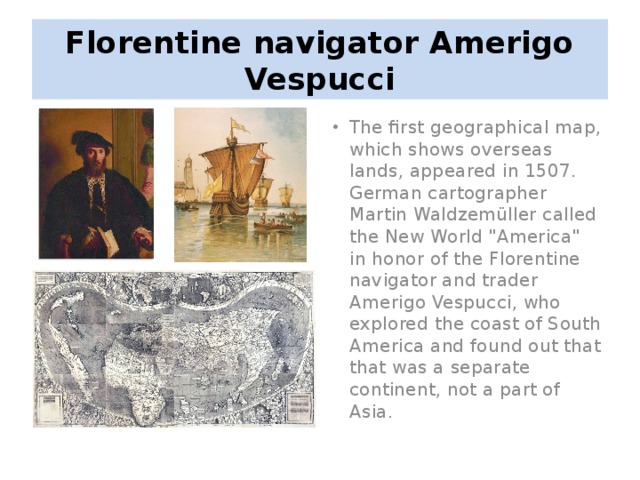
Florentine navigator Amerigo Vespucci
- The first geographical map, which shows overseas lands, appeared in 1507. German cartographer Martin Waldzemüller called the New World "America" in honor of the Florentine navigator and trader Amerigo Vespucci, who explored the coast of South America and found out that that was a separate continent, not a part of Asia.
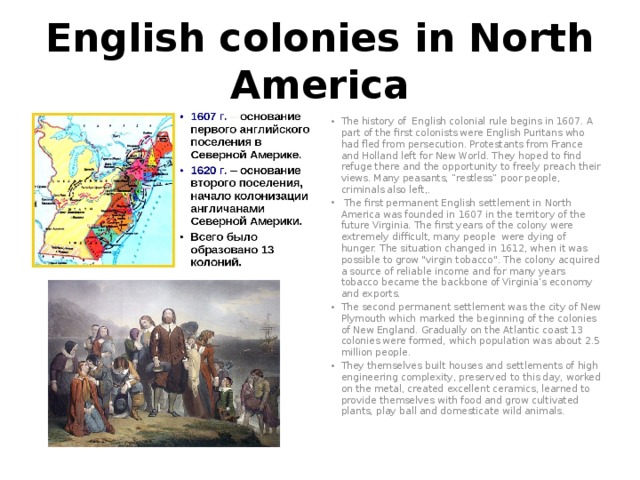
English colonies in North America
- The history of English colonial rule begins in 1607. A part of the first colonists were English Puritans who had fled from persecution. Protestants from France and Holland left for New World. They hoped to find refuge there and the opportunity to freely preach their views. Many peasants, “restless” poor people, criminals also left,.
- The first permanent English settlement in North America was founded in 1607 in the territory of the future Virginia. The first years of the colony were extremely difficult, many people were dying of hunger. The situation changed in 1612, when it was possible to grow "virgin tobacco". The colony acquired a source of reliable income and for many years tobacco became the backbone of Virginia’s economy and exports.
- The second permanent settlement was the city of New Plymouth which marked the beginning of the colonies of New England. Gradually on the Atlantic coast 13 colonies were formed, which population was about 2.5 million people.
- They themselves built houses and settlements of high engineering complexity, preserved to this day, worked on the metal, created excellent ceramics, learned to provide themselves with food and grow cultivated plants, play ball and domesticate wild animals.
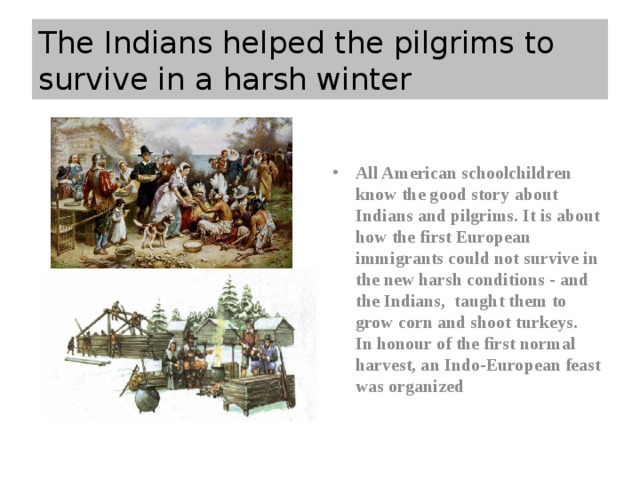
The Indians helped the pilgrims to survive in a harsh winter
- All American schoolchildren know the good story about Indians and pilgrims. It is about how the first European immigrants could not survive in the new harsh conditions - and the Indians, taught them to grow corn and shoot turkeys. In honour of the first normal harvest, an Indo-European feast was organized
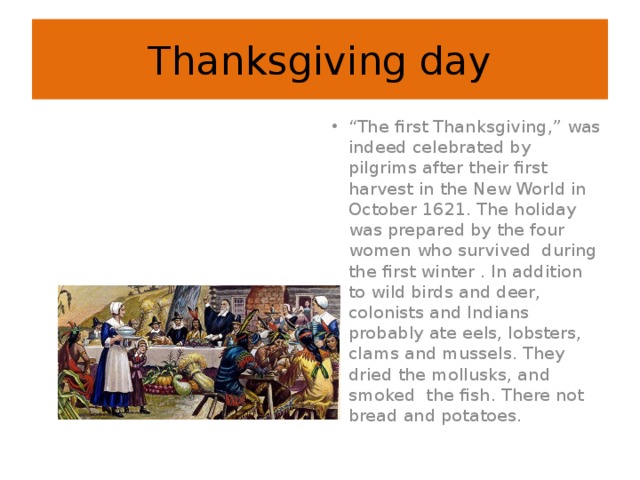
Thanksgiving day
- “ The first Thanksgiving,” was indeed celebrated by pilgrims after their first harvest in the New World in October 1621. The holiday was prepared by the four women who survived during the first winter . In addition to wild birds and deer, colonists and Indians probably ate eels, lobsters, clams and mussels. They dried the mollusks, and smoked the fish. There not bread and potatoes.








Вебинар для учителей

🎓 Свидетельство об участии ✨БЕСПЛАТНО!✨



