


Кыргызстан, Нарын, Ак Талаа, Баетов.


СДЕЛАЙТЕ СВОИ УРОКИ ЕЩЁ ЭФФЕКТИВНЕЕ, А ЖИЗНЬ СВОБОДНЕЕ
Благодаря готовым учебным материалам для работы в классе и дистанционно
Скидки до 50 % на комплекты
только до
Готовые ключевые этапы урока всегда будут у вас под рукой
Организационный момент
Проверка знаний
Объяснение материала
Закрепление изученного
Итоги урока

Была в сети 19.01.2025 16:21

Nurmanbetova Miraida Monoldorovna
учитель
 2 375
 30 774

Местоположение
Специализация
Olympic Games. Vocabulary.
Категория:
Английский язык
28.05.2020 14:53

Просмотр содержимого документа
«Olympic Games. Vocabulary.»
English lesson for the 9 th grade.
Theme: Olympic games
Oplympic Games

Olympic Games
- Origins
- The ancient Greeks first had the idea of getting men together every four years to hold and witness sporting events (in those days women did not participate, though they had their own, independent, events). The idea was to have the best athletes from all over Greece gather in one field and compete every four years. All wars and fighting had to stop while the athletes and their supporters came together in the town of Olympia for a few days to compete in a few events, mostly related to warfare (throwing the javelin, running, wrestling, boxing and chariot racing).
- The first written reference to the Games is 776 BC. They lasted until 389 AD. The idea of having the modern Games was suggested in the mid 19th century but they weren't a world event until 1896. Besides being postponed because of wars, they have been held since then every four years in different cities around the world.

- Symbols
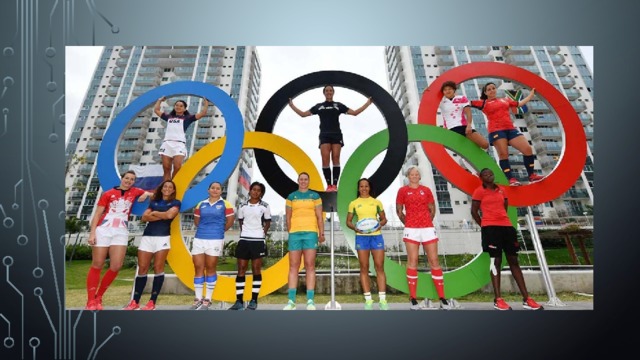
- The Olympic Games have many important symbols that most people recognize. The five rings that appear on the Olympic flag (coloured yellow, green, blue, black and red) were introduced in 1914. They represent the five continents of Africa, the Americas, Australia, Asia and Europe. The flag is raised in the host city and then flown to the next one where it is kept until the next Games. The Olympic torch, a major part of the ancient Games, was brought back in 1928 and is carried with great fanfare and publicity to the host city where it lights the burning flame of the Games. It is kept burning until the close of the Games. The torch symbolizes purity, the drive for perfection and the struggle for victory.
- Medals
- In the ancient Games, only the winner was celebrated. Each winner was given a simple crown of olive leaves to wear on his head. This was the only reward for his victory. Those who came in second or third got nothing. Interestingly, when the Games started again in 1896, silver medals were given to the first place winners. Later in 1904 in the St. Louis Games, gold was the top prize. Now, of course we have gold for first place, silver for second and bronze for third.
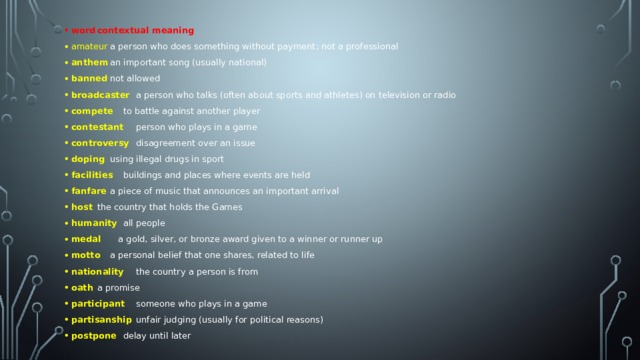
- word contextual meaning
- amateur a person who does something without payment; not a professional
- anthem an important song (usually national)
- banned not allowed
- broadcaster a person who talks (often about sports and athletes) on television or radio
- compete to battle against another player
- contestant person who plays in a game
- controversy disagreement over an issue
- doping using illegal drugs in sport
- facilities buildings and places where events are held
- fanfare a piece of music that announces an important arrival
- host the country that holds the Games
- humanity all people
- medal a gold, silver, or bronze award given to a winner or runner up
- motto a personal belief that one shares, related to life
- nationality the country a person is from
- oath a promise
- participant someone who plays in a game
- partisanship unfair judging (usually for political reasons)
- postpone delay until later
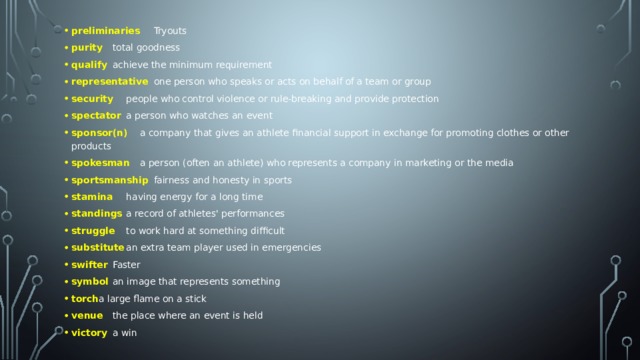
- preliminaries Tryouts
- purity total goodness
- qualify achieve the minimum requirement
- representative one person who speaks or acts on behalf of a team or group
- security people who control violence or rule-breaking and provide protection
- spectator a person who watches an event
- sponsor(n) a company that gives an athlete financial support in exchange for promoting clothes or other products
- spokesman a person (often an athlete) who represents a company in marketing or the media
- sportsmanship fairness and honesty in sports
- stamina having energy for a long time
- standings a record of athletes' performances
- struggle to work hard at something difficult
- substitute an extra team player used in emergencies
- swifter Faster
- symbol an image that represents something
- torch a large flame on a stick
- venue the place where an event is held
- victory a win

Homework: retell about Olympic games
Вебинар для учителей

🎓 Свидетельство об участии ✨БЕСПЛАТНО!✨



