


Россия, село Урняк Чекмагушевский район


СДЕЛАЙТЕ СВОИ УРОКИ ЕЩЁ ЭФФЕКТИВНЕЕ, А ЖИЗНЬ СВОБОДНЕЕ
Благодаря готовым учебным материалам для работы в классе и дистанционно
Скидки до 50 % на комплекты
только до
Готовые ключевые этапы урока всегда будут у вас под рукой
Организационный момент
Проверка знаний
Объяснение материала
Закрепление изученного
Итоги урока

Была в сети 04.04.2023 18:54

Исламова Гульназ Хамитовна
учитель
 2 688
 27 034

Местоположение
Специализация
Обучение говорению
Категория:
Английский язык
04.04.2023 18:58

Просмотр содержимого документа
«Обучение говорению»
ОБУЧЕНИЕ ГОВОРЕНИЮ
Учебно-методическое пособие
ПРЕДИСЛОВИЕ
Говорение является одним из основных видов речевой деятельности, наряду с аудированием, чтением и письмом. Требования к практическому владению говорением включены в программу I курса.
Обучение иноязычному говорению – это обучение выражению своих мыслей в устной монологической и диалогической форме на иностранном языке. Обучение говорению на английском языке является социальным заказом общества, т.к. современная жизнь немыслима без широких интернациональных контактов, а английский язык – это язык интернета и международного общения.
При составлении данного пособия мы исходили из следующих положений:
в каждом языке имеется собственный набор разговорных формул, употребление которых зависит от многих факторов, а именно: насколько хорошо собеседники знают друг друга, в какой ситуации происходит общение и каковы его цели, какие эмоции испытывают собеседники и т.д.
разговор всегда следует определённым моделям общения, несмотря на то, что имеет неподготовленный, неструктурированный характер, т.е. меняются ситуации и темы, варьируются участники.
Следовательно, если овладеть моделями общения и речевыми формулами иностранного языка, то это послужит основой овладения устной иностранной речью.
Исходя из этого, цель данного пособия - развить навык устной диалогической и монологической речи путём использования речевых формул в типичных ситуациях общения. Ситуации отобраны в пределах грамматических и лексических тем, включённых в программу I курса.
Учебно-методическое пособие включает 5 разделов, в каждом из которых перед учащимися ставятся разные задачи.
Conversational formulas. Задача первого раздела - ознакомиться с разговорными формулами, приведёнными в виде таблицы.
Activities. Второй раздел содержит упражнения, которые помогут запомнить и научиться применять эти формулы.
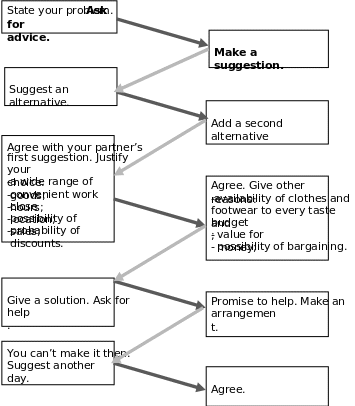
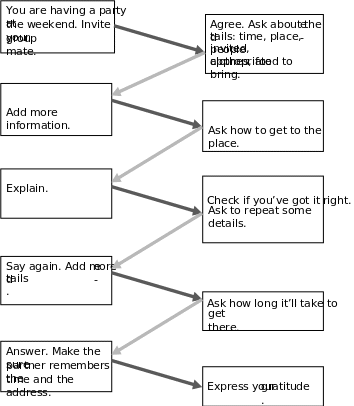
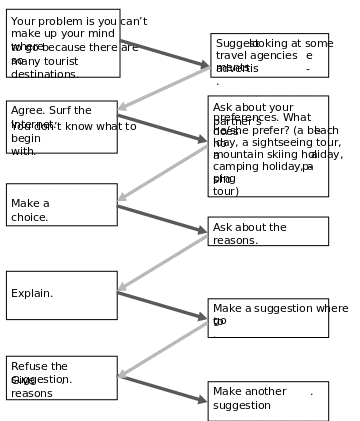
Compositional schemes for dialogues. В третьем разделе ставится задача научиться вести диалог связно и логично согласно моделям общения. Модели представлены в виде структурных схем, каждая из которых инициирует пять реплик от каждого участника.
Possible situations for dialogues. Четвёртый раздел предлагает список возможных ситуаций, в рамках которых могут быть реализованы структурные схемы из раздела III. Ситуации соответствуют темам, изучаемым на первом курсе.
Sample dialogues. Пятый раздел – это диалоги-образцы. Они подробно отражают тактику собеседников, их аргументы и точки зрения. В пятом разделе главная задача - обучающая, поэтому схемы содержат лексические подсказки. Разделы III и IV могут быть использованы для контроля и мониторинга диалогической речи.
Possible compositional schemes for monologues. В последнем разделе предлагаются возможные структурные опоры для монологических высказываний.
Пособие адресовано студентам I курса факультета иностранных языков, а также может быть рекомендовано учителям английского языка и учащимся старших классов.
Part I CONVERSATIONAL FORMULAS
| |
1. Starting a Conversation | |
|
| Phrases | Possible Replies |
| 1.1 Greeting | Good morning. (Good afternoon. Good evening.) Hello. Hi. It’s very nice/good to see you again. I 'm very pleased to see you again. Good/ nice to see you. | Good morning. (Good afternoon. Good evening.) Hello. Hi. It’s very nice/good to see you too. I 'm very pleased to see you. Good/nice to see you too. |
| 1.2 Inquiring about life and health | How are you? How are things (with you)? Haven’t seen you for ages! Where have you been? How are you doing? How are you getting on? How’s life? How have things been? Is everything okay/all right? How are you feeling these days/today? I hope you are well.
| Very well, thank you. Fairly/quite well. OK, thanks. A bit tired, otherwise all right. Not too bad. Great. Fine, thank you. Thanks, life is fine with me. Not very/too well, I 'm afraid. A lot of work, little free time and still less fun. I 'm afraid I 'm not feeling very/too well today. I'm afraid I've got rather a bad cold. |
| 1.3 Complimenting | You are … You are so … How … you are! I wish I had your … You’ve got a nice/lovely/beautiful/ wonderful … What a nice/lovely/beautiful/ wonderful … you’ve got! I wish I had a … like yours! That’s/What a nice/beautiful … (you’re wearing). | Responding to compliments That’s very kind of you. It’s very kind of you to say that. Thanks, I needed that. You’ve made my day! Do you really think so? I wouldn’t say that. I don’t think I’m better/more … than anybody else/than you. I’m glad you like it. Do you like it/them? Yes, I’m pleased with it (myself). It’s not bad, is it? |
| | You look nice/smart in/with … I (do) like your … You did very well. What a nice-looking / convenient / delicious... You are looking good. It really suits you. | Do I? Does it? Do you like it? | ||
| 1.4 Weather talk | (Very) nice and warm/sunny/ hot today, isn’t it? Marvellous weather today, isn’t it? It's a lovely/beautiful day, isn't it? Very mild, isn’t it? The days are getting shorter again, aren't they? A bit/rather/very cold/wet/ cloudy/overcast/windy today, isn’t it? Shocking day/Terrible weather today, isn’t it? Not very nice/promising, isn’t it? Looks like rain, doesn’t it?
| Yes, beautiful/very nice/wonderful/very pleasant/lovely/marvellous. And they say it is going to stay warm for the next couple of days. We could do with some nice weather for a change. Let’s hope it keeps like this. It’s about time we had some sun. Makes a change from all the rain we’ve had lately. It's so mild for the time of year! Yeah. Dark at six thirty! Yes, horrible/dreadful/ terrible/awful/shocking. And they say it is going to stay like this until the weekend. No sign of it changing, either. Good for the garden, though. | ||
|
2. Assuring / Reassuring
| ||||
| 2.1 Persuading: arguments and counterarguments | Don’t forget… That would be great, except… That’s a good idea, but… Comparisons Both…and… …as well. One similarity is (that) On the one hand…on the other hand They (don’t) seem to have much in common. They are alike. | Counter-arguments Even so,… Even if that is so,… That may be so, but.. That’s probably true, but… Possibly, but… On the other hand … But then again,… Look at it this way,… Anyway,… But in the long run,… To make up for it, ….
| ||
| | They are similar. It’s practically the same. There’s not much difference between … | Expressing confidence I honestly feel that… I’m pretty sure that … I’m fairly certain that… I strongly believe that… I’m convinced that… Without a doubt,… I’m positive … I’m…absolutely certain that… | |
| 2.2 Instructing | First of all, Then, Next, After that, Finally, Make sure you… Be careful not to… Remember to… Don’t forget to… The first thing you have to do is… After you’ve done that you… By the way, don’t forget to… Make sure you remember to… | Could you explain that, please? Sorry, I didn’t quite understand. I didn’t quite follow you. I’m not quite clear on… I didn’t catch what you said. Could you say that again? What does that mean? I’m not quite with you.
| |
| 2.3 Asking for opinion | What do you think about…? What did you think of/about …? What do you feel about …? What’s your opinion about …? | I think (that) … I thought … I believe (that) … I feel (that) … I consider (that) … In my opinion/To my mind … If you ask me, … | |
|
3. Inviting people
| |||
| 3.1 Inviting | Are you doing anything (special) …? Have you got anything (special) on …? Have you got any plans for …? What are you doing …? Are you free …? Would you like to …? | Nothing special. Why? Not as far as I remember. (Yes,) very much. (Yes,) I’d like to very much. I’d love to. That would be very nice/lovely. Thank you. I’m afraid I can’t. | |
| | I wonder whether you’d like to … Do you feel like …ing? What/How about ...ing? | I’m sorry I can’t. I’d like to/love to but … I wish I could but … Thank you, but (I’m afraid) … No, thank you/thanks. |
| 3.2 Making an appointment | I’d like to see you/talk to you (some time) about … When/What day/date/time would be convenient (for you)? Will you be able to see me …? Can you see me …? | Yes, that will be convenient/do very well. Yes, I’m free then. Yes, that’ll be just fine. Sorry, I can’t see you … Would … be more convenient? Would … suit you (better)? Could we make it …? How/What about …? Is … any good? I’m terribly sorry but I can’t make it on …/at … |
| 3.3 Requesting | Will you … (please)? Would/Could you … (please)? Do you think you could … ? Would you mind …ing? Please don’t … Would you mind not …ing? Try not to …
| (Yes,) certainly. (Yes,) of course. All right. Here you are. Not at all/in the least/a bit. I’m afraid I can’t. (I’m) sorry, I can’t. No, I can’t/won’t. Don’t worry, I won’t. Of course I won’t. I’ll do my best. |
| 3.4 Refusing | Saying ‘No’ Tactfully I really can’t manage. I’m not keen on… I don’t particularly like… I can’t stand… It’s not my idea of… I’d rather not… I’m not really interested in… But I’m not worried about… I’ve got no use for… I’m perfectly happy with… I’m afraid I can’t. I don’t see how… I doubt… What I’m worried about is… What bothers me is… | Expressing Disappointment I’m disappointed. That’s very disappointing, I must say. It comes as a great disappointment. I must say I had hoped for... I’m sorry to hear about it. What a disappointment! You have disappointed me. That’s a real shame! What a pity! That’s too bad!
|
| | Hesitation I’m afraid I don’t know. I’m afraid I can’t decide. I’m afraid I can’t make up my mind. I’ll have to think about it. I’m really not sure. I don’t know. I can’t decide. I can’t make up my mind. I’m not sure. Yes, but don’t you think… I agree with you, but… Yes, but on the other hand… I don’t see it quite like that. It depends. I’m afraid I don’t know. I’m sorry I don’t know. I haven’t a clue. I couldn’t tell you. I’m not sure. Oh, it’s slipped my mind. I’ve forgotten. It’s no good. I can’t remember. | |
| 3.5 Planning | Our plan is to… We’re thinking of… What we have in mind is… What we plan to do is… I’ll tell you what we’ll do. First of all,… To begin with,… Then,… After that,… So then,… At the end,… Finally,… To cut a long story short,… So in the end,… So, in short,… To sum up,… All in all,… To put the whole thing in a nut shell,…
| Counter plan What about this for an idea… Why don’t you… You could always… If I were you, I’d… Why not… How about … Try …ing. Adding things And another thing,… What’s more,… Just a small point,… Perhaps I should mention… And besides,… In addition,… Not to mention the fact that… Plus the fact that… |
| | Thinking Ahead If… If ever… When… Whenever… As soon as… By the time… Unless… | | ||
|
4. Agreeing / Disagreeing
| ||||
| 4.1Agreeing | I absolutely / entirely do agree with you. I’m exactly of the same opinion. My own opinion is exactly the same. That’s quite right. You are quite right there. I can’t help thinking the same. I won’t deny it. Yes, it is / does / can / has. That’s true. True enough. I fully / partially agree. Beyond all doubt. In a way yes. I think so. How true. Too true. Looks like that. Exactly. / Very likely. Of course. Sure. Certainly. Yes, indeed. Right you are. That’s it. I see. Exactly / definitely so. Undoubtedly. | Showing optimism I feel quite sure about... I feel quite sure about it. I’m very optimistic about it. I have every confidence. I’m confident. You wait and see. It’s all going to be OK. Everything will be fine (great). It can’t go wrong. Illustrating your point For example,… For instance,… Take the way (he)… Take for example… For one thing… To give you an idea… Look at the way… By way of illustration…
| ||
| 4.2 Disagreeing | I disagree, I’m afraid. I disagree with you on the point. I differ from you. I don’t think that’s right. I don’t think so. That’s not the way I see it. I can’t help thinking the opposite. | You must be joking! I don’t believe it! I don’t think that’s very fair. Are you pulling my leg? That’s news to me! Auxiliaries: Did you? Have you? | ||
| | No, he isn’t / doesn’t / can’t / hasn’t. That’s wrong. I’m not sure, in fact. I’m afraid you are wrong / mistaken. Far from it. Not at all. Just on the contrary. Not really. No way. Impossible. / Unlikely. Surely not. / Certainly not. By no means! It won’t work! Nonsense! Rubbish and stuff. Showing pessimism I’m not sure about it. I rather doubt. I’m rather doubtful about it. I don’t really believe... I’m rather skeptical about it. I don’t want to sound too pessimistic, but... | Are you? Were you? Was it? Expressing Surprise What a surprise! Extraordinary! My goodness! Good heavens! No, I don’t believe it. You must be joking. You are kidding! Are you serious? Who’d have thought it? |
| 4.3 Asking for information | Excuse me, do you know ...? Excuse me, do you happen to know ...? Can/could you tell me ... please? I was wondering if you could help me. I 'd like to know ... I wonder if you could tell me ... Would you mind telling me ... ? Sorry to trouble/bother you, but (do you know) ... I’d like to know ... I’d like some information about Can/could you give me any information about/on ..., please? I hope you don 't mind my asking but I’d like to know … I am interested in ... Could you find out ..., please? This may sound a stupid question, but I’d like to know ... | As far as I know … Well, I can tell you that ... Well, let me see ... Well now ... Oh, let me think for a moment ... I’m not sure, I’ll just have to find out ... That’s a very interesting question. I’m not really sure. I’m afraid I don’t know. I’m terribly sorry I really don’t know. I’m sorry I can’t help you there. I can’t remember. I wish I knew. Don’t ask me. I haven’t got a clue. I’ve no idea, I 'm afraid. |
| | Have you (got) any ideas about ... ? What happens if ... ? Is it necessary to ... ? | I’ll have to think about it. | |
|
5. Suggesting / Discussing / Choosing
| |||
| 5.1 Making a suggestion | Let’s … Why don’t we …? Why not …? What/How about …ing? We could/might … I suppose we could/might … I suggest that … | Yes, let’s (do that). That’s a very good idea. Good idea. That/It might be interesting. OK. All right. I don’t mind. We might as well (do that). All right, but only … Yes, I don’t mind as long as … I don’t like … I’m not very keen on/fond of … I don’t feel like it (just now). I’m feeling rather tired. I’d rather not. | |
| 5.2 Offering | Would you like … ? Would you like me to … ? Would it help if I ... ? Let me … for you. Shall I …? If you like, I could … for you. Can I help you with …? Can I do it? Can I get you ... ? If you need any help, just let me know. Do you want me to …? Is there anything I can do? | That’s very kind of you, thanks. Yes, that would be very nice. Oh would you? Thanks. Thanks a lot. Yes please. Thanks a lot. Yes. If you are sure it’s no trouble. Thanks ever so much, but it’s alright, really. That 's very kind of you but ... No, thank you. I think can manage. Thank you, but no. No, don’t bother, I can do it myself. Thank you but really don’t bother. Thank you but it’s not necessary. I think I’d prefer to do that myself because …
| |
| 5.3 Giving advice | Asking for advice I need your advice. Should I …? What would you do if you were in my shoes? I’m at a loss. I don’t whether to… or to… | Giving advice If I were you, I would… If I were in your shoes, I would… Try … -ing… You could… Why don’t you… |
| 5.4 Expressing preferences and opinions | Asking for preference What would you prefer, to... or to...? Would you like to...? Which do you prefer / like,...? Would you like...? Which do you like better...? Do you feel like...? Do you fancy...? Expressing Opinion In my opinion,… I personally believe… I personally think… I personally feel… Not everyone will agree me, but… To my mind… From my point of view,… If I had my way,… What I’m more concerned with is… In my case… In my view I suppose … I suspect that … I (don’t) believe in If you ask me It seems to me As far as I’m concerned I think it’s really great, don’t you? Personally, I’m not that keen on… What I don’t understand is.. | Stating preference I prefer... I’d prefer... I tend to prefer / to be rather more interested in... I prefer / I’d prefer... I like... best / better No, thank you. I’d rather not My favourite... It depends. I like... better. I’d rather / sooner... Yes, sure. It’s better. In a case like this,… In a situation like this,… In this sort of situation,… That’s just the point. But the question is… This raises the problem of… But can’t you see…? At first glance, it looks as if… Many people think that… We take it for granted that… It seems as if… It looks like… But in fact, In reality, The fact of the matter is… Stating indifference or lack of preference I haven’t got any particular preference. I can’t say I prefer... Well, I’m not at all that keen, actually... I must say both sound equally good to me |
| | I’m not sure. I haven’t thought about it much. As for me I’d prefer… I’d rather… There is nothing like…
| I like them both /all. Oh, I don’t mind. It’s all the same to me. I leave it to you to decide. I’ll go along with what you decide / suggest. It’s up to you to decide. Oh, I’m easy. I’ll do whatever you decide / suggest. Demanding Explanations Can you explain why… Do you mean to say… I don’t understand why… Why is it that… How come… Does this mean… |
|
6. Apologizing / Explaining
| ||
| 6.1 Apologizing | I’m very / terribly / so sorry about / for... I must apologize to you for... Please, accept my apologies. Excuse / forgive me for... Give my excuses to... I do feel sorry / bad about... I had no intention of hurting your feelings. I’m sorry that was entirely my fault. I beg your pardon. I apologize for... Sorry to trouble / bother you. Sorry, it was wrong of me... My fault... How stupid of me...
| Accepting an apology That’s / It’s quite all right. No trouble at all /whatsoever. It really doesn’t matter at all. Don’t mention it. It’s inexcusable / unforgivable. I quite understand. Don’t feel bad about it. Please, don’t worry. These things happen: it can’t be helped. No pardon needed. Let’s forget it. You needn’t apologize, why should you. How could you! It’s no trouble / bother at all. Never mind. Being sorry won’t help. Forget it. No harm done. It’s nothing to speak of. That’s a pity. |
| 6.2 Asking for reasons and giving reasons | Asking for reasons What’s the reason for...? I’d like to know the reason for... I find it interesting to know... How can you account for the fact...? Why are / do you...? Why do you / don’t you...? Why did it happen? Can you explain why... I wonder if...? What’s the point of...? Why is that? Tell me why...? What for...? Why so...? Why not...?
| Giving reasons First of all,… The basic reason why… Because of that… That’s why… That’s the reason why… For this reason… The main reason is… Secondly,… The other reason is… Another reason is… Besides that,… And on top of that,… And finally,… The most important thing is… The trouble is… The real problem is… The point is… The awful thing is… Don’t forget that… Actually,… The only thing is… To tell you the truth,… To be honest,… Frankly,… Let me explain. You see... I think it is right for the following reasons... If I could explain… It’s like this, ... Why should I... |
| 6.3 Asking permission | May I …? Can I …? Could I …? Could I possibly …? Do you think I could …? I wonder if I could ...? Would you mind if …? Is it all right if …? Is it all right for me to …? | (Yes,) certainly. (Yes,) of course. Go ahead. If you like. Not at all. No, that’s all right. (No,) I’m afraid not. (No,) I’m sorry. You can’t. No, of course not. I’d rather you didn’t. Yes, I would mind. No, it isn’t all right.
|
|
7. Concluding a Conversation
| ||
| 7.1 Being grateful | I’m so grateful to you. Thank you very much indeed. You are a great help. Thank you. Thank you ever so much. Thanks. Thanks a lot. I don’t know how to thank you. I can never thank you enough. That’s/It’s very/awfully kind of you. How kind of you. | Not at all. My pleasure. Don’t mention it. Forget it. I’m glad I was of any help. I’m glad I could help. That’s all right. No trouble at all. You’re welcome. That’s all right. It’s nothing. Think nothing of it. It’s a pleasure. I’m glad you … |
| 7.2 Leave-taking | It’s been nice talking to you, but I really must be going. It’s getting late. I’m afraid I must go now. I must be off now. I hope you’ll excuse me. I’d better go. Please, give my regards / love to... Please, remember me to... Have a good holiday. Sorry, I’ve got to rush. See you soon / later. Take care. It’s time I was going. I’d better be going. Good-bye (for now). Bye (then). Bye-bye. See you later/tomorrow/ on Saturday/next week, etc. (I’ll) be seeing you. Give my love to … (And) all the best. (And) good luck. (And) keep in touch.
| Hope to see again soon. Good-bye. Bye-bye. Bye. See you. Thank you/Thanks, I (certainly) will. Thank you. Thanks.
|
8. General Words and Phrases
8.1 Interrupting Excuse me for interrupting.
May I interrupt for a moment?
Can I add here that…? I’d like to comment on that. Can I add something?
Can I say something here?
I’d like to say something if I may. Can I ask a question?
To return to the topic
Anyway,…
In any case,…
To get back to what I was saying,… Where was I?
Could you tell me…? Do you know…?
Could you find out …?
Could I ask …?
Do you happen to know …?

Yes, how can I help you? Can I help you? What is it that you’d like to know?
Checking gambitsSorry, what did you say? Sorry? I didn’t get the bit
about…
I’m sorry I can’t hear you. Would you mind saying that again?
Are you with me?
Are you still with me?
Is that clear?
Have you got it?
Do you understand so far?
8.2 Changing Talking of… the subject That reminds me…
By the way,
Oh, before I forget,…
That reminds me…
As far as I know,
In a way, …
It all depends on…
In general, …
Generally speaking, … I mean to say…
As a matter of fact… To tell the truth,
To cut a long story short,
Correcting yourself
What I mean is…
What I meant was…
Let me put it another way.
What I’m saying is…
What I’m trying to say is…
Don’t’ misunderstand me, If I said that, I didn’t mean to…
Let me rephrase what I just said.
Part II ACTIVITIESExpressing Preferences
Ex.1. Make up sentences using «prefer» and the words given.
Example: cycling – walking I prefer walking to cycling.
being friendly – being hostile;
living in the city – living in the country;
preparing dinner yourself – going to a restaurant;
getting letters – writing them;
going to a supermarket – going to a small shop;
playing football – seeing a football match on TV;
Maugham’s novels – his short stories;
Shakespeare’s tragedies – his comedies;
Dega’s drawings – his paintings;
a detached house – a block of flats.
Ex.2. Reply to the following, expressing your preference or lack of preference.
Would you like to share the room with your friend, sister (brother)?
Would you rather have fish or meat for dinner?
Shall we phone him or send a message?
Where shall we go on Sunday?
Which do you like best: cats or dogs?
Shall we take a taxi or a bus to the meeting?
Shall we go to Moscow by train or by plain?
Would you rather live on the outskirts or in the suburbs?
Ex.3. Ask your friend what he/she prefers to do.
to ask people for help or to settle the problem himself;
to discover somebody’s or his own faults;
to communicate with friends or to stay alone;
to look elegant or casual;
to buy high-heeled or low-heeled shoes for everyday wear;
to buy clothes ready-made or tailored;
to clean the room or to have it cleaned;
to have curtains or blinds on the window;
to have a suite of furniture or separate pieces of furniture;
to have the floor covered with linoleum or laminate
Expressing Likes and Dislikes
Ex.1. Make up sentences expressing liking.
I do / really / quite / rather / very much like / enjoy:
clothes which are practical;
wearing hats;
ready-made clothes;
holidays by the sea;
watching sport on TV; - impressionist painting; - tea bags.
Ex.2. Make up sentences expressing dislike:
I’m not very / too / particularly / at all fond of / keen on:
writing letters;
getting up early;
going for long walks;
taking photos;
travelling by bus;
instant coffee;
modern teaching methods; - Mexican food.
Ex.3. Ask your partner about his/her likes, dislikes, usual habits.
working late;
standing in queues;
washing up;
being criticized;
keeping one’s word;
driving a car;
making new friends;
watching musical programs;
fast drivers;
bad weather;
junk food; 12) house plants;
13) keeping pets.
Expressing Reasoning
Ex.1. Respond to the following questions.
Why are you in a hurry?
Why didn’t you go into this business?
Why are you late for work?
Why are you angry?
Why don’t you want to keep pets at home?
Why don’t you like to live on the top floor?
Why are you tired?
Why does his flat look so old-fashioned?
Why don’t you want to be a teacher?
Why are you so rude to me?
Ex.2. Say which job would you prefer and why.
providing good living, but rather boring;
involves working indoors;
quite intellectual;
involving foreign languages and living abroad;
providing poor living, but very interesting;
involves working out-of-doors;
in some way physical or manual;
part-time; - full-time.
Expressing Opinion
Ex. 1 Express opinions using the words given and a suitable introductory phrase.
Example: John, rather handsome; – I think John is rather handsome.
Diana, very pretty;
Japanese, a difficult language;
skiing, a wonderful sport;
classical music, boring;
the children, overdressed;
a computer, essential for a translator;
the pianist, brilliant;
those students, simply lazy;
our neighbour’s garden, beautiful;
his paintings, too dark;
the novel, rather original;
doing crosswords, a waste of time;
Ex.2. Complete the sentences with In my opinion/ To my mind:
he deserves the prize.
health is the most important thing in life.
smoking and health are incompatible.
men should do more housework.
doing crosswords is a waste of time.
life is what you make of it.
education is the responsibility of parents.
pupils at school should wear a uniform.
Ex.3. Ask somebody’s opinion about 1) a well-known writer;
a film or some TV program;
a dress / a sweater / a jacket, which a fellow-student is wearing; 4) an artist;
somebody’s cooking;
somebody’s English;
a pop group;
the weather.
Ex.4. Express your opinion about
the living conditions of students in hostels;
your new suite of furniture;
your roommate’s misbehavior;
the problem of homelessness;
television;
animals in a zoo;
other people’s music in transport;
trying hard to improve yourself; 9) military service.
Expressing Agreement or Disagreement
Ex.1. Agree or disagree with the following statements.
Love your country. / Patriotism is outdated.
Everyone should be equal. / Equality is neither possible nor desirable.
Prisons should be abolished. / More prisons should be built.
Nature gives the best things in life. / Civilization saves from the cruelty of nature.
Wisdom comes with age. / Older is not necessarily wiser.
Marriage is a perfect institution. / Marriage should be abolished.
Ex.2. Express partial agreement.
Success is something that spoils people.
Women with children should work only part-time.
Children should become independent of their parents when they start work.
Detective stories are the best reading when you want to relax.
It’s wonderful to have a dog.
It’s terrible to live in the centre of a big city.
Having a car makes you lazy.
Ex. 3 Work in pairs. One student will read the statements and the other will agree or disagree to the instructions.
The theatre is more exciting than the cinema. (agree)
I think learning foreign languages is not necessary. (disagree)
I think that sport is very good for you. (agree)
Sending spaceships to the moon is a waste of money.(disagree)
Young people should learn more practical things at school. (agree)
To be happy is more important than to have a lot of money. (agree)
Ex. 4. Will you agree or disagree?
A friend tells you that a lot of people are on a diet.
Someone you don’t know very well says that pop music is terrible.
A friend says there should be differences in the housework for men and women.
Your teacher thinks that reading books and newspapers is better than watching TV.
Your brother is sure that men should not get married before they are 30.
Your sister thinks living on your own is better than sharing a flat with your friends.
Expressing Approval / Disapproval
Ex.1. Express approval using “rather” or “quite”and/or a tag question.
Example: – your friend’s apartment (comfortable, good location)
– You have rather a nice place here. Quite comfortable, and the location is very good.
the hotel you are staying in (comfortable and not far from the centre);
the film you’ve seen (interesting); 3) your friend’s country cottage (nice);
the book you’ve just finished reading.
the exhibition you’ve just been to;
today’s weather;
John’s cleverness;
Mary’s ability to do crossword puzzles (good at);
the party you went to last night;
Susan’s good look;
Ex.2. Express disapproval using «Well, personally I think ...» or «Don’t you think ...? » and the hints given in brackets.
a tie / a dress a salesgirl is showing to you (too bright);
the Russian translation of an English novel (too literal in some places);
watching TV programmes (takes too much time);
your group mate’s curiosity (too inquisitive);
a colleague’s lack of initiative (too conservative);
today’s weather (too cold);
the service in a restaurant (too slow);
the post service in holiday time (too slow);
a hotel room facing a busy street (too noisy);
Ex. 3 Express either approval or disapproval.
a friend’s tie / dress;
a friend’s new hairstyle;
a friend’s good looks;
a friend’s new TV set;
the flowers your friend is giving for your birthday;
a friend’s country house which you’ve visited;
a friend’s collection of books;
a friend’s dog;
a bookshelf your friend has made himself;
Expressing Suggestions
Ex.1. Make up suggestions.
Let’s; Why don’t we go to; Why not; We could; What about going for; How about going for;
the cinema; the exhibition; the beach; the pub; the park; a walk in the park; a drive in the country; a swim in the lake; a ride along the river; a picnic in the park;
Ex.2. Suggest the following.
taking a taxi
having a rest
sending a message
going skiing
having something to eat
going to a concert
buying a newspaper
Ex.3. One student suggests having a party and then asks for suggestions about:
when to have it; where to have it; who to invite; what food to serve; what kind of music to have; who will be responsible for everything; Expressing Advice
Ex.1. Give advice in the following short dialogues:
– I’ve got a terrible headache.
........
I think I will.
– This book is very difficult to understand.
........
Perhaps you are right.
– My room is very cold.
Is it? ........
That’s a good idea.
– It takes me one hour to get to work.
........
I’d rather not. You see I enjoy my work.
– I’m putting on weight.
........
I suppose I should.
– I can’t afford to go on holiday this year.
........
I’d rather not.
Ex.2. Give some advice
Your friend is fed up with his boring job. Suggest what he should do. Help him with advice about weekend and holiday plans.
Your friend is returning home and has to buy presents to parents, brothers and sisters. Help him with advice.
Ex.3. Advise a fellow-student (who then replies).
to read more English books;
to go and see a doctor;
to take a taxi to the airport;
to get married;
not to eat so much;
to go to bed earlier;
to put a sweater on as it is cold;
to apologize for being rude to a teacher;
to buy a new computer;
not to worry too much;
to eat more fruit;
to give up smoking;
to work harder;
to hurry otherwise he may miss the train;
Ex.4. Advise someone who says to you,
I’m nearly always late for work.
I may fail my English exam.
I don’t know where to spend my holiday this year.
I’m cold.
I’ve got a terrible headache.
My work is boring.
The baby has a high temperature.
I’ve put on some kilos.
I told my mother to mind her own business.
I can’t do all the shopping myself.
Ex.1. Ask permission
1) You want to borrow a book from your friend. 2) You want to have a day off work tomorrow.
You want to lower the blinds.
You want to smoke at the table.
You want to invite your friends to a picnic at the weekend.
You want to watch a football match on TV.
You want to use somebody’s telephone.
Ex.2. Work in pairs. One will ask permission to do some things. The other will accept or refuse according to the instructions.
Have time off to go to the dentist. – Refuse.
Leave your car in front of the house. – Refuse.
Change channels on TV. – Refuse.
Borrow some CDs for a party. – Accept.
Switch off the heater. – Refuse.
Close the curtains. – Accept.
Arrive late for the next class. – Refuse.
Ex.3. Give permission conditionally, using the words in brackets. Example: – Dad, can I take the car tonight? (Not to cram it with too many of your friends)
– All right, as long as you don’t cram it with too many of your friends.
1) Do you think I could take the book home? (Bring it back by Friday.) 2) Would you mind my using your telephone? (Not talk for too long.)
Could I possibly make a long distance telephone call? (Pay for it.)
May I take the day off on Friday? (Finish the work you are doing now.)
Is it all right if I bring the children to the concert? (Not make a noise.)
Would you mind if I come a bit later? (Be here at seven.)
Could we possibly change the timetable? (Be a free room)
Is it all right if I smoke? (Go onto a balcony)
Ex.1. Turn the following commands into polite requests.
Close the door. (to a fellow-student)
Tell me the time. (to stranger in the street)
Fetch my coat. (to a friend)
Switch on the light. (a teacher to a student)
Pass the sugar. (to an acquaintance at a party)
Put my suitcase up on the rack. (to a fellow-passenger)
Put the kettle on. (to your father)
Lend me your pen. (to your teacher)
Sign this form. (to a tourist)
Take the dog for a walk. (to your brother)
11. Wrap this vase carefully. (to a shop assistant)
Ex.2. Complete the dialogues using appropriate forms of responding to requests.
Dialogue 1
A: Could you pass me some writing paper please, Adriana?
B: ........
A: And may I have an envelope?
B: ........
A: And can I borrow a stamp, please?
B: ........
A: Would you mind posting something for me, please?
B: ........
Dialogue 2
A: May I have a glass of mineral water, please?
B: ........
A: On second thoughts, I’ll have the whole bottle, please.
B: ........
A: And a cheese sandwich, please.
B: ........
Ex.3. Reply to the following requests.
Will you help me with the translation?
Would you mind changing places with me?
Could you cut some bread, please?
Would you leave the key at the desk when you go out, please?
Do you think you could finish a bit earlier than usual today?
Will you lend me this book, please?
Would you please pass me the newspaper?
Would you mind leaving your dog outside?
Could you find out what time the train leaves, please?
Would you be so kind as to give this note to Mr. Brown?
Expressing Thanks
Ex.1. Give an appropriate form of thanks for the following situations.
A friend gives a birthday present.
A fellow-guest at a party passes you the salt.
A stranger shows you the way to the hotel.
A colleague gives you a lift.
A friend has brought you the book you asked him to lend you.
A stranger holds the door open for you.
A guest brings you some flowers.
A fellow-passenger tells you when to get off the bus.
A passer-by picks up a glove you have dropped and hands it back to you.
Ex.2. Reply to the following expressions of gratitude.
Thank you very much for your help.
Thank you for a most enjoyable evening.
What beautiful flowers. Thank you so much.
Thanks for the lift.
Thank you for showing us the places of interest.
Thank you for this marvelous present.
Thanks for letting me know about it.
Expressing Apology
Ex.1. Address your apology to another student, who then replies.
You are late for a class.
You’ve spilt coffee on a friend’s dress.
You forgot to ring your friend last night.
You didn’t hear what your friend said.
You lost your sister’s umbrella.
You accidentally hurt someone’s arm in a shop.
A librarian helped you to find a book the author of which you can’t remember. 8) You made a noise coming up late last night and woke your flat mate.
You let the shop door swing back in someone’s face.
You leave your guests on their own to finish getting the supper ready.
Ex.2. Reply to the following apologies.
I do apologize for keeping you waiting.
I’m sorry to be such a nuisance.
I’m terribly sorry but I burnt the collar of your shirt while I was ironing it.
I’m sorry I didn’t quite catch your name. 5) I’m sorry to disturb you.
I’m sorry I’m late.
Do excuse me for being so untidy.
Expressing Sympathy
Ex.1. Read the following and let another student respond to it with sympathy.
Oh, I had a very bad night. The people in the next room were having a party till about 4 in the morning.
The plane was two hours late, so we had to wait for it.
I caught a bad cold last week.
I had such a terrible headache that I couldn’t sleep the whole night.
Our poor old dog was run over last month.
We had bad weather. It was the worst holiday I had had.
Expressing Surprise
Ex.1. Express surprise at the following.
You bump into an old friend of yours whom you haven’t seen for a long time.
You learn that your best friend has written a successful novel.
Your friends give you a very nice birthday present.
Your friend has decided to live alone instead of sharing a flat with you.
Your mother tells you she sent you a lot of money last week.
Your boss has decided to give you a big pay rise.
Your friend has managed to get tickets for a very good concert.
An English tourist tells you that you speak English very well.
Part III COMPOSITIONAL SCHEMES FOR DIALOGUES
1.

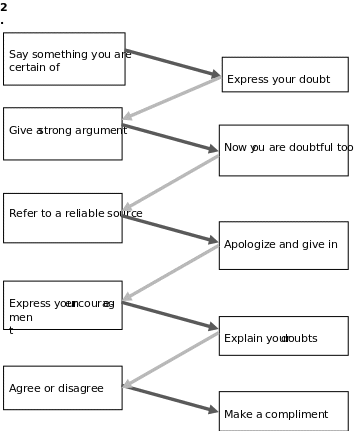
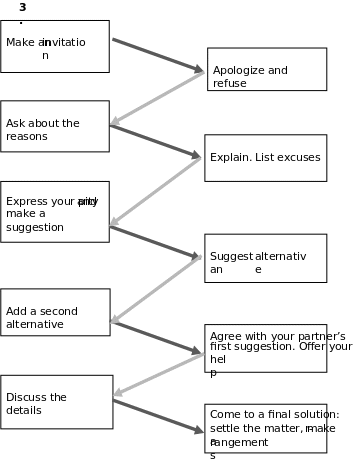
4.
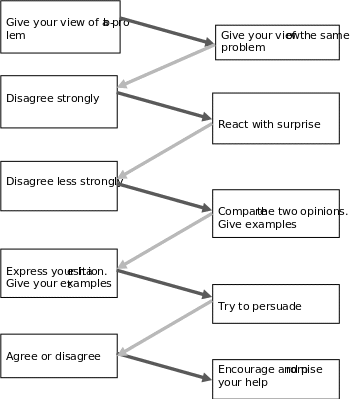

6.
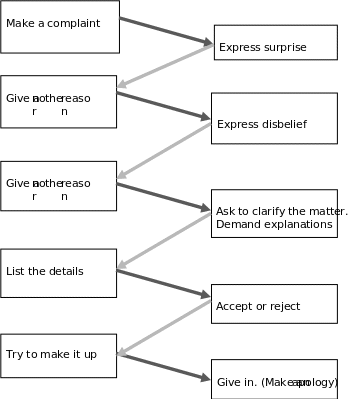
Part IV POSSIBLE SITUATIONS FOR DIALOGUES
Act out the following situations according to the compositional schemes in Part III
HomeTell your partner about the problems connected with decorating your flat.
You are sure to hire professionals is better than to decorate the flat yourself.
Invite your friend to your house-warming party.
You think that renting a flat is better than living in the hostel.
Your landlord asks you to leave the flat in two weeks.
Make a complaint to the manager of the furniture shop about the new bed (wall-unit, suite, sofa, etc.) you have recently bought.
Your problem is lack of movement. Tell your partner about it.
You are certain of the importance of sports in everybody’s life.
Invite your friend to join the gym with you.
Give your view of the problem concerning putting on weight.
You’ve caught a cold and won’t be able to go to the pool with your friend 6. Complain about your partner’s often being late.
You can’t decide what to cook for your birthday party.
You are certain of the importance of dieting.
Invite your friend to a café.
Express your view of the problem concerning lack of time for cooking.
Give a piece of bad news: your faculty canteen closes for uncertain period.
Complain about the food in the faculty canteen.
You’ve got a problem. You lagged behind the group while you were on a sick-leave. Tell your partner about it.
You are sure the best way to learn English is to go to an English-speaking country.
Invite your friend to join the university amateur theatre club with you.
Give your view of the problem concerning lack of communication with native speakers.
Give a piece of bad news: there are some changes in the curriculum. Now you’ll have to study on Saturday.
Complain to your parents about being given a lot of homework.
You can’t afford the clothes you want.
You are certain that on-line shopping is the best way to buy clothing.
Invite your friend to go shopping with you.
Express your opinion about spending a lot of money on skin-care, make-up and plastic surgery.
Give a piece of bad news: since now you are not allowed to wear jeans at university.
Make a complaint to the sales manager that the new jeans you’ve bought in their department have shrunk after washing and are too tight now.
Your problem is that you have only been in the city for a few months and don’t know where everything is.
You are certain that country life is better than city life.
Your foreign friend is coming to Chelyabinsk on business. Invite him/her to stay at your place.
Express your opinion about the environment pollution. You think that factories and plants are the worst evil and should be taken outside the city area.
Give a piece of bad news: the public transport fare has been raised again.
Complain about the difficulties of commuting / getting about the city.
You prefer a beach holiday but your parents always take you on sightseeing tours. Share your problem with a friend of yours.
You are certain that travelling abroad is worth the enormous amount of money people spend on it.
Invite your friend to go to the country at the weekend.
Express your opinion about finding a temporary job for the summer.
Give a piece of bad news: according to the forecast the weather will change for the worse at the weekend.
Complain about the climate in the South Urals.
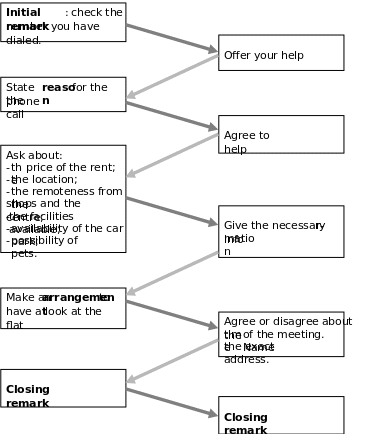
Part V SAMPLE DIALODUES 1. Talk to the flat owner. Find out the details about the flat you want to rent
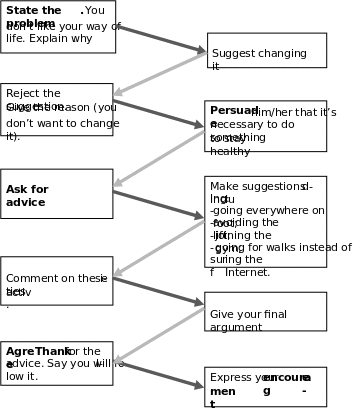
2. Persuade your friend to change his/her way of life to make it healthier
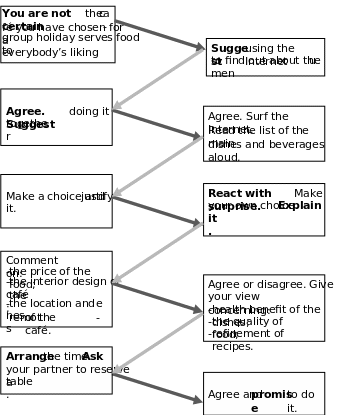
You and your group mates want to celebrate a holiday in a café. Choose the food to your liking.
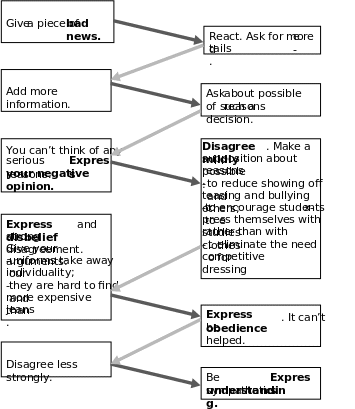
You have been informed that all the students of the faculty have to wear uniforms.
5. You want to buy some new things for the summer. Discuss with your friend where to go (a big shopping mall, a boutique, a discount centre, a market, a second hand shop, etc.)
Invite your classmate to visit you. Explain how to get to your place.
Look at some travel agencies advertisements and choose tours to your liking.
Part VI POSSIBLE COMPOSITIONAL SCHEMES FOR MONOLOGUES I. Description
Introduction (place and time)
General impression / description
What you like /liked about the object
What you dislike /disliked about it
Conclusion
II. Narration
Introduction (time and place)
Succession of actions
Conclusion (attitudes, feelings and emotions)
III. Opinion
Introduction (stating the problem)
Opinion
2-3 arguments (+/– examples)
Conclusion
IV. For and Against
1. Introduction (state the problem) 2. Arguments “for” (+/– examples)
Arguments “against” (+/–examples)
Conclusion based on given arguments / opinion
V. Comparison
Version 1Introduction (state the problem)
Arguments “for” and “against” for object 1
Arguments “for” and “against” for object 2
Conclusion (opinion / preference)
Version 2
Introduction (state the problem)
Similarities
Differences
Conclusion (opinion /preference)
Вебинар для учителей

🎓 Свидетельство об участии ✨БЕСПЛАТНО!✨



