Россия, Вад


СДЕЛАЙТЕ СВОИ УРОКИ ЕЩЁ ЭФФЕКТИВНЕЕ, А ЖИЗНЬ СВОБОДНЕЕ
Благодаря готовым учебным материалам для работы в классе и дистанционно
Скидки до 50 % на комплекты
только до
Готовые ключевые этапы урока всегда будут у вас под рукой
Организационный момент
Проверка знаний
Объяснение материала
Закрепление изученного
Итоги урока

Была в сети 23.02.2026 14:02
Андреева Галина Николаевна
Преподаватель английского языка
 451
 117 468

Местоположение
Специализация
НОУ Diffusion of Languages
Категория:
Английский язык
28.10.2020 18:13

Просмотр содержимого документа
«НОУ Diffusion of Languages»

Diffusion of Languages
Prepared by : Lihatskaya Mary, grade 11A
Scientific Coordinator: Galina Andreeva,
High Qualification English Teacher
Nizhny Novgorod
201 7


Nowadays we widely use foreign words in different areas
Sport
Серфинг, армрестлинг, фристайл.
Politics
Премьер-министр, парламент, мэр.
Tourism
Тур, гид, экскурсия, сервис.
Culture
Мемуары, реконструкция, декорировать.
Modern slang
Триллер, лузер, диск-жокей
Science
Эластичный, аналогичный, перманентный.

Targets
- To determine a root of the word ОК
- To suggest a word that will be used as often as the word OK in the near future

Tasks
- To study the information about loanwords ;
- to present the historical review of the anglicisms
- To classify the data received ;
- To determine a unified meaning of word «О K »;
- To examine existing theories of origin/adoption of this word ;
- To select and justify the most appropriate theory origin of the work « OK »


According to the Russian language text book , loanwords are the words adopted from foreign languages and incorporated into Russian language.

Reasons for adoption of words
- Close political, trade and economic ties;
- Use loanwords to name some special things;
- Influence of foreign cultures and fashion;
- Desire to make Russian language more modern

Loanwords update the language :
- Enhance language richness ;
- Serve as a source of new roots and terms ;
- Russian language becomes more modern ;
- Using loanwords, we better understand foreigners .

Many scientists also find disadvantages :
- We forget our « great and mighty » Russian language ;
- Though people are aware of Russian synonyms, they use loanwords ;
- Reluctant to make the text more understandable to a listener

Anglicisms and theirs types.
- An English word or expression that is used in another language called an Anglicism.
- 1. Phonetic borrowings
- 2. Hybrids
- 3. Direct loans
- 4. Exotic words
- 5. Compounds

An experiment.
Modern slang
Wow, Ok, Super
Tourism
Gide, Excursion, Visa
Culture
Gallery, Portrait, Museum
Politics
Default, President, Crisis
Science
Collider, Admittance, Pragmatics


Americans believe that the most popular in the world expression « OK » is truly American

Alan Walker Read
Suggested 12 versions of «Ок» origin
- Orrin kendall
- Open key
- Old Kinderhook
- All correct= oll korrect
- O ll korrekt

"oken" = affirmative answer to a question
- "oken" = affirmative answer to a question

ОК = Oberst Kommandant
( Supreme Command )
‘ OK’ is an abbreviation for Oberst Kommandant (the German for Colonel-in-Command)and was used by Baron Von Steuben, an American General in the Revolutionary War

«ОК» - derives from the name of the Haitian town Aux Cayes
Coat of arms
of Haiti

German version
«ohne korrektur»
(german)
=
« no correction »

French version
«0 killed » = « zero killed »

«O.K.»
( from Greek «OLA KALA )
=
« everything is all right »

Flag of Oklahoma

Martin Van Buren
In 1840 OK was used as the initials of Old Kinderhook, alias Martin Van Buren, the eighth President of the United States. During the campaign of his invalid re-election his supporters wrote: "Vote for OK."
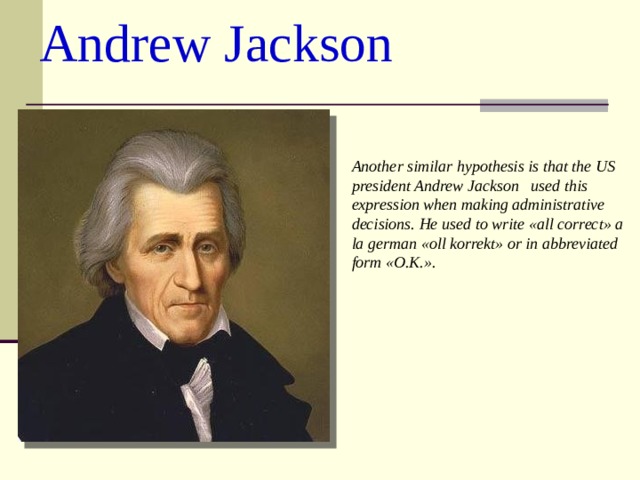
Andrew Jackson
Another similar hypothesis is that the US president Andrew Jackson used this expression when making administrative decisions. He used to write «all correct» a la german «oll korrekt» or in abbreviated form «O.K.».

OK
Lexical meaning
OKEN
« approve »
« good »
Phonetic form
Expression of consent
[əu’kei]
Visual form
[‘əukən]
( presumable pronunciation )
ok
oken



Вебинар для учителей
🎓 Свидетельство об участии ✨БЕСПЛАТНО!✨