


Казахстан, Зыряновск


СДЕЛАЙТЕ СВОИ УРОКИ ЕЩЁ ЭФФЕКТИВНЕЕ, А ЖИЗНЬ СВОБОДНЕЕ
Благодаря готовым учебным материалам для работы в классе и дистанционно
Скидки до 50 % на комплекты
только до
Готовые ключевые этапы урока всегда будут у вас под рукой
Организационный момент
Проверка знаний
Объяснение материала
Закрепление изученного
Итоги урока

Была в сети 13.05.2026 11:13

Семизбаева Валентина Нуркановна
учитель английского языка
 1 790
 40 875

Местоположение
Специализация
Natural disasters short-term plan
Категория:
Английский язык
07.06.2019 20:35

Просмотр содержимого документа
«Natural disasters short-term plan»
| 7.3C Natural Disasters Term 3 Unit 3 | School: Mayak Secondary School | |||||
| Date: 04.03.2017 | Teacher’s name: Semizbayeva V.N.
| |||||
| Grade 7 | Number present: | Number absent: | ||||
| Theme of the lesson: | Vocabulary “Natural Disasters in Kazakhstan”. | |||||
| Learning objectives(s) that this lesson is contributing to | 7.C2 use speaking and listening skills to provide sensitive feedback to peers 7.C6 organise and present information clearly to others 7.R2 understand specific information and detail in texts on a range of familiar general and curricular topics | |||||
| Lesson objectives | All learners will be able to: | |||||
| ||||||
| Most learners will be able to: | ||||||
| ||||||
| Some learners will be able to: | ||||||
| ||||||
| Language objective | Topical vocabulary: lightning, volcanic eruption, flood, avalanche, hurricane, drought, explosion, landslide, tornado, earthquake, forest fire, tsunami Grammar: Present and Past Simple Passive Voice forms | |||||
| Value links | Transparency: Teacher and learners assess each other, justify their assessment and give feedback; students are free to express their opinions. Academic honesty and transparency: Students independently carry out individual tasks. | |||||
| Cross curricular links | Geography and Social Studies | |||||
| Previous learning | Learners will be familiar with some of the vocabulary associated with natural disasters. Learners may have some knowledge of the associated problems, but they are not expected to have a thorough knowledge. | |||||
| Use of ICT | Projector or Smart board for showing a presentation | |||||
| Intercultural awareness | Perception of different global problems, such as natural disasters, in their own country and around the world | |||||
| Kazakh culture | Think about the weather and natural disasters in Kazakhstan | |||||
| Pastoral Care | Student centered teaching: respect, support and scaffolding; Promote a sense of responsibility, careful attitude and respect for others among all the learners. | |||||
| Health and Safety | Everyday classroom precautions will ensure that safety measures are provided to prevent the exposure of electrical power cords. | |||||
| Planned stages time | Planned activities | Resources | ||||
|
5 minutes
| Warmer: Disaster Dictation: (I) Instructions: Tell your learners you are going to describe a scene that you would like them to draw. “Draw three houses on the right in the middle. Each house has four windows and a door. On the roof of one of the houses there are two people and a dog. Draw two trees on the left in the middle. At the top of the picture draw some clouds and a lightning. The clouds look grey and it’s raining a lot. In the sky there is a helicopter. Around the houses there is water. The water touches the top windows of the house….” (W I) Ask students to look at their pictures. Ask them what they think has happened in the scene? Answers may be the following: flood, hurricane, etc. Ask them about other natural disasters they know. Learners are informed about the lesson objectives. |
PPP, Slide 1-2 | ||||
| Main part 5 min.
| The main part of the lesson Vocabulary Practice. Matching: (I) Learners are offered to practise topical vocabulary, so they do a matching exercise, given on the work-sheet. Differentiation: The task may be differentiated in accordance with learners’ language proficiency: less-experienced learners match words with the pictures (task 1), more-able learners read the information about the disasters and write their names on the lines (task 2). Peer-assessment: Learners are encouraged to exchange their work-sheets and evaluate each other. Teacher should have enough “keys” to give one to each student Keys: Task 1: 1) hurricane, 2) tsunami, 3) explosion, 4) flood, 5) volcanic eruption, 6) drought, 7) earthquake, 8) landslide, 9) lightning, 10) tornado, 11) avalanche, 12) forest fire Task 2: 1) avalanche, 2) flood, 3) volcanic eruption, 4) tsunami, 5) tornado, 6) forest fire, 7) earthquake, 8) drought What natural disasters could happen in your region / area? |
Appendix 1 Work-sheet “Vocabulary”
PPP, Slide 3-4
| ||||
| 20 min. 3 6 3 8 | Reading Pre-reading task. Now we shall read the text. What is this text about you will say me when you watch a video. What is this video about? Where it was? How many people were evacuated? Can you tell me what our text will be about. (Disaster in Kazakhstan). Learners are given two short texts about other disasters in Kazakhstan. Look at the text and tell me what kind of disasters you will read? While-reading task Learners analyze the information together and fill in the table. Then groups compare information in their tables. Warm-up “pass the beat around the room” Post-reading Learners show their understanding by matching disasters and dates with their description. This work is done in writing. Assessment Learners submit their papers. Learners will achieve their learning objective if they can match 3 out of 4 disasters and their descriptions. |
Video “mudslide in Almaty”
Appendix 2
Appendix 3
Appendix 4
| ||||
| 6 | Home task T: You have some instructions which are mixed up. I’d like you to be divided into 3 groups. The 1’st group will find things to do when a hurricane comes, the 2’nd – for fire, the 3’rd – for earthquake. Try to find all the things and put them in the right order. | Appendix 5 Formative Reading Worksheet
| ||||
| 4 min. | Reflection.
Feedback The teacher puts three pictures on the walls around the classroom: the suit case (all information will use in the future), meat grinder (information is interesting but I still should work with it ), the trash (the information unnecessary) The learners write their names on the colour sticky papers and place their stickers on the appropriate picture, expressing spiritual, emotional state
|
| ||||
| End 1min | Feedback: Teacher asks students what task was difficult to them and which pair worked well. |
| ||||
|
Additional information | ||||||
| Differentiation – how do you plan to give more support? How do you plan to challenge the more able learners?
| Assessment – how are you planning to check learners’ learning? | Critical thinking
| ||||
| More support:
Do more complicated tasks . | We use peer-assessment for vocabulary exercises and peer, self-assessment for reading. | Some questions provide critical thinking while answering to them. | ||||
| Summary evaluation What two things went really well (consider both teaching and learning)? 1: 2: What two things would have improved the lesson (consider both teaching and learning)? 1: 2: What have I learned from the lesson about this class or individuals that will inform my next lesson? | ||||||
Appendix 1
Appendix 1
Vocabulary
Task 1
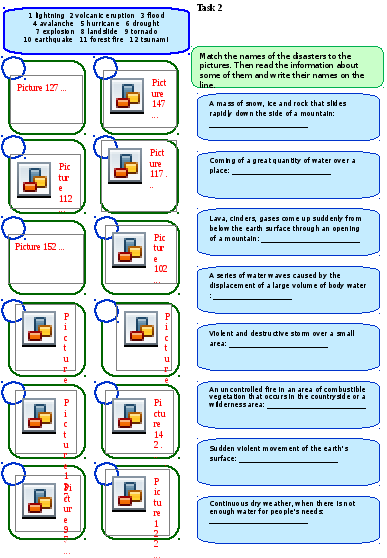
Appendix 2
| Task |
| Read the text Recent major disasters and response activities (easier) In May 2003, the Zhambyl region was hit by an earthquake with a magnitude of 5.4 on the Richter scale. The earthquake affected 43,300 people and destroyed many buildings. The local administration and people were not ready for this disaster. Flooding in east Kazakhstan in May 2001 lasted for more than one month, affecting 4,500 people and damaging roads and buildings in the east Kazakhstan and Semipalatinsk region. The National Society of Kazakhstan supported flood victims with food, bedding and other very important things.
|
Magnitude - магнитуда
Richter scale – шкала Рихтера
local administration – местная администрация
Affect - повлияли
Destroyed - разрушили
Damaging - разрушая
Supported – поддержало
Victims - жертвы
Appendix 3
| When did it happened? | Where did it happened? | What happened? | How many people affected? |
|
|
|
|
|
|
|
|
|
|
Descriptor:
8-7 - Excellent! You understand the text.
6- 4 Good job! But check some information once more.
3 – read the text once more carefully.
Appendix 4
| Key Learning objectives | Success criteria |
| 7.R2 understand specific information and detail in texts on a range of familiar general and curricular topics | Students achieved the LO if they were able to match 3 out of 4 disasters and their descriptions.
|
Match the events and their description
| Event | Description |
| 1. Floods in 2001 | It lasted for more than one month. |
| More than 13,000 people lost their homes | |
| Ten lives were lost. | |
| The local administration and people were not ready for this disaster. | |
| 2. Earthquake in 2003 | It damaged roads and buildings in the east Kazakhstan and Semipalatinsk region. |
| It affected 43,300 people and destroyed many buildings. |
Descriptor:
3-4 you achieved Language objective
2 – read this text once more at home
Appendix 5
Switch on TV or radio and listen to the information.
Prepare some food, water, medicine and other necessary things.
Fix the furniture, put heavy things on the floor.
Find the safe place in a building (near the main walls, in the corners)
Switch off gas, water, electricity.
If you are outside, find a pit, a ditch, or a ravine far from buildings.
Take your passport, some necessary things and go to the definite place.
Keep away damaged buildings.
If possible, bring in outdoor furniture and move essential items to an upper floor.
Be prepared! Pack a bag with important items in case you need to evacuate. Don't forget to include needed medications.
If advised to evacuate your home, do so immediately.
КГУ «Маякская средняя школа»
Урок английского языка
Тема:
“Natural Disasters in Kazakhstan”
7 класс
учитель: Семизбаева В.Н.
2018-2019 учебный год

Вебинар для учителей

🎓 Свидетельство об участии ✨БЕСПЛАТНО!✨



