

Казахстан, Баканас


СДЕЛАЙТЕ СВОИ УРОКИ ЕЩЁ ЭФФЕКТИВНЕЕ, А ЖИЗНЬ СВОБОДНЕЕ
Благодаря готовым учебным материалам для работы в классе и дистанционно
Скидки до 50 % на комплекты
только до
Готовые ключевые этапы урока всегда будут у вас под рукой
Организационный момент
Проверка знаний
Объяснение материала
Закрепление изученного
Итоги урока

Была в сети 14.05.2021 09:08

Досымбаева Гулзира Мейрамбекқызы
учитель английского языка
 811
 80 127

Местоположение
Специализация
Natural Disasters
Категория:
Английский язык
07.12.2019 13:01

Просмотр содержимого документа
«Natural Disasters»
Open lesson plan
| 7.3C Natural Disasters Term 3 Unit7 | School: 149 | |||||
| Date: 22.02.2018 | Teacher’s name: Dossmbayeva Gulzira
| |||||
| Grade 7 __ | Number present: | Number absent: | ||||
| Theme of the lesson: | Natural Disasters
| |||||
| Learning objectives(s) that this lesson is contributing to | 7.C8 develop intercultural awareness through reading and discussionn. 7.R2 understand specific information and detail in texts on a range of familiar general and curricular topics. 7.R5 deduce meaning from context in short texts on a growing range of familiar general and curricular topics. 7.S8 recount some extended stories and events on a growing range of general and curricular topics. | |||||
| Lesson objectives | All learners will be able to: | |||||
| Practice topical vocabulary through such activities as matching and drawing dictation; Read the text and find the words according to the definitions; | ||||||
| Most learners will be able to: | ||||||
| Read the text and give full and grammatically correct answers to the questions; | ||||||
| Some learners will be able to: | ||||||
| Provide unprepared speech to answer a variety of questions at sentence level and in conversations with some flexibility; | ||||||
| Language objective | Topical vocabulary: lightning, volcanic eruption, flood, avalanche, hurricane, drought, explosion, landslide, tornado, earthquake, forest fire, tsunami Grammar: Present and Past Simple Passive Voice forms | |||||
| Value links | Transparency: Teacher and learners assess each other, justify their assessment and give feedback; students are free to express their opinions. Academic honesty and transparency: Students independently carry out individual tasks. | |||||
| Cross curricular links | Geography and Social Studies | |||||
| Previous learning | Learners may have some knowledge of the associated problems, but they are not expected to have a thorough knowledge. | |||||
| Use of ICT | Projector or Smart board for showing a presentation | |||||
| Intercultural awareness | Perception of different global problems, such as natural disasters, in their own country and around the world | |||||
| Kazakh culture | Think about the weather and natural disasters in Kazakhstan | |||||
| Pastoral Care | Student centered teaching: respect, support and scaffolding; Promote a sense of responsibility, careful attitude and respect for others among all the learners. | |||||
| Health and Safety | Everyday classroom precautions will ensure that safety measures are provided to prevent the exposure of electrical power cords. | |||||
| Planned timings | Planned activities | Resources | ||||
| 2 minutes 1 minute 5 minutes | Greeting: Good morning, students! As you see, today we have some guests in our lesson! Let`s greet them! How are you today? Now we will play the game “snow ball” I will ask questions, who get the ball he\she must answer the question! OK! Good job!
Dividing into groups Now, I`ll divide you into two groups! Here in the board you can see some sticks, you must chose one of them! Then if you see under the stick number 1 you are in the group 1, if it`s 2 we are in the group 2! Is it clear for you! Ok, let`s go!
Warmer: Now, please, listen to me carefully! For each group I’ll give papers and I read you dictation and you must draw picture. This task called drawing dictation. OK, let`s start! Each group will draw your own pictrure! “Draw three houses on the right in the middle. Each house has four windows and a door. On the roof of one of the houses there are two people and a dog. Draw two trees on the left in the middle. At the top of the picture draw some clouds and a lightning. The clouds look grey and it’s raining a lot. In the sky there is a helicopter. Around the houses there is water. The water touches the top windows of the house….” Have you done it? OK, look at your pictures! What can you see? Could you tell us what is happening in the picture? What do you think about when you see your pictures? Let`s speak! Can guess that, what about we will talk in our lesson for today? Yes, you are right! Today we will talk about Natural Disasters! It`s very awful to think about it! Learners are informed about the lesson objectives. |
Sticks
PPP, slide 2 | ||||
| Main part 5 minutes
| The main part of the lesson Vocabulary. Lead-in: Let`s get to know new words Ok, students, now we will learn new words which are connected with the theme! First we do choral drill after that we will do individual drill! Drought /draʊt/ flood earthslide Hurricane /hʌrɪk(ə)n Lightning /lʌɪtnɪŋ/ Tornado /tɔneɪdəʊ/ Volcanic eruption |
PPP, Slide 3-4
| ||||
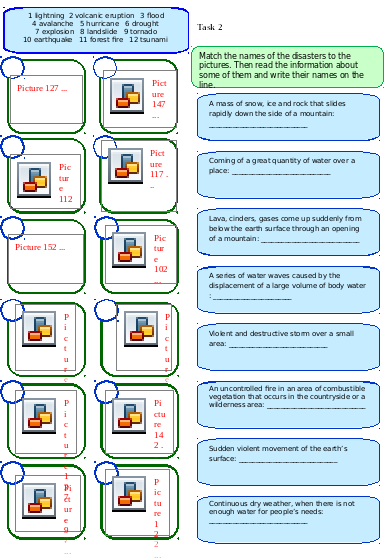
| 5 minutes | Task 1. Vocabulary matching. Did you learn all new words? Are you sure? Ok, let1s check your knowledge! Now i`ll give you some cards! It`s individual work! Each of you have cards, in the cards you can see pictures, you must put number for the picture, write names under the definitions on the lines! \ (I) Learners are offered to practise topical vocabulary, so they do a matching exercise, given on the work-sheet. Differentiation: The task may be differentiated in accordance with learners’ language proficiency: less-experienced learners match words with the pictures (task 1), more-able learners read the information about the disasters and write their names on the lines (task 2). Peer-assessment: Learners are encouraged to exchange their work-sheets and evaluate each other. Teacher should have enough “keys” to give one to each student Keys: Task 1: 1) hurricane, 2) tsunami, 3) explosion, 4) flood, 5) volcanic eruption, 6) drought, 7) earthquake, 8) landslide, 9) lightning, 10) tornado, 11) avalanche, 12) forest fire Task 2: 1) avalanche, 2) flood, 3) volcanic eruption, 4) tsunami, 5) tornado, 6) forest fire, 7) earthquake, 8) drought |
Appendix 1 Work-sheet “Vocabulary”
| ||||
| 10 minutes
(7+3)
5 minutes | Formative Reading. The article about Hurricane Sandy (I) Learners are given the article about Hurricane Sandy. They should read the text and do the tasks given on the worksheets. The text: Hundreds of people, living on America’s east coast, were made homeless and at least 62 people were killed by Hurricane Sandy. Thousands of homes were destroyed and left without electricity. Subways and tunnels in New York City were flooded by the water of the superstorm. Schools were closed as the hurricane brought the season’s first snow. Emergency shelters were built and hot meals were given to the people by the American Red Cross. Politicians say that the topic climate change was brought back by this Hurricane. President Barack Obama was impressed by thousands of volunteers who helped where they could. Differentiation: Less-able learners do Level 1. More-able learners have an extra task (to give full and grammatically correct answers to the given questions) – Level 2. Self-assessment: Learners evaluate their own progress comparing their answers with the keys. Keys: Level 1 Homeless Electricity Subway Superstorm Emergency shelter Climate change Volunteer It should be mentioned that Level 2 Task B is assessed by the teacher and the answers are discussed individually with each student. To get achieved – 6 points for Level 1, 11 points for Level 2 Concept checking Let`s to know what did you lean from today`s lesson! Play the the game called football! Here you can see two person this is first group, and it`s second group! This is as competition that`s why try to answer the questions correctly and fast. Also I have question from pervious lessons! |
Appendix 2 Formative Reading Worksheet
| ||||
|
5 minutes | End of the lesson Giving home task Your home task will be ex2 reading task. Feedback Lets gave me your feedback for today`s lesson! I`ll give you this kind of hands you must write for each finger your answers. In the board you can see the questions! I`ll evaluate you giving medals Gold-excellent! Silver - good! Bronze – satisfactory Our lesson is over! You are free, good bye! |
| ||||
| End 1min | Feedback: Teacher asks students what task was difficult to them and which pair worked well. |
| ||||
|
Additional information | ||||||
| Differentiation – how do you plan to give more support? How do you plan to challenge the more able learners?
| Assessment – how are you planning to check learners’ learning? | Critical thinking
| ||||
| More support: Provide less able learners with easier tasks (vocabulary and reading) More able learners: Do more complicated tasks and provide full, grammatically correct answers to all questions. | We use peer-assessment for vocabulary exercises and self-assessment for reading. | Some questions provide critical thinking while answering to them. | ||||
| Summary evaluation What two things went really well (consider both teaching and learning)? 1: 2: What two things would have improved the lesson (consider both teaching and learning)? 1: 2: What have I learned from the lesson about this class or individuals that will inform my next lesson? | ||||||


Formative Assessment
Reading
Level 1
| Unit | Natural Disasters |
| Learning Objectives | 7.R5 deduce meaning from context in short texts on a growing range of familiar general and curricular topics 7.R2 understand specific information and detail in texts on a range of familiar general and curricular topics |
| Level of thinking skills | Comprehension Application Analysis |
| Assessment criteria | Find the words according to their definitions |
| Task A Find out the words that are described in the text. people who do not have a home to live in ………………………………………….. a source of power that makes e.g. a computer work ………………………………. public transportation which is under the ground ……………………………………. an extremely strong wind plus bad weather …………………………………………. an organization that helps people ………………………………………………….. long-term change of weather conditions …………………………………………….. someone who works/helps and does not want money for it ………………………….. | |
| Descriptor | A learner |
|
| comprehends the task and finds the words; |
Formative Assessment
Reading
Level 2
| Unit | Natural Disasters |
| Learning Objectives | 7.R5 deduce meaning from context in short texts on a growing range of familiar general and curricular topics 7.R2 understand specific information and detail in texts on a range of familiar general and curricular topics |
| Level of thinking skills | Comprehension Application Analysis |
| Assessment criteria | Find the words according to their definitions Give full and grammatically correct answers to the questions |
| Task A Find out the words that are described in the text. people who do not have a home to live in ………………………………………….. a source of power that makes e.g. a computer work ………………………………. public transportation which is under the ground ……………………………………. an extremely strong wind plus bad weather …………………………………………. an organization that helps people ………………………………………………….. long-term change of weather conditions …………………………………………….. someone who works/helps and does not want money for it ………………………... Task B 1) What happened to the people of America’s east coast? ___________________________________________________________________________ 2) What happened to their homes? ___________________________________________________________________________ 3) What happened to the subways and the tunnels in New York City? ___________________________________________________________________________ 4) Why were the children not at school? ___________________________________________________________________________ 5) What was built? ___________________________________________________________________________ 6) Which important topic was brought back into people’s minds? ___________________________________________________________________________ 7) What was the President of the United States impressed by? ___________________________________________________________________________ | |
| Descriptor | A learner |
|
| comprehends the task and finds the words; |
| answers the questions properly. | |

Вебинар для учителей

🎓 Свидетельство об участии ✨БЕСПЛАТНО!✨



