

Россия, Москва


СДЕЛАЙТЕ СВОИ УРОКИ ЕЩЁ ЭФФЕКТИВНЕЕ, А ЖИЗНЬ СВОБОДНЕЕ
Благодаря готовым учебным материалам для работы в классе и дистанционно
Скидки до 50 % на комплекты
только до
Готовые ключевые этапы урока всегда будут у вас под рукой
Организационный момент
Проверка знаний
Объяснение материала
Закрепление изученного
Итоги урока

Была в сети 08.09.2026 22:02

Чернявская Екатерина Юрьевна
Учитель
 81
 235 436

Местоположение
Специализация
Modal verbs can/could/be able to
Категория:
Английский язык
08.09.2026 21:56

Просмотр содержимого документа
«Modal verbs can/could/be able to»
Методическая система
Modal verbs
1.Основные элементы методической системы.
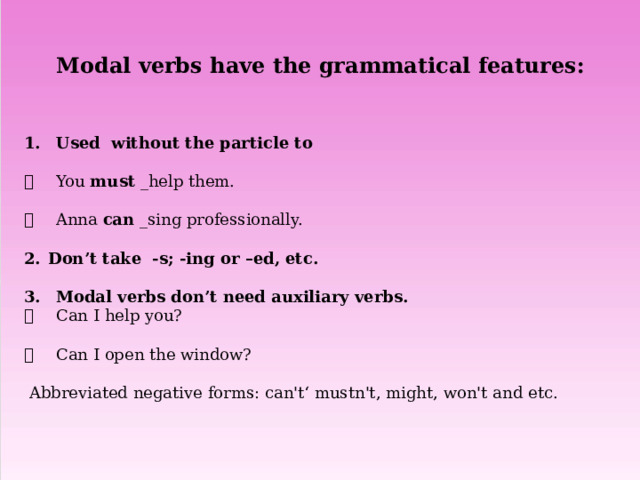
Modal verbs have the grammatical features:
Методическая система преподавателя состоит
1. Used without the particle to
You must _help them.
Anna can _sing professionally.
- Don’t take -s; -ing or –ed, etc.
3. Modal verbs don’t need auxiliary verbs.
Can I help you?
Can I open the window?
Abbreviated negative forms: can't‘ mustn't, might, won't and etc.

Can .
We use can+ infinitive :
We can see the lake from our hotel.
Declarative sentences ( affirmative ):
They can ride a bike. (subject + can+ notional verb+ various secondary elements)
Declarative sentences ( nеgative ):
They can’t ride a bike. (subject + can+ NOT+ notional verb+ various secondary elements)
Interrogative sentences:
Can you speak any foreign languages?
Wh-questions (special questions):
How can I help you? (Wh+ can+ subject+ notional verb+ various secondary elements)

To be able to
The equivalent of the verb can is be able to .
They are able to do the job faster than anyone else.
Can is used only in the present and past tense.
To be able to is more often used to express an action in the future , , but only in certain cases:
I am free today so I am able to cook a dinner for us.
Andrew was not able to take part in the race because his car was damaged.
My husband earned enough this year so we will be able t o go to the sea this summer.

Could/Was(Were) able to or managed to
COULD shows us that subject was able to do something in the past:
He could play the violin when he was twelve.
We use could especially with verbs of perception and thinking:
We had a lovely room in the hotel. We could see the lake.
As soon as l walked into the room, I could smell gas.
Could you hear that?
When we are talking about a specific situation or when nothing a specific achievement, we use was/were able to or managed to . Their meanings are very close.
The fire spread through the building very quickly, but fortunately everybody was able to escape/ managed to escape . ( not could escape)
We didn’t know where David was, but we managed to find/ were able to find him in the end. (not could find).


Вебинар для учителей

🎓 Свидетельство об участии ✨БЕСПЛАТНО!✨



