

Россия, Москва


СДЕЛАЙТЕ СВОИ УРОКИ ЕЩЁ ЭФФЕКТИВНЕЕ, А ЖИЗНЬ СВОБОДНЕЕ
Благодаря готовым учебным материалам для работы в классе и дистанционно
Скидки до 50 % на комплекты
только до
Готовые ключевые этапы урока всегда будут у вас под рукой
Организационный момент
Проверка знаний
Объяснение материала
Закрепление изученного
Итоги урока

Была в сети 08.09.2026 22:02

Чернявская Екатерина Юрьевна
Учитель
 81
 235 436

Местоположение
Специализация
"Modal verb may"
Категория:
Английский язык
06.09.2026 01:26

Просмотр содержимого документа
«"Modal verb may"»

May/might
Can/ could
Must
Have to
Be allowed to
Be able to

Can/Can’t
Методическая система
May/Might
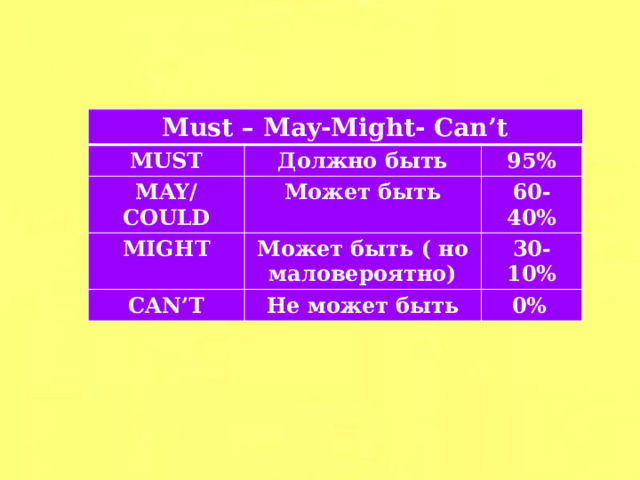
Must – May-Might- Can’t
MUST
Должно быть
MAY/COULD
Может быть
95%
MIGHT
60-40%
Может быть ( но маловероятно)
CAN’T
Не может быть
30-10%
0%

Sign the conversational situations.

1.Основные элементы методической системы.
May
- formal
- polite
- respectful
e.g A student asks his friend, “Steve, can I borrow your book?”
A student asks his teacher, “Professor, may I borrow your book?”
Методическая система преподавателя состоит
Might
- very formal
- hesitant
- tentative
How much did you pay for this house if may ask/ if I might ask?

Give permission (may)
He is in the room. You may see him.
Johnny may stay up late.
Refusing permission (may not)
Candidates may not bring a calculator into the examination room.
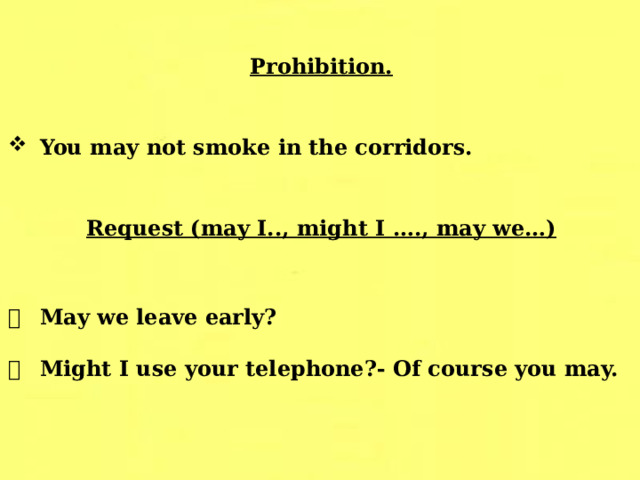
Prohibition.
- You may not smoke in the corridors.
Request (may I.., might I …., may we…)
May we leave early?
Might I use your telephone?- Of course you may.

Fill the gaps with must or may.
1) A: You … be careful when you cross the street.
B: I know, Mum.
2) A: What are you doing this evening?
B: I’m not sure. I … go to the cinema.
3) А: Are you busy?
B: Yes. I … finish this project tonight.
4) A: Can I go to John’s party, Dad?
B: You can but you … be home early.
5) A: Are you coming with us to the beach?
B: I … come but I don’t know yet.
6) A: We … have a barbecue next week.
B: Oh, that’s great! Call me when you know for sure.

Choose the correct answer
- Good morning. How can/ must I help you?
- Frank may/must be late this evening.
- I’m sorry. You can’t/couldn’t park here.
- Could/Must I sit here, please?
- May/Must I borrow your pen, please?
6. I must/ can’t go to the hospital. I feel ill.

Complete the sentences using might + the following:
bite
break
need
rain
slip
wake
- Take an umbrella with you when you go out. It ………. later.
2. Don’t make too much noise. You …… the baby.
3. Be careful of that dog. It ….. You.
- Don’t throw that latter away. We ….. It later.
- Be careful. The footpath is very icy. You …… .
- Don’t let the children play in this room. They …. something.

Write these sentences in a different way using might
- Perhaps Helen is in her office.
- Perhaps she is working.
- Perhaps she wants to be alone.
- Perhaps she doesn’t want to see me.
- Perhaps she isn’t working today.
Write sentences with might not
- I’m not sure that Liz will come to the party.
- I’m not sure that I’ll go out this evening.
- We might not be able to get tickets for the game .
- I’m not sure that Sam will be able to go out with us tonight.

Translate into English using the modal verbs must, may, might or can't.
- Они, должно быть, живут в Санкт-Петербурге.
- Они, может быть, живут в Санкт-Петербурге.
- Может быть, они и живут в Санкт-Петербурге (хотя едва ли).
- Не может быть, что они живут в Санкт-Петербурге.
- Они, должно быть, жили в Санкт-Петербурге.
- Они, может быть, жили в Санкт-Петербурге.
- Может быть, они и жили в Санкт-Петербурге (хотя едва ли).
- Не может быть, что они жили в Санкт-Петербурге.
- Не может быть, что он на работе.
- Он, должно быть, был на работе.
- Он, может быть, на работе.
- Он, может быть, был на работе.
- Может быть, он и на работе (хотя едва ли).
- Может быть, он и был на работе (хотя едва ли).

Change the highlighted words with a modal verb .
- Kate is able to use the computer.
- You are forbidden to eat or drink in class.
- You are obliged to tidy your room at the weekend.
4. There’s a possibility it will snow tonight.
Вебинар для учителей

🎓 Свидетельство об участии ✨БЕСПЛАТНО!✨



