Россия, р.п. Красные Баки


СДЕЛАЙТЕ СВОИ УРОКИ ЕЩЁ ЭФФЕКТИВНЕЕ, А ЖИЗНЬ СВОБОДНЕЕ
Благодаря готовым учебным материалам для работы в классе и дистанционно
Скидки до 50 % на комплекты
только до
Готовые ключевые этапы урока всегда будут у вас под рукой
Организационный момент
Проверка знаний
Объяснение материала
Закрепление изученного
Итоги урока

Была в сети 31.10.2026 19:58

Воронина Марина Владимировна
преподаватель английского и немецкого языка, преподаватель информатики
 91 619
 192

Местоположение
Специализация
Методические указания по английскому языку для III курса «Инструменты и меры безопасности при проведении ремонтных работ на автомобильном транспорте"
Категория:
Английский язык
10.01.2021 19:41

Просмотр содержимого документа
«Методические указания по английскому языку для III курса «Инструменты и меры безопасности при проведении ремонтных работ на автомобильном транспорте"»
ДЕПАРТАМЕНТ ЛЕСНОГО ХОЗЯЙСТВА НИЖЕГОРОДСКОЙ ОБЛАСТИ
Государственное бюджетное профессиональное
образовательное учреждение Нижегородской области
«КРАСНОБАКОВСКИЙ ЛЕСНОЙ КОЛЛЕДЖ»
МЕТОДИЧЕСКИЕ УКАЗАНИЯ
по дисциплине «Иностранный язык
в профессиональной деятельности (Английский язык)»
для студентов III курса
Инструменты и меры безопасности
при проведении ремонтных работ на автомобильном транспорте
для специальности 23.02.07 «Техническое обслуживание
и ремонт двигателей, систем и агрегатов автомобилей»

| РАССМОТРЕНО: на заседании предметно-цикловой комиссии общеобразовательных дисциплин ПРОТОКОЛ № от « » ___________ 2021г. Председатель ПЦК Поспелова Т.В. | Составила: преподаватель иностранных языков Воронина М.В.
|
Красные Баки
2021
Lesson 1
INSTRUMENTS AND MATERIALS
Exercise 1. Match the words on the left with their transcription on the right. Learn to read them correctly. Do you know their Russian equivalents? If not, consult the dictionary.
| pincers saw spanner drill chisel hammer screwdriver pliers | [drIl] ['hæmə(r)] ['pInsəz] [sL] ['skru:draIvə(r)] ['plaIəz] ['t∫Iz(ə)l] ['spænə(r)] |
Exercise 2. Make verbs corresponding to the adjectives.
Example: dark – darken
tight – ..., thick – …, loose – …, wide – …, light – …, deep – …
Exercise 3. Explain the function of the tools (b) the way it is shown in the example. Use
the expressions below (a).
Example: Pincers are for pulling out nails.
a) grip things / cut metal pipes / tighten and loosen nuts / cut wooden planks / tighten and loosen screws / drive in nails / drill holes / pull out nails / cut holes in wood
b) pincers (клещи), hacksaw (ножовка), handsaw (пила), hammer (молоток),
spanner (гаечный ключ), screwdriver (отвертка), drill (сверло),
pliers (плоскогубцы), chisel (резец, долото)
Exercise 4. Read the text and fill in the table below with the information from the text.
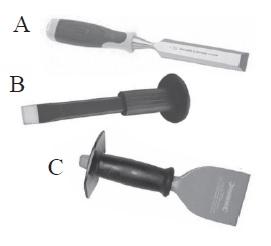
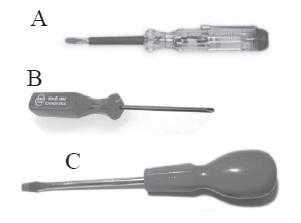 Here are three types of chisel. Chisel A is used for cutting soft materials, such as wood, and chisel В is used for cutting metal. Chisel С is for cutting away old plaster and brickwork.
Screwdriver A is for tightening and loosening screws on electrical equipment. В is for loosening very small crews and С is for loosening ordinary screws.
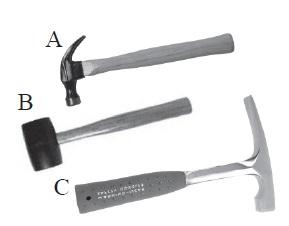 Hammer A is for hammering in nails and also for pulling nails out of wood. Hammer В is for breaking rocks and concrete. Hammer С is for breaking bricks.
| tool | job |
| a) Chisel A b) Chisel В c) Chisel С d) Screwdriver A e) Screwdriver B f) Screwdriver C | cuts soft materials … … … … … |
Exercise 5. Match а–i with 1–9:
| a) combustible b) soft c) brittle d) hard e) rigid f) light g) tough h) flexible i) heavy | 1) легкий 2) гибкий 3) мягкий 4) жесткий, негнущийся 5) твердый, прочный 6) хрупкий, ломкий 7) тяжелый 8) жесткий, прочный 9) горючий |
Exercise 6. Answer these questions and give reasons. Use the words in brackets.
Example: Is wood a good material for making car engines (двигателей)?
(combustible + soft) – No, because it's too combustible and too soft.
1. Is glass a safe material for safety goggles (защитные очки)? (brittle)
2. Is plastic safe for making fly wheels? (light)
3. Is aluminium a good material for making car bodies (кузова)? (light)
4. Is wood safe for making seats? (tough)
5. Is concrete a good material for making a crankshaft (коленчатый вал)? (brittle)
Exercise 7. Are these the right tools for the job? If not, give reasons.
Example: Ron wants to twist electric wires together using a pair of scissors. – Wrong tool. Scissors are too sharp.
1. John is cutting a thick electric cable with a table knife.
2. Alan is trying to drill a 30 mm hole in a metal plate. The drill bit has a diameter of 25 mm.
3. Mike is trying to cut metal rods with a handsaw.
4. Alex is trying to drive nails into a plank of wood by hitting them with a spanner.
5. George is hammering two planks of wood together using 40 mm nails. Each plank is 30 mm thick.
6. Gary is trying to cut holes in wood with a hammer.
Lesson 2
СОСЛАГАТЕЛЬНОЕ НАКЛОНЕНИЕ
Сослагательное наклонение в английском языке - это форма глагола, выражающая желание, предположение, сомнение или нереальность выполнения действия. В русском языке это выражается глаголами в прошедшем времени в сочетании с частицей «бы» (чтобы, если бы и т. д.).
Для выражения сослагательного наклонения употребляются синтетические формы (простые) - в основном без вспомогательного глагола (это Subjunctive I) и аналитические формы - со вспомогательным глаголом (это Subjunctive II): should/would ring/have written, should have done, may/might + инфинитив и т. п.).
It is necessary that he start there immediately. (синтетическая форма) - Необходимо, чтобы он отправился туда немедленно.
It’s a pity you can’t come tomorrow. He would help you. (аналитическая форма) - Жаль, что вы не можете прийти завтра. Он помог бы вам.
Сослагательное наклонение Subjunctive I (синтетическая форма) употребляется в простом предложении и в главном и придаточном предложении сложноподчиненного предложения (в главном - с условным придаточным, выражающим нереальное условие). Синтетические формы подразделяются на Present Subjunctive и Past Subjunctive и употребляются без изменения, независимо от времени, к которому относится действие (настоящему, прошедшему или будущему).
Сослагательное наклонение Subjunctive II (аналитическая форма) употребляется в придаточном предложении сложноподчиненного предложения. Аналитические формы сослагательного наклонения выражаются в придаточных предложениях через Indefinite Subjunctive и Perfect Subjunctive.
Употребление сослагательного наклонения
1. В придаточных предложениях, следующих после конструкций: it is necessary - необходимо, it is required - нужно, необходимо, it is demanded — нужно (обязательно), it is important - важно, it is strange — странно и т. п., вводимых союзом that, употребляется Present Subjunctive или II форма Indefinite Subjunctive (should (have) + инфинитив без to).
It is necessary that he read (should read) it. - Необходимо, чтобы он прочитал это.
2. В придаточных дополнительных предложениях после глаголов, выражающих приказание, требование, предложение, предположение - to order, to command, to suggest, to insist и др., употребляется II форма Indefinite Subjunctive.
Her parents suggested that she should go to the South. - Её родители предложили, чтобы она поехала на юг.
3. После глагола to wish в придаточных дополнительных предложениях для выражения желания, надежды, сожаления о невозможности желаемого, а также в выражениях типа I wish I knew (в значении I don’t know):
а) если желание осуществимо, употребляется аналитическая форма would + инфинитив без to: I wish they would pass their exams. - Мне хочется, чтобы они сдали экзамены.
б) если желание нереально и неосуществимо, то в придаточном предложении имеет место сдвиг времен (Past Subjunctive от to be - were. Past Indefinite или Past Perfect - от всех других глаголов соответственно правилам согласования времен: если в главном предложении глагол стоит в Present Indefinite, то в придаточном - в Past Indefinite; если в главном предложении глагол стоит в Past Indefinite или в другом прошедшем времени, то в придаточном - в Past Perfect, т. е. Perfect Subjunctive).
Если действие относится к настоящему времени, то оно выражается через Simple Past/Past Indefinite.
I wish it were summer now. (= It’s a pity it is not summer now.)
Как бы мне хотелось, чтобы сейчас было лето. (= Жаль, что сейчас не лето.)
Глагол to wish может стоять и в прошедшем времени, форма Subjunctive не изменяется при этом.
Не wished he knew it. (= He was sorry he didn’t know it.) Жаль, что он не знал этого.
Если действие относится к прошедшему времени, то оно выражается через Past Perfect.
I wish he hadn’t gone. (= I am sorry he went.)
Как бы мне хотелось, чтобы он не уезжал. (= Жаль, что он уехал.)
в) если выражается сожаление в отношении невыполнимости действия в будущем, используется глагол could.
I wish he could come to see me tomorrow (but he couldn’t). Жаль, что он не сможет прийти ко мне завтра.
4. В придаточных предложениях обстоятельства цели в конструкции с that, so that, in order that - чтобы, для того чтобы; lest - чтобы не употребляется II форма Indefinite Subjunctive (should + инфинитив). Present Subjunctive (go, write…) или сочетание глагола may (might) + инфинитив или can (could) + инфинитив.
He brought me the book so that I should read it. Он принёс мне книгу (для того), чтобы я прочёл её.
5. В придаточных предложениях условия, сравнения после союзов if/if only — если бы, если бы только. as if/as though — как будто, как если бы употребляется Past Subjunctive (were, went, brought и т. п.) или Past Perfect (had brought, had rained и т. п.):
а) для выражения невозможности совершения действия или нереального условия по отношению к настоящему времени употребляется Past Subjunctive (Simple Past).
If we all went to Paris! Если бы мы все поехали в Париж!
If only we had money! Если бы только у нас были деньги!
б) для выражения невыполнимого действия, относящегося к прошлому, употребляется Past Perfect: If it had rained yesterday! Если бы вчера был дождь!
6. В придаточных уступительных предложениях, которые вводятся союзами или союзными словами though, although — хотя, whoever — кто бы ни, however — как бы ни, whatever — что бы ни, wherever — где бы ни, куда бы ни, употребляется II форма Indefinite Subjunctive (should write и т. п.) или Present Subjunctive (write, go и т. п.), если действие выражено глаголом в сослагательном наклонении и относится к будущему времени.
Whoever should knock at night I shall never open the door. Кто бы ни постучал ночью, я никогда (ни за что, ни в коем случае) не открою дверь.
7. В восклицательных предложениях (иногда с упоминанием сверхъестественных сил).
Long live freedom! Да здравствует свобода!
God bless you! Да благословит тебя Бог!
Bless you! Будьте здоровы! — (если кто-то чихнул)
Exercise 1. Раскрывая скобки, напишите каждое предложение три раза, образуя условные предложения I, II и III типов
Например. If you (to be) free, I (to come) to see you.
If you are free, I shall come to see you.
If you were free, I should come to see you.
If you had been free, I should have come to see you.
1. If you (to be) busy, I (to leave) you alone.
2. If my friend (to come) to see me, I (to be) very glad.
3. If mother (to buy) a cake, we (to have) a very nice tea party.
4. If we (to receive) a telegram from him, we (not to worry).
5. If you (not to work) systematically, you (to fail) the exam.
Exercise 2. Перепишите каждое из следующих предложений дважды, образуя предложения нереального условия: a) относящиеся к настоящему или будущему (II тип); b) относящиеся к прошедшему (III тип)
1. If I am not too busy, I shall go to the concert.
2. They will all be surprised if I make such a mistake.
3. If he doesn’t come in time, shall we have to wait for him?
4. If no one comes to help, we shall be obliged to do the work ourselves.
5. If you put on your glasses, you will see better.
Exercise 3. Раскройте скобки, употребляя глаголы в требующейся форме
1. If he were not such an outstanding actor, he (not to have) so many admirers.
2. If you (to give) me your address, I shall write you a letter.
3. If she (not to be) so absent-minded, she would be a much better student.
4. If my sister does not go to the south, we (to spend) the summer in St. Petersburg together.
5. If they (not to go) to Moscow last year, they would not have heard that famous musician.
Exercise 4. Прочитайте текст и ответьте на вопросы:
Among the variety of mechanical tools used for disassembling and assembling machine parts and in their repairing are wrenches. According to their construction and application wrenches may be of different types: single-ended and double-ended nut wrenches, adjustable wrenches, socket wrenches and special wrenches.
A nut wrench is used for screwing and unscrewing nuts. It consists of a handle and a head with an opening known as the span.
Adjustable wrenches may be used for unscrewing nuts and bolts of different dimensions.
Socket wrenches are applied in cases when nuts or bolt heads located in recesses are hardly accessible for a nut wrench.
Special wrenches are used for unscrewing and screwing nuts of a definite type.
Wrenches are used by drivers for repairing cars, in locksmith's shops and fitter's shops. Fitters use them to screw different types of machine parts as: washers, bolts, shafts, etc. Plumbers use them to repair pipes, taps, etc. Besides different types of wrenches there are round pliers or needle nose pliers which are widely used by locksmiths, electricians and other specialists for gripping, screwing or cutting off thin metal and wires.
l. What operations are applied in maintenance and repair of machines?
2. What instruments are used for disassembling and assembling machine parts?
3. How are wrenches subdivided?
4. What is a nut wrench used for?
5. When are adjustable wrenches applied?
6. In what cases are socket wrenches used?
7. What wrenches are used for screwing and unscrewing nuts?
8. By whom are different wrenches used?
9. What other mechanical tools can be used in repairing?
Exercise 5. Найдите в тексте существительные от глаголов:
to maintain, to operate, to construct, to fit, to assemble; to apply
Lesson 3
SERVICE STATION EQUIPMENT
Exercise 1. Read about some features of exhaust gas analysers (Eco Gas – 4) and find the English equivalents to:
выхлопной газ; портативный; проверка утечки
• exhaust gas analyser is capable of measuring CO, HC, CO2, O2
• serial (последовательный) port for PC interface
• portable, compact and light weight design
• suitable for “Road Tests”
• electronic leak check facility
Exercise 2. Say whether the following sentences are True or False.
1. Exhaust gas analyser Eco Gas – 4 is capable of measuring CO, HC, CO2, O2.
2. Eco Gas is not suitable for “Road Tests”.
3. Eco Gas – 4 is capable of checking the tyre pressure.
4. Eco Gas – 4 is light and portable.
Exercise 3. Match a–h with 1–7 and give the characteristics of the auto car wash.
Example: This auto car wash is easy to use and maintain.
| a) auto car wash b) choice of 11 wash programmes c) variable frequency
d) vertical brush motion e) stainless steel pipes and nozzles f) painted with anti-corrosion paint g) easy to use and maintain h) quick installation | 1) простое в использовании и обслуживании 2) переменная частота 3) трубы и наконечники из нержавеющей стали 4) выбор 11 программ мытья 5) быстрая установка 6) движение щёток в вертикальном направлении 7) покрыто антикоррозийным покрытием 8) автомойка |
Exercise 4. Fill in the gaps with the following words to make up the words and word combinations corresponding to those in Russian:
hydraulic, equipment, door, wrench, rollover
| test … for wheel and steering alignment | проверочное оборудование для регулировки схода-развала колес и рулевого управления |
| adjustable arm of … lift | регулируемый рычаг гидравлического подъемника |
| impact spanner/ impact … | ударный гаечный ключ |
| … straightener | приспособление для правки двери |
| … stand | поворотный ремонтный стенд |
Exercise 5. Match 1–10 with a–i.
| a) power screwdriver b) hydraulic lift c) tyre pressure gauge d) tools e) body hammer f) engine lifting hook g) car wash hose h) repair shop i) oil can | 1) гидравлический подъемник 2) инструменты 3) рихтовочный молоток 4) электроотвертка 5) крюк для подъема двигателя 6) шланг для мойки автомобилей 7) ремонтный бокс 8) измеритель давления в шинах 9) масленка |
Exercise 6. Read the dialogue and find the English equivalents to the words and word combinations in Russian below.
Не в порядке; не работает, как положено; запускаться в холодном состоянии; работает с шумами; развивать полные обороты; давно пора; отрегулировать клапаны; чрезмерный зазор; поломка; заменить масло.
– What can I do for you?
– My car seems to be out of order.
– What is wrong?
– The engine doesn’t work properly. It doesn’t start cold and runs noisily.
– Any other problems?
– Well, the engine develops no full rate (полные обороты).
– Let’s get the car into the repair shop.
(After examining the car). The engine will have to be repaired.
– What is the problem?
– I think it’s high time to adjust valves (клапаны). There is also the excessive clearance (зазор) between the piston (поршень) and the cylinder.
– I couldn’t trace (обнаружить) this fault by myself.
– It’s necessary to change the motor oil in the engine. Let’s also measure CO2 and the tyre pressure.
– Yes, please.
– Well, it really needs being seen to.
– No doubt. By the way, it needs washing badly.
Exercise 7. Look through the dialogue from exercise 6 again and say what equipment
and tools could be used by the auto mechanic to diagnose the car.
Lesson 4
ПОВЕЛИТЕЛЬНОЕ НАКЛОНЕНИЕ
Повелительное наклонение употребляется для выражения просьбы, запрета, призыва, совета и приказа. Главная функция — выражение побуждения к действию.
Повелительное наклонение (The Imperative Mood) имеет одну форму 2-го лица и выражает побуждение к действию (open the window, don't make me mad). Удобно оно тем, что легко образуется: глагол будет всегда иметь 1 форму: как в словаре (в форме инфинитива без частички «to»).
Существует утвердительная и отрицательная форма повелительного наклонения, и разные способы передать его в английском языке. Утвердительная форма совпадает с формой глагола, взятого без частицы «to»:
Stop talking! – Прекрати (-те) разговаривать!
Wash my car! – Помой мою машину!
Если говорящий желает усилить просьбу и сделать ее более выразительной, то можно прибегнуть к вспомогательному глаголу «do», который ставится перед инфинитивом:
Do brush your teeth! – Почисть свои зубы (непременно).
Do show us some respect! – Прояви уважение (однозначно).
Не забывайте про вежливость: «please», «just», «if you don’t mind»:
Wash the dishes, please. - Помой, пожалуйста, посуду.
При использовании somebody / someone / anybody / anyone / nobody / everybody / no one в качестве подлежащего, мы также получаем предложение в повелительном наклонении:
Nobody moves — nobody gets hurt! – Никому не шевелиться, и никто не пострадает!
Еще можно усилить наше предложение с помощью наречий «always» и «never», которые ставятся перед глаголом. Обычно это рекомендация или совет:
Never trust anyone. – Никогда не доверяй никому.
Повелительное наклонение также используется в разговорном английском, иногда в переносном смысле, а иногда для выражения вопроса или указания.
Guess where I live? – Угадай, где я живу?
Если же мы хотим попросить человека не делать чего-то (отрицательная форма), то выражаем повелительное наклонение в английском с помощью: «don't», опять же без частицы «to»:
Don’t bother me! – Не беспокой меня!
Don’t look at me! – Не смотри на меня!
Отрицательно-побудительная форма глаголов «to be», «to have» образуется аналогичным способом:
Don’t be scared to tell the truth. – Не бойся говорить правду.
Don’t have a try. – Не пытайся.
Выразить повелительное наклонение, а точнее запретить что-то сделать, можно и другими способами, например, с помощью глагола «stop» + V(ing):
Stop talking! – Перестань говорить!
Stop making noise! – Перестань шуметь!
Let + повелительное наклонение
Особой формой повелительного наклонения является оборот с английским глаголом let (позволить). В таких предложениях нужное личное местоимение (в объектном падеже - me, us, him, her, it, them) или имя существительное (в общем) ставится между глаголом «let» и инфинитивом.
В сочетании с 1-м лицом единственного числа у нас выходит просьба:
Let me pass. – Разрешите пройти.
Если поставить его с 1-м лицом множественного числа, получится призыв к совместному действию:
Let's have some fun. - Давайте повеселимся!
Ну а в сочетании с 3-м лицом как единственного, так и множественного числа, он выражает распоряжение или позволение:
Let them laugh. – Пусть посмеются.
Let Nick wash your car. – Пускай Ник помоет твою машину.
Let me pass, I'm a doctor. – Пропустите меня, я доктор.
Глагол «let» обладает самостоятельным значением «разрешать», «пускать». Но в примерах выше он его утрачивает и употребляется для побуждения к совместным действиям. В случае употребления в самостоятельном значении, форма «let us» не сокращается. Обратите внимание на смысловые оттенки:
Let us go. – Дайте (позвольте) нам уйти.
Let’s go (разговорный стиль). Let us go (официальный стиль). – Пошли. Давайте сходим/пойдем.
В случае построения отрицательной формы повелительного наклонения при помощи глагола «let» возможен также вариант без вспомогательного глагола «do»:
Let’s not trust him. – Давайте не будем ему доверять.
Let her not wake up until you count to three. – Пусть она не просыпается до тех пор, пока ты не сосчитаешь до трех.
Exercise 1. Переведите на английский язык:
1. Не закрывайте окна.
2. Позовите носильщика, пожалуйста.
3. Пойдемте домой.
4. Не сердитесь на меня.
5. Прочитайте эту статью.
6. Покажите мне эти документы.
7. Пусть он пойдет туда один.
8. Пусть она сделает эту работу сама.
9. Пусть они подождут меня внизу.
10. Пусть он не ходит туда сегодня вечером.
Exercise 2. Выразите просьбу по модели: John, shut the door, please.
1) Bob to give you a call after five.
2) Ask Mary to buy her a present.
3) Tell Nelly to take the book to the library.
4) Tell the secretary to type papers today.
5) Ask Peter to buy some bread to me.
Exercise 3. Раскрывая скобки, поставьте местоимения в нужном падеже:
1.Let (we) discuss these questions this morning.
2. Let (he) translate the letters from German into Russian.
3. Let (I) go to see him after classes this evening.
4. Let (they) give the books to the library in time.
5. Let (she) revise all the words from Lesson Two.
6. Let (we) read a book about our city.
Exercise 4. Переведите на английский язык:
1) Не ешь столько мороженого.
2) Не выходи на улицу без шапки.
3) Останься посмотреть телепрограмму с нами.
4) Попроси Ника принести словарь.
5) Пригласи их в гости.
6) Переходите улицу только на перекрестке.
7) Проводи меня домой.
8) Не ссорься с родителями.
9) Не перебивай меня.
Exercise 5. Сделайте высказывания отрицательными:
1) Let him read!
2) Call up John!
3) Print!
4) Let them play the game!
5) Answer the phone!
6) Go to school!
7) Continue!
8) Let her choose the code!
9) Wait!
10) Let’s press the key!
Lesson 5
PREVENTIVE MAINTENANCE
Exercise 1. Divide the words into two groups: with the stress on the first and on the second syllable.
Dictionary, preventive, maintenance, pollution, engine, corrosion, repair, produce, pressure, coolant.
Exercise 2. Say what the preventive maintenance includes. Make the list of tips how to help the car to last longer.
Exercise 3. Read the text below and complete your list of tips with the information from the text.
Few basic car maintenance tips
Preventive maintenance is important to keep your car safe. With proper care your car will last longer and some of the possible problems can be avoided. Well-maintained car is not only safer, it’s also more economical and produces less pollutions. If the car is well-maintained, you can expect higher price when you decide to sell it.
Regular oil changes are very important to keep your engine in a good shape.
Wash your car regularly, wax it once in a while to keep the car body shiny and free from corrosion.
Take care of any minor concerns as soon as you can, so it won’t cause serious problems and an expensive repair later.
Avoid overheating the engine.
Changing spark plugs, air filter, timing belt and other items according to maintenance schedule may save you from costly repairs.
Use only original parts.
Exercise 4. Give the English equivalents to the word combinations and phrases:
Профилактическое обслуживание, время от времени, уберечь кузов от коррозии, вызывать серьёзные проблемы, содержать двигатель в хорошем состоянии, машина прослужит дольше, можно избежать проблем.
Exercise 5. There are certain vehicle components that need periodical replacement. Маке up sentences to explain what damages the faulty device can cause, using the information from the table.
Example: Dirty fuel filter may cause engine stalling and loss of engine power.
| device | damage the faulty device can cause |
| dirty fuel filter | engine stalling and loss of engine power |
| dirty air filter
| loss of engine power, increased fuel consumption, air flow sensor failure, etc. |
| old engine coolant
| loses its anti-corrosive and other characteristics and may cause water pump to fail |
| spark plugs | spark plugs replacement can significantly improve the engine performance |
| timing belt (зубчатый ремень привода) | cause serious engine damage, especially if it’s a diesel engine |
| fuel injectors | a problem with fuel consumption |
Exercise 6. Read the text and fi ll in the gaps with the words and word combinations:
pressure, plugs, fi lter, injectors, tune-up, oil, gas, warmed up.
Few tips how to improve emission test results
– Change the engine … before testing. For old or high mileage car (автомобиль с большим пробегом) using thicker oil may help.
– Change the spark … and the air … if you changed them a long time ago.
– Complete … may be an option for older cars.
– Flushing (промывание) the fuel … usually helps.
Before the test:
– Check and adjust a tyre … .
– Fill the car with premium … .
– Make sure, the engine is fully … before test.
Exercise 7. Answer the following questions.
1. Preventive maintenance is important to keep the car safe, isn’t it?
2. Why should we take care of any minor concerns as soon as possible?
3. What a driver or a car mechanic should do to keep the engine in a good
shape?
4. Do we need to undertake anything if the fuel fi lter is dirty?
5. What fault device can cause loss of engine power and increased fuel consumption?
Lesson 6
FINDING FAULT IN A CAR
Exercise 1. Learn to read the following words properly. Do you know their Russian equivalents? If not, consult the dictionary.
abnormal [æb'nLm(ə)l]
consumption [kən'sAmpS(ə)n]
manifold ['mænI,fəVld]
to dismantle [dIs'mænt(ə)l]
to fl ush [fl AS]
to bleed [bli:d]
to jam [dʒæm]
Exercise 2. Match a–l with 1–12.
| a) The fuel tank leaks. b) The engine gets overheated from time to time. c) Abnormal oil consumption. d) Intake manifold has a hole in it. e) Jacket water has frozen.
f) Flush the radiator.
g) The carburettor has to be dismantled and cleaned. h) Blow through the fuel piping. i) The brake pedal has fallen through. j) Bleed the braking system. k) Adjust the hand brake. l) It doesn’t ignite. | 1) Повышенный расход масла. 2) В приёмной трубе (приемном коллекторе) дыра. 3) Промойте радиатор струёй воды. 4) Протекает бензобак. 5) Карбюратор нужно разобрать и почистить. 6) Время от времени двигатель перегревается. 7) Вода в охлаждающей рубашке замёрзла. 8) Тормозная педаль запала. 9) Продуйте топливную магистраль. 10) Отрегулируйте ручной тормоз. 11) Нет зажигания. 12) Прокачайте тормозную систему. |
Exercise 3. Give the English equivalents to the following words and word combinations.
Бак протекает, двигатель перегревается, расход масла, приемная труба (приемный коллектор), вода в охлаждающей рубашке, продуть, педаль западает, отрегулировать.
Exercise 4. Read the following text and fi ll in the gaps with the words below.
Finding a fault in a car
If your car doesn’t … in the morning, you should check three things first: the battery, the fuel … and the spark … . It is easy to repair these … . If the battery is flat, you should … it. If this doesn’t work, you should … it. If the petrol tank is empty, … it up. If the spark plugs are dirty, … them, and if the gap in a spark plug is too narrow or too wide, … it to the correct width.
If your car doesn’t start, the petrol pump may be …, or the fuel pipe may be blocked. If the pump is broken, it must be … or replaced. If the fuel pipe is blocked, take it off and unblock it.
If there is a loud CLICK! When you turn the key, the starter motor may be jammed. If it is, you can try to release it by pushing the car … and backwards (in 2nd gear). If the car still doesn’t start, the starter motor should be repaired or … .
Level, replace, plugs, adjust, forwards, faults, start, fi ll, clean,
recharge, broken, repaired, replaced.
Exercise 5. Use the information from the text to complete the dialogue.
Client: Could I ask you for advice? You see, my car doesn’t start in the morning. What should I do?
You: … .
Client: But I checked the battery yesterday. It was flat. I tried to recharge it, but it was still flat. What do I do next?
You: … .
Client: If the gap in a spark plug is too narrow, how to adjust it?
You: … .
Client: How do you know that the starter motor might be jammed?
You: … .
Client: How can I repair this fault?
You: … .
Client: But I pushed the car forwards and backwards, the starter still didn’t work.
You: … .
Client: Thank you. You were very helpful.
Exercise 6. Make up questions from the words:
1. What / do / if / car / your / start / doesn’t / in the morning / do / you?
2. What / should / check / first / you?
3. Is / these faults / it / to repair / easy?
4. What / you / do / if / is / empty / do / the petrol tank?
5. How / you / can / the starter motor / release?
Exercise 7. Answer these questions:
1. You check the battery. It’s flat. You try to recharge it. It's still flat. What do you do next?
2. If the gap in a spark plug is too narrow, how do you adjust it? Do you widen it or make it narrower?
3. How do you know that the starter motor might be jammed? What do you hear?
4. You push the car forwards and backwards, but the starter still doesn’t work. What do you do now?
Lesson 7
Грамматические упражнения
Exercise 1. Change singular into plural and plural into singular in the following sentences.
1. This is a pedal.
2. These are brake shoes.
3. I’ve got new brake pads.
4. There is a master cylinder in the car.
5. Is this a disk rotor?
6. What part is that?
7. Is there a conditioner in this car?
Exercise 2. Choose the right variant:
1. If Rita ... (opens / will open) a boutique in the High Street, she’ll make lots of money.
2. If the economy doesn’t improve, lots of businesses ... (will close / would close) down.
3. This burglar alarm is so sensitive: it goes off if a mouse ... (runs / will run) across the floor.
4. George may go to prison unless he won’t ... (pay / pays) his taxes.
5. The company... (was / would be) more successful if it spent more money on advertising.
6. If the employees of a company ... (are / were) happy, they work harder.
7. We might sell our business if it ... (makes / would make) another loss this year.
8. It looks like Molly’ll be okay, unless something new ... (will happen / happens).
Exercise 3. Open the brackets:
1. Michael would not agree even if you (to ask) him.
2. If they (mention) this yesterday, everything would have been done.
3. If I (to find) that letter, I’ll show it to you.
4. If I meet him, I (to invite) him.
5. Would they come if we (to invite) them?
6. The boss (be) very disappointed if you aren’t at the meeting tomorrow.
7. The teacher said, “I’ll begin the lesson as soon as Jack (stop) talking.”
8. The old gentleman doesn’t go out in winter. He (go) out if the weather gets warmer.
9. She’s flying to Cairo tomorrow. She’ll send her family a telegram providing she (arrive) with a delay.
10. If the plane had left on time, they (be) in Minsk now.
11. If they hadn’t walked 40 km, they (not / be) exhausted now.
12. What would have become of us, if I (come) to you then!'
13. He would have been scrupulous — if he (can)!
14. What is the answer if you (add) 17 to 75?
Exercise 4. Explain why these things happen.
EXAMPLE: The spark plugs gave a spark at last. (to clean) -Being cleaned the spark plugs gave a spark.
1. The engine needs cooling. (to heat)
2. The ammeter is recording no current. (to break)
3. The moving parts work almost without friction. (to oil)
4. Solar-powered systems operate at night. (to supply with batteries)
5. The project promises good results. (to design carefully)
6. The car needs a serious overhaul. (to damage)
Exercise 5. Expand the following sentences as shown in the example.
EXAMPLE: When removed the particles of dirt can't cause damage. - When the particles of dirt are removed, they can't cause damage.
1. If tested the engine may be started.
2. When repaired and repainted, the car looked as good as new.
3. If removed impurities cannot block the carburettor.
4. When removed from the pump, the filter is cleaned with a brush.
5. If added to the engine, oil decreases friction between the moving parts.
6. When adjusted properly, the spark plugs produce a spark.
Exercise 6. Translate the sentences:
1. Джим пригрозил уйти в отставку, если правительство потерпит поражение
2. Если бы в компании согласились, мы могли бы достичь быстрого прогресса.
3. Компания вернет деньги, если вы передумаете.
4. Не пишите эти упражнения.
5. Я бы отказался сотрудничать, если бы я был в вашем положении
Exercise 7. Translate the sentences:
а) Запретите своему брату:
смотреть телевизор,
готовить в микроволновой печи,
пользоваться вашим шампунем.
б) Предупредите своего брата:
что он может простудиться, так как очень легко одевается,
что он может потерять свой мобильный телефон, так как постоянно кладёт его в разные места,
что он может сказать лишнее родителям, так как не следит за своими словами.
Lesson 8
PRE-WINTER MAINTENANCE
Exercise 1. Read the text and say which things in the car should be:
a) checked before winter;
b) changed or installed before winter.
A number of things in your car need to be checked before winter: the condition of the battery, battery terminals, the engine cooling system, the condition of the engine antifreeze, all the belts, the brakes, the tyres, the windshield wipers, the lights, etc.
All the fluids need to be checked and topped up or changed if needed. It’s a good idea to change the engine oil before winter – the fresh oil will make the engine start easier in cold weather. Things like brakes, steering and suspension can only be inspected when the car is lifted on the hoist (подъёмник). Сheck the freezing point and the condition of the engine coolant. A simple problem such as a bad thermostat or even a small leak will result in a long warm-up time and little heat from the heater on the highway.
Consider installing good-quality winter tyres. Winter tyres are specifically designed to improve traction on snow-covered or icy roads. Winter tyres need to be installed on all four wheels. While winter tyres have better traction on winter roads than all-season tyres, they are not foolproof; drive carefully in winter conditions. Winter tyres wear faster on dry roads in warm weather; don’t forget to remove them when the winter season is over. Check tyre pressure regularly in winter.
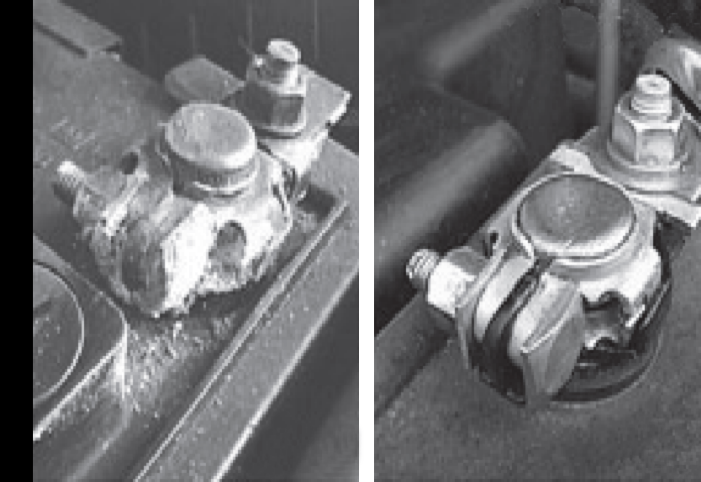
A dead battery is one of the most common causes of a no-start in winter. Unfortunately, there is no way to tell when the battery will decide to quit – sometimes it happens unexpectedly with no prior signs. However, if you feel that cranking speed is slower than before, the battery is probably close to its end. Make sure the battery terminals are not corroded. Corroded terminals will cause troubles.
Windshield wipers are very critical to winter driving; consider installing winter wipers. Make sure you replace summer washer fluid with special winter windshield washer fluid that won’t freeze. If the washer jets don’t spray properly, clean and adjust them.
There are some other things to remember:
– synthetic oil will help your car to start easier in extreme cold;
– worn out spark plugs or bad ignition cables are more likely to cause problems with starting in cold weather;
– vehicles with a diesel engine need special attention – a simple thing like dirty fuel filter could cause a lot of troubles on a cold day;
– consider buying winter floor mats – they will help to keep the water from leaking under the car’s carpet, which could cause corrosion to the wiring and electronic components.
Exercise 2. Find the correct English equivalents to the following word combinations.
Нуждается в проверке; необходимо пополнить; легче заводиться; может быть обследована; длительное время разогрева; позаботиться об установке; сконструирована таким образом, чтобы улучшить движение; необходимо установить; не забыть снять их; невозможно сказать.
Exercise 3. Find in the text the sentences with the Passive voice and translate them.
Exercise 4. Use the correct form of the verbs in brackets to complete the following sentences.
1. Before winter consider (to change) the engine oil.
2. The condition of the brakes need (to check).
3. Make sure that all the fl uids in the car (to top) up.
4. Don’t forget (to inspect) the condition of the antifreeze.
5. Remember (to check) tyre pressure.
Exercise 5. Rewrite the following sentences in the Active voice. The following words and word combinations can be used:
It’s a good idea to; check; consider; make sure; don’t forget to.
Example: Winter tyres need to be installed on all four wheels.
Consider installing winter tyres on all four wheels.
1. A number of things in your car need to be checked out before winter.
2. Any problems with your car need to be taken care of before winter.
3. All the fl uids need to be checked and topped up or changed if needed.
4. Things like brakes, steering and suspension can only be inspected when the car is lifted on the hoist.
5. With proper care your car will last longer and some of the possible problems can be avoided.
Exercise 6. Complete the sentences according to the text.
1. The fresh oil will make the engine … .
2. Such a simple problem as a bad thermostat or even a small leak may cause … .
3. To improve traction on snow-covered or icy roads … are used.
4. Don’t forget to remove winter tyres when … .
5. Replace summer washer fluid with special … .
6. Clean and adjust the washer jets if they … .
7. Winter floor mats will help to … .





Вебинар для учителей
🎓 Свидетельство об участии ✨БЕСПЛАТНО!✨