


Россия, р.п. Красные Баки


СДЕЛАЙТЕ СВОИ УРОКИ ЕЩЁ ЭФФЕКТИВНЕЕ, А ЖИЗНЬ СВОБОДНЕЕ
Благодаря готовым учебным материалам для работы в классе и дистанционно
Скидки до 50 % на комплекты
только до
Готовые ключевые этапы урока всегда будут у вас под рукой
Организационный момент
Проверка знаний
Объяснение материала
Закрепление изученного
Итоги урока

Была в сети 31.10.2026 19:58

Воронина Марина Владимировна
преподаватель английского и немецкого языка, преподаватель информатики
 91 619
 192

Местоположение
Специализация
Методические указания по английскому языку для III курса «Основные компоненты и механизмы автомобиля"
Категория:
Английский язык
04.12.2020 19:01

Просмотр содержимого документа
«Методические указания по английскому языку для III курса «Основные компоненты и механизмы автомобиля"»
ДЕПАРТАМЕНТ ЛЕСНОГО ХОЗЯЙСТВА НИЖЕГОРОДСКОЙ ОБЛАСТИ
Государственное бюджетное профессиональное
образовательное учреждение Нижегородской области
«КРАСНОБАКОВСКИЙ ЛЕСНОЙ КОЛЛЕДЖ»
МЕТОДИЧЕСКИЕ УКАЗАНИЯ
по дисциплине «Иностранный язык
в профессиональной деятельности (Английский язык)»
для студентов III курса
Основные компоненты и механизмы автомобиля
для специальности 23.02.07 «Техническое обслуживание
и ремонт двигателей, систем и агрегатов автомобилей»
| РАССМОТРЕНО: на заседании предметно-цикловой комиссии общеобразовательных дисциплин ПРОТОКОЛ № от « » сентября 2020г. Председатель ПЦК _Поспелова Т.В. | Составили: преподаватели иностранных языков Воронина М.В., Булкина Т.А. |
Красные Баки
2020
Lesson 1
Компоненты автомобиля
Упражнение 1. Прочтите слова и словосочетания и запомните их русские эквиваленты:
engine (power plant) - двигатель (силовая установка)
chassis - шасси
body - кузов
power train - силовая передача
running gear - ходовая часть
steering system - рулевое управление
brakes - тормоза
clutch - сцепление
gearbox - коробка передач
propeller shaft - карданный вал
final drive - главная передача
differential - дифференциал
rear axle - задний мост
axle shafts - полуоси
frame with axles - рама с осями
wheels and springs - колеса с рессорами
hood - капот
fenders - крылья
heater - отопитель
windshield wiper - стеклоочиститель
include - включать в себя
consist of - состоять из
as well - также
in turn - в свою очередь
source of power - источник энергии
fuel - топливо
cooling - охлаждение
lubricating - смазка
Упражнение 2. Прочтите и переведите интернациональные слова:
Automobile, chassis, electric, system, control, differential, ventilator, cylinder.
Прочтите и переведите текст, а затем выполните следующие за ним упражнения:
The automobile is made up of three basic parts: the power plant, or the engine, the chassis and the body. The engine is the source of power that makes the wheels rotate and the car move. It includes fuel, cooling, lubricating and electric systems. Most automobile engines have six or eight cylinders. The chassis includes a power train (power transmission), a running gear, steering and braking systems as well.
The power train carries the power from the engine to the car wheels. The power transmission, in turn, contains the clutch, gearbox, propeller or cardan shaft, final drive, differential, rear axle and axle shafts. The running gear consists of a frame with axles, wheels and springs. The body has a hood, fenders and accessories: the heater, stereo tape recorder, windshield wipers, conditioner, speedometer and so on.
Упражнение 3. Выберите и запишите термины, данные ниже, которые относятся к: the engine (двигателю); the chassis (шасси); the body (кузову).
Fuel system, axle shaft, accessories, cooling system, frame with axles, running gear, lubricating system, steering system, heater, propeller shaft, power transmission, final drive, windshield wiper, clutch, wheels and axle shafts, gearbox, electric system, differential.
Упражнение 4. Найдите в тексте ответы на вопросы:
1. What main parts is the automobile made up of?
2. What is the function of the engine?
3. What systems does the engine include?
4. What does the chassis consist of?
5. What units does the power transmission comprise?
Упражнение 5. Закончите предложения, выбрав соответствующее по смыслу окончание.
| 1. The automobile is made up of... | a. a power transmission, running gear, steering and braking systems. |
| 2. The engine is ... | b. the clutch, gearbox, propeller shaft, final drive, differential and axle shafts. |
| 3. The engine includes ... | c. a hood, fenders and accessories. |
| 4. The chassis consists of... | d. the engine, the chassis and the body. |
| 5. The power transmission comprises ... | e. a frame with axles, wheels and springs. |
| 6. The running gear consists of.. | 6. the source of power. |
| 7. The body has ... | 7. fuel, cooling, electric and lubricating systems. |
Упражнение 6. Найдите в тексте английские эквиваленты предложений и запишите их.
1. Автомобиль состоит из трех основных частей: двигателя, шасси и кузова.
2. Двигатель — это источник энергии.
3. Двигатель включает в себя топливную, охлаждающую, смазывающую и электрическую системы.
4. Шасси включает в себя силовую передачу, ходовую часть, рулевую и тормозную системы.
5. Силовая передача (трансмиссия), в свою очередь, состоит из сцепления, коробки передач, карданного вала, главной передачи, дифференциала, заднего моста и полуосей.
6. Ходовая часть включает в себя раму с осями, колеса и рессоры.
7. Кузов включает в себя капот, крылья и вспомогательные аксессуары: отопитель, стеклоочистители, магнитолу, кондиционер и т. п.
Упражнение 7. Прочтите диалог несколько раз, а затем выполните следующие за ним упражнения.
A: Do you know what parts the automobile is made up of?
В.: Certainly. It is made up of the engine, the chassis and the body,
A: What is the source of power?
B: The source of power is the engine. It includes fuel, cooling, lubricating and electric systems.
A: And what does the chassis consist of?
B: It consists of a power transmission, running gear, steering and braking systems. By the way, the power transmission, in turn, comprises the clutch, gearbox, propeller shaft, final drive, differential, rear axle and axle shafts.
A: And what has the body?
B: The body has a hood, fenders and accessories, such as: the heater, stereo tape recorder, windshield wipers, conditioner and so on.
A: Thank you very much for your information.
B: Don't mention it. I am glad to help you.
Упражнение 8. Найдите в диалоге слова и словосочетания, эквивалентные русским словам и словосочетаниям, приведенным ниже.
Сделан из; шасси; кузов; включать в себя; топливная, охлаждающая, смазывающая и электрическая системы; трансмиссия; ходовая часть; рулевая и тормозная системы; карданный вал; главная передача; дифференциал; задний мост; полуоси; капот; крылья; вспомогательные устройства; стеклоочистители.
Упражнение 9. Закончите предложения, используя необходимые слова или словосочетания, данные ниже.
A: What parts does the automobile ... ?
B: It is made up of...
A: What is...?
В: The source of power is the ...
A: What systems does the engine ...?
В: It includes ...
A: What does the chassis ... ?
В: The chassis ....
A: What does the power train include?
B: The power train includes ...
A: What units does the body comprise?
B: It comprises ... and accessories such as ...
A: Thank you for your ....
Engine, chassis, body, power train, running gear, steering system, brakes, clutch, gearbox, propeller shaft, final drive, differential, rear axle, axle shafts, hood and fenders, heater, windshield wipers, information, conditioner, consist(s) of, the source of power, include, fuel, cooling, lubricating, electric systems.
Lesson 2
Двигатель
Упражнение 1. Прочтите слова и словосочетания и запомните их русские эквиваленты.
bottom dead center - нижняя мертвая точка
charge of fuel — заряд топлива
combustion — сгорание
combustion chamber – камера сгорания
compression stroke — такт сжатия(смеси)
connecting rod - шатун
crankshaft — коленчатый вал
cylinder - цилиндр
diesel engine — дизельный двигатель
exhaust stroke — такт выпуска
four-stroke cycle — четырехтактный цикл
fuel injection — впрыск топлива
ignite — воспламенять
ignition — воспламенение
intake (inlet) stroke — такт впуска
internal combustion engine – двигатель внутреннего сгорания
mixture — смесь
operating cycle - рабочий цикл
petrol engine — бензиновый двигатель
piston — поршень
power stroke — рабочий ход
pressure - давление
reciprocating movement — возвратно-поступательное движение
residual gas — остаточный газ
rotary movement — вращательное движение
spark plug — свеча зажигания
stroke — ход (поршня)
top dead center — верхняя мертвая точка
valve – клапан
Упражнение 2. Переведите слова на русский язык
to combust - combustion; to operate - operation; to ignite - ignition; to reciprocate - reciprocation; to connect - connection; to compress - compression; to describe - description.
Упражнение 3. Прочтите и переведите интернациональные слова.
Principle, cycle, piston, center, cylinder, atmosphere.
Упражнение 4. Переведите предложения на русский язык
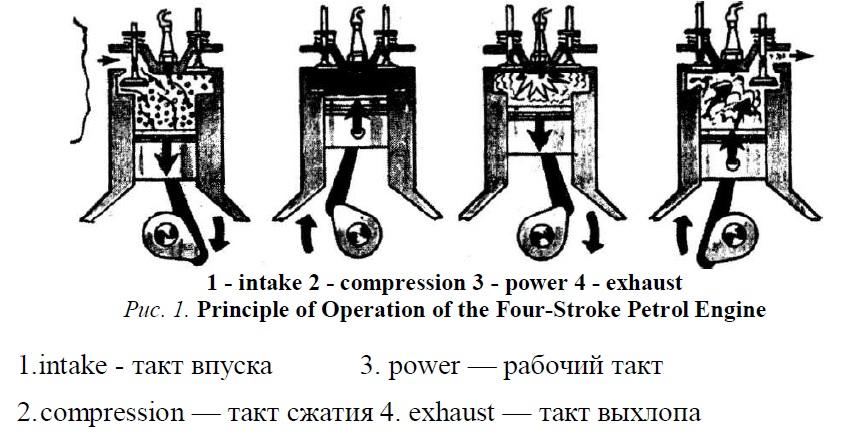
1. During the inlet (intake) stroke the inlet valve opens and a charge of fuel (mixture) flows into the cylinder.
2. During the compression stroke the inlet valve is closed and the fuel is compressed by the rising piston.
3. During the power stroke both valves are closed, pressure rises in the combustion chamber, and the spark ignites the mixture.
4. During the exhaust stroke the exhaust valve is opened, pressure is released and the residual gases flow into the atmosphere through the exhaust valve.
Прочтите и переведите текст, а затем выполните следующие за ним упражнения.
Principle of Operation of the Four-Stroke Petrol Engine
The internal combustion engine is called so because fuel is burned directly inside the engine itself. Most automobile engines work on a 4-stroke cycle. A cycle is one complete sequence of 4 strokes of the piston in the cylinder. The operating cycle of the four-stroke petrol engine includes: inlet stroke (intake valve opens), compression stroke (both valves closed), power stroke (both valves closed), exhaust stroke (exhaust valve is opened).
To describe the complete cycle, let's assume that the piston is at the top of the stroke (top dead center) and the inlet and the exhaust valves are closed. When the piston moves down the inlet valve opens to intake a charge of fuel into the cylinder. This is called the inlet (intake) stroke. On reaching the lowest position (bottom dead center) the piston begins to move upward into the closed upper part on the cylinder, (he inlet valve is closed and the mixture is compressed by the rising piston. This is called the compression stroke. As the piston again reaches the top dead center the spark plugs ignite the mixture, both valves being closed during its combustion. As a result of burning mixtures the both valves being closed during its combustion. As a result of burning mixtures the gases expand and great pressure makes the piston move back down the cylinder. This stroke is called the power stroke. When the piston reaches the bottom of its stroke, the exhaust valve is opened, pressure is released, and the piston again rises. It lets the burnt gas flow through the exhaust valve into the atmosphere. This is called the exhaust stroke which completes the cycle. So the piston moves in the cylinder down (intake stroke), up (compression stroke), down (power stroke), up (exhaust stroke). The heat released by the fuel is transformed into work so that the reciprocating movement of the pistons is converted into rotary movement of a crankshaft by means of connecting rods.
Упражнение 5. Найдите в тексте абзацы и переведите их на русский язык, где идет речь:
о такте впуска,
о такте сжатия,
о рабочем ходе,
о такте выпуска.
Упражнение 6. Выберите правильные по смыслу ответы на вопросы.
1. Why is the engine called the internal combustion engine?
2. What stroke is called the inlet one?
3. What is a compression stroke?
4. What takes place in the cylinder on power stroke?
5. What takes place on the exhaust stroke?
6. By means of what is the reciprocating movement of the pistons converted into rotary movement of a crankshaft?
Упражнение 7. Прочтите текст и ответьте на вопросы:
а. Каковы преимущества бензиновых двигателей?
б. Каковы преимущества дизельных двигателей?
Engines
The two most common types of engines for cars are the petrol engine and diesel engine. Petrol engines are usually lighter and smaller than diesel engines. This makes them cheaper, and this is why most cars use petrol engines. Petrol engines are also less noisy than diesel engines. They usually go foster. On the other hand, diesel engines use less fuel than petrol engines, and this is why trucks use them. They are also safer than petrol engines, because there is less danger of fire.
There are two main types of petrol engine - 4-stroke and 2-stroke. All cars use 4-stroke engines. But most motorbikes use 2-stroke engines. They are lighter and smaller than 4-stroke engines, and are therefore cheaper.
Lesson 3
Рама автомобиля
Упражнение 1. Прочтите слова и словосочетания и выучите их русские эквиваленты.
frame — рама
twist - кручение
support — опора
suspension - подвеска
body - кузов
channel section — полая секция
longitudinal members - лонжероны
weld — сваривать
cross members — поперечины
rivet — заклепывать
reinforce — усиливать
insulate — изолировать
rigid — жесткий
rubber pad – резиновая прокладка
mining - прочный
unibody construction — конструкция
withstand strains — выдерживать с несущим кузовом нагрузки
strengthen – укреплять
Упражнение 2. Переведите на русский язык интернациональные слова.
Chassis, structure, system, integral, construction, steel, vibration, passenger, metal, contact.
Упражнение 3. Переведите слова, обращая внимание на суффиксы.
То found - foundation; frame - frameless; to construct - construction; structure — structural — structurally; to attach — attachment; to vibrate — vibration; to insulate - insulation; usual — usually.
Прочтите и переведите текст, а затем выполните следующие за ним упражнения.
Frame
The foundation of the automobile chassis is the frame which provides support for the engine, body and power-train members. Cross members reinforce the frame. The frame is rigid and strong so that it can withstand the shocks, vibrations, twists and other strains to which it is put on the road.
The frame provides a firm structure for the body, as well as a good point for the suspension system. There are two types of frames, namely: conventional frames and integral (unibody) frames (frameless constructions).
Conventional frames are usually made of heavy steel channel sections welded or riveted together. All other parts of the car are attached to the frame.
In order to prevent noise and vibrations from passing to the frame and from there to the passengers of the car, the frame is insulated from these parts by rubber pads.
It is also important to insulate the frame in order to prevent metal- to-metal contacts.
Frameless (unibody) constructions are called so because they are made integral with the body. The body parts are used to structurally strengthen the entire car. Some unibody frames have partial front and rear frames for attaching the engine and suspension members.
Упражнение 4. Найдите в тексте и выпишите английские эквиваленты русским терминам.
Лонжероны, поперечины, жесткий, прочный, выдерживать нагрузки, подвеска, обычная (общепринятая) рама, безрамная конструкция, полые секции, сваренные или заклепанные, прикреплять к раме, резиновые прокладки, укреплять.
Упражнение 5. Найдите в тексте ответы на вопросы.
1.What does the frame provide?
2.Why is the frame rigid and strong?
3.What types of frames are there?
4.What is the conventional frame made of?
5.By what is the frame insulated from the other car parts? For what purpose?
6.What do you know about unibody frames?
Упражнение 6. Переведите предложения на английский язык.
1. Рама обеспечивает опору для кузова, двигателя и узлов силовой передачи.
2. Она состоит из лонжеронов и поперечин, которые усиливают раму.
3. Рама должна выдерживать вибрацию, кручения и другие нагрузки (напряжения).
4. Рамы бывают двух типов: обычные (стандартные) и выполненные воедино с кузовом.
5. Стандартные рамы изготовлены из стальных полых секций, сваренных или заклепанных вместе.
6. Безрамные конструкции выполнены воедино с кузовом.
7. Рама изолируется от кузова резиновыми прокладками, чтобы шумы и вибрации не проходили к пассажирам автомобиля.
Lesson 4
Сцепление
Упражнение 1. Прочтите слова и словосочетания и постарайтесь запомнить их русские эквиваленты.
friction device — фрикционное устройство
pressure disc — нажимной диск
hard-wearing material - износо-стойкий материал
connect — соединять
gearbox — коробка передач
frictional force - сила трения
start the car - завести автомобиль
clutch pedal — педаль сцепления
release the engine — отсоединить двигатель
at rest — в покое
is engaged — включено (подсоединено)
fix — крепить (устанавливать)
flywheel - маховик
is disengaged - отключено
friction disc (plate) — фрикционный диск
run idly - работать вхолостую
Упражнение 2. Переведите слова, обращая внимание на суффиксы и префиксы.
Connect —disconnect — connection — disconnection; operate — operation; friction — frictional; engage — engagement — disengagement.
Упражнение 3. Прочтите и переведите интернациональные слова.
Start, disc, friction, frictional, material, base, principal, control, pedal.
Прочтите и переведите текст, а затем выполните следующие за ним упражнения.
Clutch
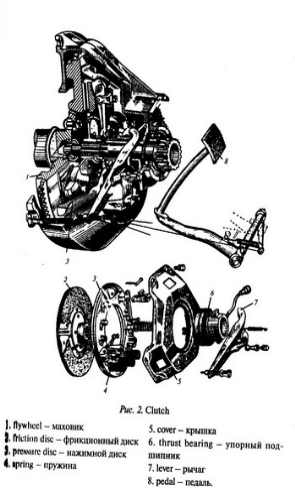
The clutch is a friction device. It connects the engine to the gears in the gearbox. It is used for disconnecting the engine from the gearbox, for starting the car and for releasing the engine from the car wheels.
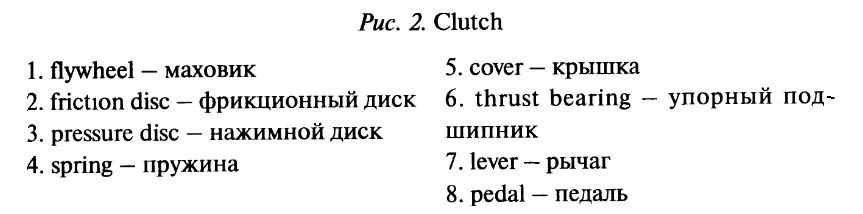
The clutch is fixed between the flywheel of the engine and the gearbox and consists of two plates (discs): the friction disc and the pressure disc. The friction disc is situated between the flywheel and the pressure plate and has a hard-wearing material on each side.
The basic principal operation of the clutch is a frictional force acting between two discs. The clutch is controlled by the clutch pedal. When the pedal is at rest the clutch is engaged and the running engine is connected to the gearbox. When the pedal is pressed down the clutch is disengaged and the engine runs idly.
Упражнение 4. Найдите в тексте данные ниже слова и напишите
их русские эквиваленты.
Friction device, clutch, gearbox, to free, to start, to release, flywheel, pressure plate, basic principle of operation, to fix, hard-wearing material, to consist of, to be controlled by, running engine, to run idly, to engage, to disengage, to press down, to be at rest.
Упражнение 5. Найдите в тексте ответы на следующие вопросы:
1.What device is the clutch?
2.What units does it connect?
3.What is the clutch used for?
4.Where is the clutch placed?
5.What plates does the clutch consist of?
6.What is the basic principal operation of the clutch?
7.What is the clutch controlled by?
8.What takes place when the clutch pedal is at rest?
9.When does the engine run idly?
Упражнение 6. Прочтите диалог и выполните следующие за ним упражнения.
A: What is the function of the clutch?
В: You see, it serves three functions. It is used for freeing the engine from the gearbox, for starting the car and for freeing the engine from car wheels.
A: Is it a friction device?
В.: Yes, of course. It is fixed between the flywheel of the engine and the gearbox and usually consists of two discs.
A: What discs?
В: The friction disc (driven disc) and the pressure disc.
A.: I suppose the principle of operation of clutches is a frictional force between discs. Am I right?
В.: Yes, you are. When the clutch is fully engaged the frictional force makes discs rotate at the same speed.
A: And by what is the clutch controlled?
B: By the clutch pedal. When it is at rest the clutch is engaged and when it is pressed down the clutch is disengaged and the engine is disconnected from the car wheels.
A.: Thank you. And what types of clutches do you know?
B: Positive clutches and gradual engagement clutches.
A: Thank you very much for your information.
B: Not at all. Glad to help you.
Упражнение 7. Найдите в диалоге английские эквиваленты следующим русским терминам и выпишите их.
Функция сцепления, для отключения двигателя от коробки передач, крепится между маховиком и коробкой передач, фрикционный (ведомый) диск, нажимной диск, фрикционная сила, сцепление включено, педаль в исходном положении, педаль сцепления нажата.
Lesson 5
Согласование времён. Косвенная речь
В английском языке употребление времени глагола-сказуемого в придаточном предложении зависит от времени глагола-сказуемого в главном предложении. Это называется правилом согласования времен.
Правило согласования времен заключается в следующем:
1)Если в главном предложении глагол-сказуемое стоит в одной из форм настоящего или будущего времени, то глагол-сказуемое в придаточном предложении может стоять в любой временной форме, которая требуется по смыслу. Mum says, ‘Dinner is ready’. - Mum says that dinner is ready.
2)Если в главном предложении глагол-сказуемое стоит в одной из форм прошедшего времени, то в придаточном предложении глагол-сказуемое нужно употреблять также в одной из форм прошедшего. He said, ‘I’m cold’. - He said that he was cold.
Переход от прямой речи к косвенной происходит так:
Сообщение
Прямая речь: Не said, “I go there.”
Косвенная речь: Не said (that) he went there.
Как видно из примера, знаки прямой речи (запятая и кавычки) отсутствуют и действует закон согласования времен.
Вопрос
Вопрос без вопросительного слова. Здесь используется союз if или whether, примерно соответствующие в русском языке частицы ли:
Прямая речь: Не asked, “Do you go there?”
Косвенная речь: He asked if they went there.
Здесь соблюдается прямой порядок слов (подлежащее стоит перед сказуемым), а также закон согласования времен.
Вопрос с вопросительным словом. В этом случае роль соединительного элемента играет само вопросительное слово. Здесь тоже соблюдаются прямой порядок слов и закон согласования времен:
Прямая речь: Не asked, “When do you go there?”
Косвенная речь: He asked when they went there.
Просьба или приказ
Поскольку в повелительном наклонении употребляется инфинитив (неопределенная форма глагола), то никакого согласования времен здесь нет:
| Прямая речь: | Не said to them, “Go there.” |
| Косвенная речь: | He told them to go there. |
| В отрицательной форме: |
|
| Прямая речь: | Не said to them, “Don’t go there.” |
| Косвенная речь: | He told them not to go there. |
Если время и место действия, указываемые в прямой речи, при обращении в косвенную речь изменились, то происходит замена наречий места и времени, а также указательных местоимений:
| Прямая речь | Косвенная речь |
| now | then |
| today | that day, at the time |
| tomorrow | the next day |
| the day after tomorrow | two days later, in two days’ time |
| yesterday | the day before, on the previous day |
| the day before yesterday | two days before |
| last night | (on) the previous night |
| ago | before |
| next year | the next year, the following year |
| last year | the previous year |
| here | there |
| this | that |
| these | those |
Если для косвенной речи время и место действия имеют то же значение, что и для прямой, то никакой замены делать не нужно. Например, если кто-либо сказал: “I’ll be here tomorrow” и для участников разговора слова здесь и завтра имеют тот же смысл, то не нужно менять их на там и на следующий день: Не said he would be here tomorrow.
Замену нужно делать лишь в том случае, если понятия завтра и здесь относятся уже к другому дню и месту: Не said he would be there the next day.
Упражнения
№1. Измените повелительные предложения по модели, используя глаголы ask, order, advise, remind, recommend, warn, implore.
Model: He said, “Open the door!” — He asked me to open the door.
He said, “Don’t go there!” — He ordered us not to go there.
1. He asked, “Close the door!”
2. The children ordered, “Read to us!”
3. She said, “Don’t laugh at him!”
4. The teacher asked, “Please give me a pen.”
5. Mother reminded, “Don’t be late for college.”
6. He advised, “Take the umbrella.”
7. She said, “Please help yourself.”
8. He said, “Don’t ask me this silly question again!”
9. She reminded, “Call me as soon as you can!”
10. Jane begged, “Help me, please”
№2. Измените утвердительные предложения по модели, используя глаголы ask, order, advise, remind, recommend, warn, implore.
Model: She said, “He is my friend.” — She said that he was her friend.
1. Tom remarked, “I didn’t expect him to be so young.”
2. Jane muttered, “I am sorry I am late”.
3. Jean said, “My Dad will be fifty years old next year.”
4. Mother answered, “The children are playing in the garden.”
5. Sam told Boris, “It is raining outside. Take an umbrella.”
6. The teacher said in surprise, “Sorry to say, but you have got a bad mark for your test.”
7. Mike noted, “I called him a few days ago.”
8. Vlad explained, “I have had a flu, but now I am feeling much better.”
9. Lena told her friend, “I am going to the seaside for a holiday.”
10. His friend shouted, “It’s a lie!”
№3. Измените вопросительные предложения по модели, используя глаголы ask, order, advise, remind, recommend, warn, implore.
Model: He asked, “When do you finish your work?” - He asked me when I finished my work. She asked, “Is everything ready?” - She asked if everything was ready.
1. He inquired, “Do you want to speak to me?”
2. She wondered, “When will they arrive?”
3. Mother asked in surprise, “Have you already done your homework?”
4. George inquired, “Are you sure that you are doing the right thing?”
5. The man asked, “When were you last in the Crimea?”
6. He wondered, “What are you laughing at?”
7. The boy asked, “Why were you so surprised?”
8. He asked, “Are you playing football with us today?”
9. She inquired, “Who will help me to do the washing up?”
10. Fred asked, “Did you write the answer to his previous letter?”
№4. Переведите предложения, используя правила согласования времен там, где это необходимо, обращая внимание на время в главном предложении:
Дэвид сказал, что его мама учитель.
Мы увидели, что дети играли в настольный теннис.
Она надеется, что я не буду работать по воскресеньям в следующем году.
Я не знала, что они сегодня заняты и не смогут мне помочь.
Я думал, что он болеет.
Мы надеялись, что они придут вовремя.
Я не знал, что его сестра учит немецкий язык.
Я была уверена, что они учили французский в школе.
Он уверен, что закончит работу до вечера.
Мой друг говорит, что уже перевел эту статью.
Lesson 6
Коробка передач
Упражнение 1. Прочтите слова и словосочетания и запомните их русские эквиваленты
gear — шестерня, передача
gearbox - коробка передач
gearing - зубчатое соединение
road conditions — дорожные условия
forward speed — передняя скорость
reverse drive – обратный (задний) ход
low gear - первая передача
top gear — четвертая (прямая) передача
sliding-mesh gearbox – коробка передач со скользящими шестернями
constant-mesh gearbox- коробка передач с постоянным зацеплением шестерен
epicyclic (planetary) gearbox - эпициклическая (планетарная) коробка передач
ordinary gearing — стандартное зубчатое соединение
characteristic feature — характерная особенность
fixed axes – зафиксированные (неподвижные) оси
rotate bodyly — вращаться корпусом
axis - ось
axle — вал
secure — обеспечить
shifting – переключение
in direct line-важно
Упражнение 2. Прочтите и переведите на русский язык интернациональные слова.
Principal, function, construction, constructional, class, classify, type, planet, planetary, history, historical.
Упражнение 3. Переведите слова, обращая внимание на суффиксы.
Move — movement, construct — construction — constructional,
arrange — arrangement, history — historical — historically,
wide — widely, vary — various, simple — simply, body — bodily.
Прочтите текст, а затем выполните следующие за ним упражнения.
Gearbox
The gearbox is placed between the clutch and the propeller shaft. The principal function of the gearbox is to vary the speed of the car movement to meet the road conditions. The gearbox provides four forward speeds and one reverse, as follows:
1. First or low gear;
2. Second gear;
3. Third gear;
4. Fourth or top gear;
5. Reverse gear.
There are many constructional arrangements of gearboxes, which can be classified as follows:
1. Sliding-mesh type;
2. Constant-mesh type;
3. Epicyclic (planetary) type.
The sliding-mesh type is the simplest one and is the oldest historically. The constant-mesh type is the most widely used type. They are termed "ordinary" gearing, the characteristic feature of which is that I lie axes of the various gears are fixed axes. The gears simply rotate about their own axes.
The characteristic feature of epicyclic (planetary) gearing is that one gear rotates about its own axis and also rotates bodily about some other axis.
To secure the several speeds of the car the clutch shaft is mounted in direct line with the gearbox shaft. The gearbox shaft carries on it the sliding gears which are used for shifting to secure the forward speeds and the reverse drive.
Упражнение 4. Найдите в тексте ответы на вопросы.
1.Where is the gearbox situated?
2.What is the function of the gearbox?
3.What speeds does the gearbox provide?
4.What types of gearboxes do you know?
5.Why is the clutch shaft mouned in direct line with the gearbox shaft?
Упражнение 5. Переведите предложения на английский язык.
1. Коробка передач предназначена для изменения скорости движения автомобиля.
2. Коробка передач обеспечивает четыре передние скорости и задний ход.
3. Коробки передач могут быть: со скользящими шестернями, с постоянным зацеплением шестерен и планетарного типа.
4. Самыми простыми являются коробки передач со скользящими шестернями.
5. Коробки передач с постоянным зацеплением шестерен используются наиболее часто.
6. Скользящие шестерни на валу коробки передач используются для обеспечения передних скоростей и обратного хода.
Упражнение 6. Прочтите диалог и разыграйте его в парах.
Mike: Peter, do you remember what our teacher told us last time?
What do you know about gearboxes?
Peter: I know that the gearbox is used to change the speed of the car.
M.: And how many speeds does the gearbox provide?
P.: It can provide four forward speeds and one reverse.
M.: Into what types are the gearboxes divided according to their arrangements?
P.: They are divided into sliding-mesh type, constant-mesh type and epicyclic type.
M.: What type is the simplest?
P.: The sliding-mesh one.
M.: Thank you very much for you help.
P.: You are welcome. Glad to help you.
Lesson 7
Тормоза
Упражнение 1. Прочтите слова и словосочетания и запомните их русские эквиваленты.
brakes — тормоза
force the fluid — подавать жидкость
performance - работа
under pressure - под давлением
safety — безопасность
brakes are applied — тормоза срабатывают
depend — зависит
slow – замедлять
braking effort - тормозное усилие
divide - разделять
push down on the brake pedal - нажать на тормозную педаль
namely - именно
drum brakes — барабанные тормоза
band brake — ленточный тормоз
disk brakes - дисковые тормоза
shoe brake — колодочный тормоз
hydraulic assisted brakes — тормоза с гидравлическим приводом
brake shoes — колодки тормоза
brake fluid — тормозная жидкость
brake pedal - тормозная педаль
master cylinder – главный цилиндр
Упражнение 2. Прочтите и переведите интернациональные слова.
Mechanism, passenger, type, hydraulic, cylinder, vacuum, function, classify, classification, mechanical, electric, electromagnet.
Упражнение 3. Переведите слова, обращая внимание на суффиксы.
Safe — safety; to improve — improvement; to move — movement;
to drive - driver; to apply - application; to attach - attachment;
to arrange - arrangement; to perform - performance; name - namely;
to operate — operation; to equip — equipment.
Прочтите текст, а затем выполните следующие за ним упражнения.
Brakes
Brakes are used to slow or stop the car where it is necessary. It is one of the most important mechanisms of the car as upon its proper performance the safety of passengers depends. Car brakes can be divided into two types, namely: drum brakes and disc brakes. The drum type may be either a band brake or a shoe brake. Depending on their functions, the automobile has foot brakes and hand brakes (parking brakes). According to their mode of operation, the brakes are classified as: mechanical brakes, hydraulic brakes, airbrakes, electric brakes. Brakes are controlled by the brake pedal.
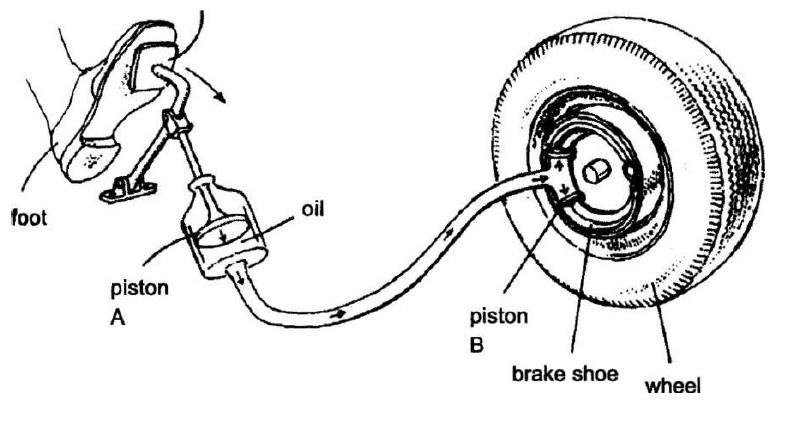
Most braking systems in use today are hydraulic. This system consists of a master cylinder mounted on the car frame and wheel cylinders. When the driver pushes down on the brake pedal, it forces the piston to move in the master cylinder and brake fluid is delivered from 11 to the wheel cylinders. The piston movement causes brake shoes to move and the brakes are applied (the brake shoes are pressed against the brake drums). The air brake uses compressed air to apply the braking force to the brake shoes.
Electric brakes use electromagnets to provide the braking effort against the brake shoes. Formerly brakes were applied only to the two rear wheels, but now all cars are equipped with all-wheels brakes. Today many improvements are being made in brakes.
Упражнение 4. Найдите в тексте английские эквиваленты следующих русских терминов и выпишите их.
Тормоза, безопасность пассажиров зависит от правильной работы тормозов, барабанные тормоза, дисковые тормоза, тормоза с усилителем, гидравлический привод тормозов, жидкость под давлением, тормоза срабатывают, тормозное усилие, нажать на тормозную педаль.
Упражнение 5. Найдите в тексте ответы на следующие вопросы:
1. What is the function of the brakes?
2. What types are brakes divided into?
3. What brakes do you know according to their mode of operation?
4. What braking systems are used today?
5. By what are brakes controlled?
6. When are brakes applied?
Упражнение 6. Переведите следующие предложения на английский язык.
1. Тормоза являются наиболее важным механизмом автомобиля.
2. Они используются для замедления движения или остановки автомобиля.
3. Тормоза можно разделить на два типа, а именно: барабанные тормоза и дисковые тормоза.
4. На большинстве автомобилей используется гидравлический привод или пневматический привод.
5. Тормоза срабатывают, когда водитель нажимает на тормозную педаль.
Упражнение 7. Переведите текст, пользуясь словарем.
Troubles in Braking System
The basic troubles of the braking system are as follows:
1. poor braking action;
2. sticking brake shoes which would not return to the initial position after a brake pedal is released;
3. non-uniform braking of the left and the right wheels on a common axle;
4. leakage of brake fluid and air leakage in the hydraulic brake;
5. poor air tightness of the pneumatic brake control.
What to do:
1. Check the action of the foot and hand brakes and leak proofness of the brake hoses connections, components of the hydraulic and pneumatic controls of the brakes, as well as of the vacuum- power system.
2. Inspect the friction linings, wheel-brake springs, master and wheel cylinders of the hydraulic brake and the air compressor of the pneumatic brake using a test manometer to check it.
Lesson 8
Рулевое управление
Упражнение 1. Прочтите слова и словосочетания и запомните их русские эквиваленты.
guide the саг — управлять автомобилем
means of turning — средство поворота
front wheels – передние колеса
steering wheel — рулевое колесо
steering column — рулевая колонка
for this purpose — для этой цели
pivot — шарнир
swing (swang, swung) - поворачиваться
steering knuckle arm – рычаг поворотного кулака
tie-rod — поперечная тяга
in turn — в свою очередь
pitman arm - рулевая сошка
rack and pinion assembly — рулевой механизм с рейкой и шестерней
ball joint — шаровой шарнир
leverage — рычажный механизм
hose — шланг, рукав
steering gear assembly – рулевой механизм
rack and pinion type - реечно-шестеренчатый тип (рулевого механизма)
recirculating ball steering - рулевой механизм с шариковой гайкой
worm and sector — червяк и сектор
injury - повреждение
steering box - картер рулевого механизма
Упражнение 2. Прочтите слова и сопоставьте их с русскими значениями.
column, spindle, system, hydraulic, pump, reservoir, popular, type, effective, effectiveness, effectively, energy, function, to deform, deformation.
Упражнение 3. Переведите слова, обращая внимание на суффиксы и префиксы.
Rotate — rotation, apply — application, move — movement, develop — development, drive — driver, form - reform - deform - deformation, guide — guidance.
Прочтите текст, а затем выполните следующие за ним упражнения.
Steering System
То guide the car, it is necessary to have some means of turning the front wheels so that the car can be pointed in the direction the driver wants to go. The steering wheel in front of the driver is linked by gears and levers to the front wheels for this purpose. The front wheels are on pivots so they can be swung to the left or right. They are attached by steering knuckle arms to the rods. The tie-rods are, in turn, attached to the pitman arm.
When the steering wheel is turned, gearing in the steering gear assembly causes the pitman arm to turn to the left or right. This movement is carried by the tie-rods to the steering knucle arms, and wheels, musing them to turn to the left or right.
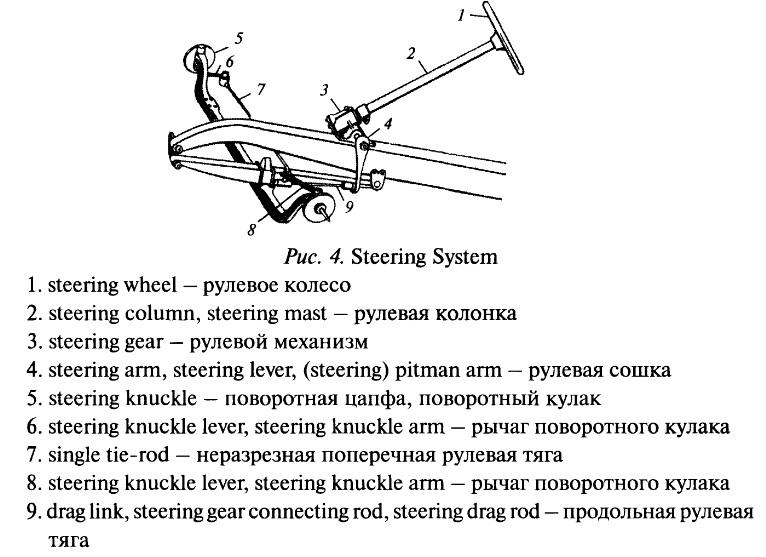
The steering system incorporates: the steering wheel and column, steering gear, pitman arm, steering knuckle arm, front axle, steering knuckle pivot, tie-rods.
There are several different manual steering gears in current use, such as the rack and pinion type and the recirculating ball type. The rack and pinion steering gear is widely used. Another manual steering gear which is popular in imported cars is the worm and sector type.
The steering wheel and column are the source of injury to the driver, air bags and other devices being developed now to safe the life of a driver.
Energy-absorbing columns must stop the steering wheel and column from being pushed to the rear as the front of the car is crushed in an impact. Energy-absorbing columns must also provide the driver with a tolerable impact as he moves forward and strikes the wheel with his chest.
Упражнение 4. Найдите в тексте ответы на вопросы.
1.What mechanism is necessary to guide the car?
2.How is the steering wheel connected to the front wheels?
3.Why can the front wheels be swung to the left or to the right?
4.What does the manual steering system incorporate?
5.What types of manual steering gears in use do you know?
Упражнение 5. Переведите на русский язык, обращая особое внимание на герундий.
1.То guide the car it is necessary to have some means of turning the front wheels.
2.The steering wheel in front of the driver is linked by gears and levers to the front wheels for turning the car in the direction the driver wants to go.
3.Without using the steering system the car moves only in the direct position.
4.Manufacturers can use rack and pinion type steering gear without choosing another type because "rack and pinion" type steering is very dependable.
5.Energy-absorbing columns must stop the steering wheel from being pushed to the rear when the front of the car is damaged in an impact.
Упражнение 6. Переведите текст.
Troubles of Steering Gear Components
Steering gear and linkage may have the following basic troubles: excessive steering-wheel free play, bending of steering rod, oil leakage from the steering-gear case, disadjustment of steering gear.
What to do
1.Check the steering-wheel free play and steering gear performance while the car is running.
2.Check the steering-gear case for oil leakage by visual inspection.
3.Adjust the steering gear. Steering gear of the worm and roller type is adjusted by end playing in the steering worm shaft bearings.
Упражнение 7. Прочтите диалог
Stas: Look here. I have some troubles with the steering system.
Vlad: What troubles?
S.: The first is excessive free play of the steering wheel.
V.: You should check free play of the steering wheel and steering gear performance.
S.: The second problem is oil leakage from the steering gear case.
V.: Check the steering gear case for oil leakage visually. Anything else?
S.: Sure. It is disadjustment of the steering gear. And I don't know
what to do.
V.: You see, in this case it is better for you to go to a repairing shop.
Good specialists should do this job.
S.: Thank you very much.
V.: Not at all.




Вебинар для учителей

🎓 Свидетельство об участии ✨БЕСПЛАТНО!✨



