


Россия, р.п. Красные Баки


СДЕЛАЙТЕ СВОИ УРОКИ ЕЩЁ ЭФФЕКТИВНЕЕ, А ЖИЗНЬ СВОБОДНЕЕ
Благодаря готовым учебным материалам для работы в классе и дистанционно
Скидки до 50 % на комплекты
только до
Готовые ключевые этапы урока всегда будут у вас под рукой
Организационный момент
Проверка знаний
Объяснение материала
Закрепление изученного
Итоги урока

Была в сети 31.10.2026 19:58

Воронина Марина Владимировна
преподаватель английского и немецкого языка, преподаватель информатики
 91 619
 192

Местоположение
Специализация
Методические указания 2 курс 7 часть (ТОР) 2026
Категория:
Английский язык
16.10.2026 09:18

Просмотр содержимого документа
«Методические указания 2 курс 7 часть (ТОР) 2026»
МИНИСТЕРСТВО ЛЕСНОГО ХОЗЯЙСТВА
И ОХРАНЫ ОБЪЕКТОВ ЖИВОТНОГО МИРА НИЖЕГОРОДСКОЙ ОБЛАСТИ
Государственное бюджетное профессиональное
образовательное учреждение Нижегородской области
«КРАСНОБАКОВСКИЙ ЛЕСНОЙ КОЛЛЕДЖ»
(ГБПОУ НО «КБЛК»)
МЕТОДИЧЕСКИЕ УКАЗАНИЯ
по дисциплине «Иностранный язык
в профессиональной деятельности (Английский язык)»
для студентов II курса 7 часть
Тема 4.2. Инструменты, оборудование и станки
для специальности 23.02.07 Техническое обслуживание
и ремонт автотранспортных средств 
Разработали:
преподаватели иностранных языков
Воронина М.В.,
Булкина Т.А.
Красные Баки
2026
Lesson 1
INSTRUMENTS AND MATERIALS
№1. Match the words with their transcription. Translate the words:
| pincers saw spanner drill chisel hammer screwdriver pliers | [drIl] ['hæmə(r)] ['pInsəz] [sL] ['skru:draIvə(r)] ['plaIəz] ['t∫Iz(ə)l] ['spænə(r)] |
№2. Make verbs corresponding to the adjectives and translate them:
tight, soft, deep, short, dark, thick, loose, wide, strong, long, light; simple, pure, solid, intense, electric, identical; active, regular; crystal, legal, critic.
№3. Explain the function of the tools (b) the way it is shown in the example using the expressions below (a):
Example: Pincers are for pulling out nails.
a) grip things / cut metal pipes / tighten and loosen nuts / cut wooden planks / tighten and loosen screws / drive in nails / drill holes / pull out nails / cut holes in wood
b) pincers (клещи), hacksaw (ножовка), handsaw (пила), hammer (молоток), spanner (гаечный ключ), screwdriver (отвертка), drill (сверло), pliers (плоскогубцы), chisel (резец, долото)
№4. Read the text and fill in the table below with the information from the text:

 Here are three types of chisel. Chisel A is used for cutting soft materials, such as wood, and chisel В is used for cutting metal. Chisel С is for cutting away old plaster and brickwork.
Screwdriver A is for tightening and loosening screws on electrical equipment. В is for loosening very small crews and С is for loosening ordinary screws.
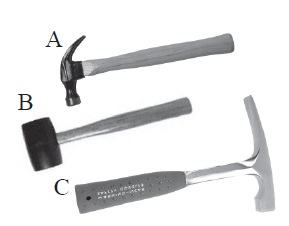
Hammer A is for hammering in nails and also for pulling nails out of wood. Hammer В is for breaking rocks and concrete. Hammer С is for breaking bricks.
| tool | job |
| a) Chisel A b) Chisel В c) Chisel С d) Screwdriver A e) Screwdriver B f) Screwdriver C g) Hammer A h) Hammer В i) Hammer С | cuts soft materials … … … … … … … … |
№5. Match the word with its translation:
| a) combustible b) soft c) brittle d) hard e) rigid f) light g) tough h) flexible i) heavy | 1) легкий 2) гибкий 3) мягкий 4) жесткий, негнущийся 5) твердый, прочный 6) хрупкий, ломкий 7) тяжелый 8) жесткий, прочный 9) горючий |
№6. Translate the words:
leather, copper, lead, steel, rubber, fiberglass, glass, titanium, plastic, aluminum, magnesium, silver, gold, wood, metal, plank, brick, iron, paper
№7. Define the material, translate the sentences:
1) A light, artificial substance that can be made into different shapes when it is soft and is used in a lot of different ways - …
2) A hard, transparent substance that objects such as windows are made of - …
3) A usually hard, shiny material such as iron, gold, or silver which heat and electricity can travel through - …
4) A strong material that bends easily, originally produced from the juice of a tropical tree, and used to make tyres, boots - …
5) The hard material that trees are made of - …
6) A very strong metal made from iron, used for making knives, machines - …
7) A small, hard, rectangular block used for building walls, houses - …
8) The skin of animals that is used to make things such as shoes and bags - …
9) A soft, red-brown metal, used in electrical equipment and to make coins - …
10) Thin, flat material used for writing on, covering things in - …
№8. Answer these questions and give reasons, using the words in brackets:
Example: Is wood a good material for making car engines?
(combustible + soft) – No, because it's too combustible and too soft.
1. Is glass a safe material for safety goggles (защитные очки)? (brittle)
2. Is plastic safe for making fly wheels? (light)
3. Is aluminium a good material for making car bodies (кузова)? (light)
4. Is wood safe for making seats? (tough)
5. Is concrete a good material for making a crankshaft (коленчатый вал)? (brittle)
№9. Are these the right tools for the job? If not, give reasons:
Example: Ron wants to twist electric wires together using a pair of scissors. – Wrong tool. Scissors are too sharp.
1. John is cutting a thick electric cable with a table knife.
2. Alan is trying to drill a 30 mm hole in a metal plate. The drill bit has a diameter of 25 mm.
3. Mike is trying to cut metal rods with a handsaw.
4. Alex is trying to drive nails into a plank of wood by hitting them with a spanner.
5. George is hammering two planks of wood together using 40 mm nails. Each plank is 30 mm thick.
6. Gary is trying to cut holes in wood with a hammer.
№10. Read, translate the text and complete the table below:
It is important to know the properties of engineering materials. For example, steel is used for making girders because it is an elastic metal. Cast iron is never used for making girders because it is brittle. The properties of a material determine its use.
Malleability (ковкость): It is easy to roll a malleable material into a new shape. A malleable material does not fracture easily under pressure. Gold is extremely malleable. It is possible to roll gold into very thin sheets. Copper is very malleable and so is lead. Glass is not at all malleable and nor is cast iron. It is very easy to fracture glass with a hammer. Cast iron also fractures easily.
Ductility (растяжимость): It is easy to draw a ductile material. It does not fracture and it retains its new shape. Copper is extremely ductile. Tin is very ductile and so is aluminium. Steel is not very ductile and nor is lead. It is very difficult to draw lead into thin wire because it fractures easily.
Elasticity (гибкость): An elastic material stretches easily under stress. However, remove the stress and it does not retain its new shape. It regains its original shape. Rubber is extremely elastic. Some steels are quite elastic. Glass is not at all elastic and nor is cast iron.
Durability (прочность): A durable material does not corrode easily. Under normal conditions, glass is very durable and so are plastics. Among the metals, chromium is extremely durable and so is platinum. Gold is quite durable and so is aluminium. Cast iron is not very durable and nor is steel.
| MATERIAL | malleability | ductility | durability |
| copper | | | **** |
| aluminum | *** | | |
| gold | | **** | |
| glass | | * | |
| extremely =***** very =**** quite =*** not very =** not at all =* | |||
Lesson 2
Components of the automobile
№1. Translate the words and word-combinations:
engine (power plant), chassis, body, wheels, fuel system, cooling system, lubricating system, electric systems, cylinders, power train, running gear, steering system, braking system, transmission, clutch, gearbox, propeller shaft, cardan shaft, final drive, differential, rear axle, axle shafts, frame with axles, springs, hood, fenders, heater, windshield wiper, conditioner, speedometer
№2. Read, translate the text and write out the international words (10):
The automobile is made up of three basic parts: the power plant, or the engine, the chassis and the body. The engine is the source of power that makes the wheels rotate and the car move. It includes fuel, cooling, lubricating and electric systems. Most automobile engines have six or eight cylinders. The chassis includes a power train (power transmission), a running gear, steering and braking systems as well.
The power train carries the power from the engine to the car wheels. The power transmission, in turn, contains the clutch, gearbox, propeller or cardan shaft, final drive, differential, rear axle and axle shafts. The running gear consists of a frame with axles, wheels and springs. The body has a hood, fenders and accessories: the heater, stereo tape recorder, windshield wipers, conditioner, speedometer and so on.
№3. Classify the nouns which refer to: the engine; the chassis; the body
Fuel system, axle shaft, accessories, cooling system, frame with axles, running gear, lubricating system, steering system, heater, propeller shaft, power transmission, final drive, windshield wiper, clutch, wheels and axle shafts, gearbox, electric system, differential.
№4. Answer the questions:
1. What main parts is the automobile made up of?
2. What is the function of the engine?
3. What systems does the engine include?
4. What does the chassis consist of?
5. What units does the power transmission comprise?
6. What assemblies does the running gear consist of?
7. What has the body?
№5. Match the parts of the sentences, translate them:
| 1. The automobile is made up of... | a. a power transmission, running gear, steering and braking systems. |
| 2. The engine is ... | b. the clutch, gearbox, propeller shaft, final drive, differential and axle shafts. |
| 3. The engine includes ... | c. a hood, fenders and accessories. |
| 4. The chassis consists of... | d. the engine, the chassis and the body. |
| 5. The power transmission comprises ... | e. a frame with axles, wheels and springs. |
| 6. The running gear consists of.. | 6. the source of power. |
| 7. The body has ... | 7. fuel, cooling, electric and lubricating systems. |
№6. Choose a proper translation of the words; translate other Russian words into English:
a) rotation - вращать, вращение, вращательный;
b) fundamentally - основной, в основном, основа;
c) difference - различие, различать, различный;
d) lubrication - смазка, смазывать, смазывающий;
e) transmission - передача, передавать, передаточный;
f) differential - дифференциал, дифференцировать, дифференциальный;
g) driver - водитель, водить, водительский.
№7. Read the dialogue and find the words and word-combinations in the text:
Сделан из; шасси; кузов; включать в себя; топливная, охлаждающая, смазывающая и электрическая системы; трансмиссия; ходовая часть; рулевая и тормозная системы; карданный вал; главная передача; дифференциал; задний мост; полуоси; капот; крылья; вспомогательные устройства; стеклоочистители.
A: Do you know what parts the automobile is made up of?
В.: Certainly. It is made up of the engine, the chassis and the body,
A: What is the source of power?
B: The source of power is the engine. It includes fuel, cooling, lubricating and electric systems.
A: And what does the chassis consist of?
B: It consists of a power transmission, running gear, steering and braking systems. By the way, the power transmission, in turn, comprises the clutch, gearbox, propeller shaft, final drive, differential, rear axle and axle shafts.
A: And what has the body?
B: The body has a hood, fenders and accessories, such as: the heater, stereo tape recorder, windshield wipers, conditioner and so on.
A: Thank you very much for your information.
B: Don't mention it. I am glad to help you.
№8. Match the word with its definition:
| 1) body | a) a piece of metal that curves round and round and that returns to its original shape after being pushed or pulled |
| 2) clutch | b) the metal part that covers a car engine |
| 3) chassis | c) the set of gears in a motor vehicle and the metal box that contains them |
| 4) speedometer | d) one of the parts at each corner of a car above the wheels |
| 5) fenders | e) a piece of equipment in a vehicle that shows how fast it is moving |
| 6) gearbox | f) the structure of a vehicle that the outer metal is fixed on to |
| 7) hood | g) the part of a car or truck that you press with your foot when you change gear (= part that controls how fast the wheels turn) |
| 8) spring | h) the main part of a vehicle |
№9. Translate into English. Write out the verbs from the text and :
Несколько причин почему необходимо знать устройство автомобиля:
- Безопасность. Понимание того, как устроен автомобиль, помогает водителю принимать правильные решения в экстренных ситуациях на дороге. Знание механизмов торможения, управления и других систем повышает безопасность эксплуатации авто.
- Эффективное обслуживание. Знание устройства автомобиля позволяет владельцам самостоятельно выполнять небольшие работы по техническому обслуживанию и ремонту. Это помогает экономить деньги и время, а также поддерживать автомобиль в хорошем состоянии.
- Выявление и устранение неполадок. Понимание работы различных систем автомобиля помогает быстрее выявлять и устранять неисправности. Это сокращает время простоя автомобиля и минимизирует затраты на ремонт.
- Выбор и покупка автомобиля. Знание устройства автомобиля помогает будущему владельцу в выборе подходящей модели и конфигурации, учитывая свои потребности, требования и возможности.
- Рациональное использование ресурсов. Понимание принципов работы автомобиля помогает экономить топливо и продлевать срок службы основных компонентов, таких как двигатель, трансмиссия и подвеска.
- Улучшение взаимодействия с сервисом и автомастерскими. Люди, знающие устройство своего автомобиля, могут лучше общаться с механиками и понимать рекомендации по техническому обслуживанию и ремонту, а также в состоянии уберечь себя от обмана при обращении к недобросовестным специалистам.
№10. Find 10 verbs from the text and write 4 forms of them:
Example: stop – stopped – stopped – stopping; go – went – gone - going
№11. Make a dialogue about at a car service station (10-12 phrases)
Lesson 3
Engine
№1. Write the new words in your copybook:
bottom dead center - нижняя мертвая точка
charge of fuel — заряд топлива
combustion — сгорание
combustion chamber – камера сгорания
compression stroke — такт сжатия(смеси)
connecting rod - шатун
crankshaft — коленчатый вал
cylinder - цилиндр
diesel engine — дизельный двигатель
exhaust stroke — такт выпуска
four-stroke cycle — четырехтактный цикл
fuel injection — впрыск топлива
ignite — воспламенять
ignition — воспламенение
intake (inlet) stroke — такт впуска
internal combustion engine – двигатель внутреннего сгорания
mixture — смесь
operating cycle - рабочий цикл
petrol engine — бензиновый двигатель
piston — поршень
power stroke — рабочий ход
pressure - давление
reciprocating movement — возвратно-поступательное движение
residual gas — остаточный газ
rotary movement — вращательное движение
spark plug — свеча зажигания
stroke — ход (поршня)
top dead center — верхняя мертвая точка
valve – клапан
№2. Translate the words into Russian:
to combust - combustion; to operate - operation; to ignite - ignition; to reciprocate - reciprocation; to connect - connection; to compress - compression; to describe - description.
№3. Translate the international words and make your own sentences:
Principle, cycle, piston, center, cylinder, atmosphere.
№4. Translate into Russian:
1. During the inlet (intake) stroke the inlet valve opens and a charge of fuel (mixture) flows into the cylinder.
2. During the compression stroke the inlet valve is closed and the fuel is compressed by the rising piston.
3. During the power stroke both valves are closed, pressure rises in the combustion chamber, and the spark ignites the mixture.
4. During the exhaust stroke the exhaust valve is opened, pressure is released and the residual gases flow into the atmosphere through the exhaust valve.
№5. Read, translate the text and answer the questions:
Principle of Operation of the Four-Stroke Petrol Engine
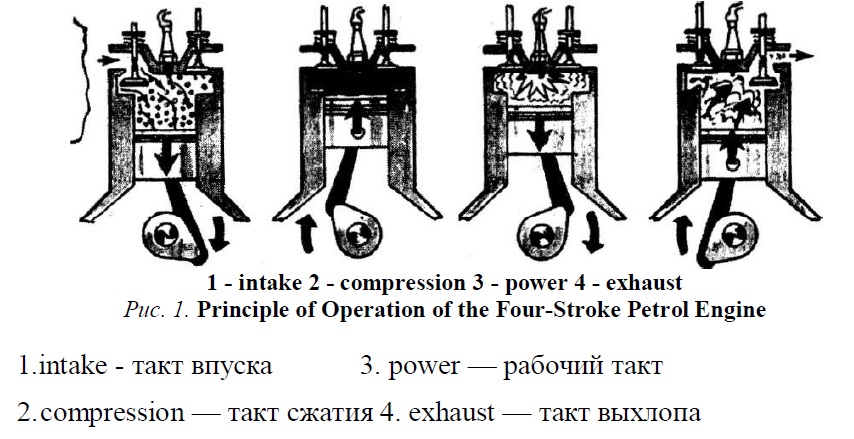
The internal combustion engine is called so because fuel is burned directly inside the engine itself. Most automobile engines work on a 4-stroke cycle. A cycle is one complete sequence of 4 strokes of the piston in the cylinder. The operating cycle of the four-stroke petrol engine includes: inlet stroke (intake valve opens), compression stroke (both valves closed), power stroke (both valves closed), exhaust stroke (exhaust valve is opened).
To describe the complete cycle, let's assume that the piston is at the top of the stroke (top dead center) and the inlet and the exhaust valves are closed. When the piston moves down the inlet valve opens to intake a charge of fuel into the cylinder. This is called the inlet (intake) stroke. On reaching the lowest position (bottom dead center) the piston begins to move upward into the closed upper part on the cylinder, (he inlet valve is closed and the mixture is compressed by the rising piston. This is called the compression stroke. As the piston again reaches the top dead center the spark plugs ignite the mixture, both valves being closed during its combustion. As a result of burning mixtures the both valves being closed during its combustion. As a result of burning mixtures the gases expand and great pressure makes the piston move back down the cylinder. This stroke is called the power stroke. When the piston reaches the bottom of its stroke, the exhaust valve is opened, pressure is released, and the piston again rises. It lets the burnt gas flow through the exhaust valve into the atmosphere. This is called the exhaust stroke which completes the cycle. So the piston moves in the cylinder down (intake stroke), up (compression stroke), down (power stroke), up (exhaust stroke). The heat released by the fuel is transformed into work so that the reciprocating movement of the pistons is converted into rotary movement of a crankshaft by means of connecting rods.
1. Why is the engine called the internal combustion engine?
2. What stroke is called the inlet one?
3. What is a compression stroke?
4. What takes place in the cylinder on power stroke?
5. What takes place on the exhaust stroke?
6. By means of what is the reciprocating movement of the pistons converted into rotary movement of a crankshaft?
№6. Write out and translate the paragraph about:
о такте впуска,
о такте сжатия,
о рабочем ходе,
о такте выпуска.
№7. Read the text and answer the questions in English:
а. Каковы преимущества бензиновых двигателей?
б. Каковы преимущества дизельных двигателей?
Engines
The two most common types of engines for cars are the petrol engine and diesel engine. Petrol engines are usually lighter and smaller than diesel engines. This makes them cheaper, and this is why most cars use petrol engines. Petrol engines are also less noisy than diesel engines. They usually go foster. On the other hand, diesel engines use less fuel than petrol engines, and this is why trucks use them. They are also safer than petrol engines, because there is less danger of fire.
There are two main types of petrol engine - 4-stroke and 2-stroke. All cars use 4-stroke engines. But most motorbikes use 2-stroke engines. They are lighter and smaller than 4-stroke engines, and are therefore cheaper.
№8. Write out 5-7 nouns with singular –plural – translation forms from the text:
Example: driver – drivers - водители
№9. Write out 5 abstract nouns with translation from ex.1, make your own sentences:
Example: Copper – медь. Copper is very malleable and so is lead.
№10. Write out 5 adjectives: positive –comparative – superlative:
Example: fast – faster - the fastest
№11. Write 4 forms of the verbs:
Example: stop – stopped – stopped – stopping; go – went – gone - going
work, do, use, make, call, be, close, take, reach, drive
№12. Make a dialogue about scheduled oil change (10-12 phrases)
Lesson 4
Car frame
№1. Write the new words in your copybook and make your own sentences:
frame — рама
twist - кручение
support — опора
suspension - подвеска
body - кузов
channel section — полая секция
longitudinal members - лонжероны
weld — сваривать
cross members — поперечины
rivet — заклепывать
reinforce — усиливать
insulate — изолировать
rigid — жесткий
rubber pad – резиновая прокладка
mining - прочный
unibody construction — конструкция
withstand strains — выдерживать с несущим кузовом нагрузки
strengthen – укреплять
№2. Translate the international words and make your own sentences:
Chassis, structure, system, integral, construction, steel, vibration, passenger, metal, contact.
№3. Translate into Russian:
То found - foundation; frame - frameless; to construct - construction; structure — structural — structurally; to attach — attachment; to vibrate — vibration; to insulate - insulation; usual — usually.
№4. Read, translate the text and answer the questions:
The foundation of the automobile chassis is the frame which provides support for the engine, body and power-train members. Cross members reinforce the frame. The frame is rigid and strong so that it can withstand the shocks, vibrations, twists and other strains to which it is put on the road.
The frame provides a firm structure for the body, as well as a good point for the suspension system. There are two types of frames, namely: conventional frames and integral (unibody) frames (frameless constructions). Conventional frames are usually made of heavy steel channel sections welded or riveted together. All other parts of the car are attached to the frame.
In order to prevent noise and vibrations from passing to the frame and from there to the passengers of the car, the frame is insulated from these parts by rubber pads. It is also important to insulate the frame in order to prevent metal- to-metal contacts.
Frameless (unibody) constructions are called so because they are made integral with the body. The body parts are used to structurally strengthen the entire car. Some unibody frames have partial front and rear frames for attaching the engine and suspension members.
1. What does the frame provide?
2. Why is the frame rigid and strong?
3. What types of frames are there?
4. What is the conventional frame made of?
5. By what is the frame insulated from the other car parts? For what purpose?
6. What do you know about unibody frames?
№5. Find the words in the text and write them:
Лонжероны, поперечины, жесткий, прочный, выдерживать нагрузки, подвеска, обычная (общепринятая) рама, безрамная конструкция, полые секции, сваренные или заклепанные, прикреплять к раме, резиновые прокладки, укреплять.
№6. Translate into English:
1. Рама обеспечивает опору для кузова, двигателя и узлов силовой передачи.
2. Она состоит из лонжеронов и поперечин, которые усиливают раму.
3. Рама должна выдерживать вибрацию, кручения и другие нагрузки (напряжения).
4. Рамы бывают двух типов: обычные (стандартные) и выполненные воедино с кузовом.
5. Стандартные рамы изготовлены из стальных полых секций, сваренных или заклепанных вместе.
6. Безрамные конструкции выполнены воедино с кузовом.
7. Рама изолируется от кузова резиновыми прокладками, чтобы шумы и вибрации не проходили к пассажирам автомобиля.
№7. Write out 10 nouns with singular –plural – translation forms from the text ex.4:
Example: driver – drivers - водители
№8. Write out 5 abstract nouns with translation from ex.4, make your own sentences:
Example: Copper – медь. Copper is very malleable and so is lead.
№9. Write positive –comparative – superlative adjectives:
Example: cool – cooler - the coolest
good, modern, smart, large, hot, easy, far, comfortable, fast, safe, big, dry
№10. Write 4 forms of the verbs:
Example: stop – stopped – stopped – stopping; go – went – gone - going
insulate, withstand, provide, have, prevent, know, receive, see, vibrate, throw
Lesson 5
Clutch
№1. Write the new words in your copybook and make your own sentences:
friction device — фрикционное устройство
pressure disc — нажимной диск
hard-wearing material - износо-стойкий материал
connect — соединять
gearbox — коробка передач
frictional force - сила трения
start the car - завести автомобиль
clutch pedal — педаль сцепления
release the engine — отсоединить двигатель
at rest — в покое
is engaged — включено (подсоединено)
fix — крепить (устанавливать)
flywheel - маховик
is disengaged - отключено
friction disc (plate) — фрикционный диск
run idly - работать вхолостую
№2. Translate into Russian:
Connect —disconnect — connection — disconnection; operate — operation; friction — frictional; engage — engagement — disengagement.
№3. Translate the international words and make your own sentences:
Start, disc, friction, frictional, material, base, principal, control, pedal.
№4. Read, translate the text and answer the questions:
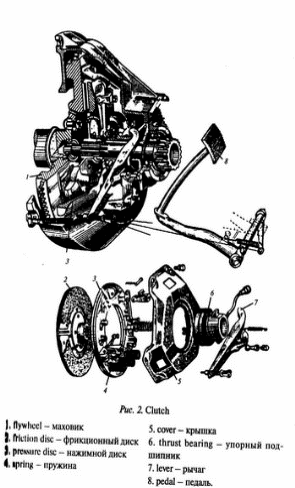
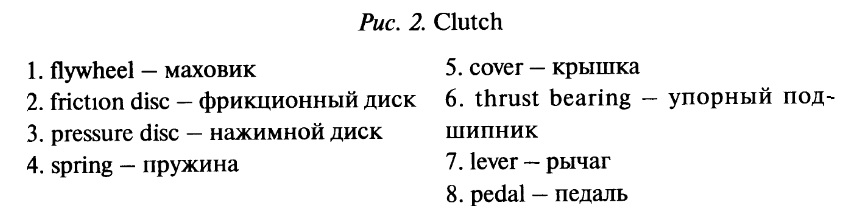
The clutch is a friction device. It connects the engine to the gears in the gearbox. It is used for disconnecting the engine from the gearbox, for starting the car and for releasing the engine from the car wheels.
The clutch is fixed between the flywheel of the engine and the gearbox and consists of two plates (discs): the friction disc and the pressure disc. The friction disc is situated between the flywheel and the pressure plate and has a hard-wearing material on each side.
The basic principal operation of the clutch is a frictional force acting between two discs. The clutch is controlled by the clutch pedal. When the pedal is at rest the clutch is engaged and the running engine is connected to the gearbox. When the pedal is pressed down the clutch is disengaged and the engine runs idly.
1. What device is the clutch?
2. What units does it connect?
3. What is the clutch used for?
4. Where is the clutch placed?
5. What plates does the clutch consist of?
6. What is the basic principal operation of the clutch?
7. What is the clutch controlled by?
8. What takes place when the clutch pedal is at rest?
9. When does the engine run idly?
№5. Find the words in the text and write them:
их русские эквиваленты.
Friction device, clutch, gearbox, to free, to start, to release, flywheel, pressure plate, basic principle of operation, to fix, hard-wearing material, to consist of, to be controlled by, running engine, to run idly, to engage, to disengage, to press down, to be at rest.
№6. Read, translate and act the dialogue:
A: What is the function of the clutch?
В: You see, it serves three functions. It is used for freeing the engine from the gearbox, for starting the car and for freeing the engine from car wheels.
A: Is it a friction device?
В.: Yes, of course. It is fixed between the flywheel of the engine and the gearbox and usually consists of two discs.
A: What discs?
В: The friction disc (driven disc) and the pressure disc.
A.: I suppose the principle of operation of clutches is a frictional force between discs. Am I right?
В.: Yes, you are. When the clutch is fully engaged the frictional force makes discs rotate at the same speed.
A: And by what is the clutch controlled?
B: By the clutch pedal. When it is at rest the clutch is engaged and when it is pressed down the clutch is disengaged and the engine is disconnected from the car wheels.
A.: Thank you. And what types of clutches do you know?
B: Positive clutches and gradual engagement clutches.
A: Thank you very much for your information.
B: Not at all. Glad to help you.
№7. Find the words in the dialogue and write them:
Функция сцепления, для отключения двигателя от коробки передач, крепится между маховиком и коробкой передач, фрикционный (ведомый) диск, нажимной диск, фрикционная сила, сцепление включено, педаль в исходном положении, педаль сцепления нажата.
№8. Write out 7 nouns with singular –plural – translation forms from the text ex.4:
Example: driver – drivers - водители
№9. Write out 3 sentences in Passive Voice from ex.4 and translate them:
Example: The frame is insulated from these parts by rubber pads.- Рама изолирована от этих частей резиновыми прокладками.
№10. Write positive –comparative – superlative adjectives:
Example: fast – faster - the fastest
old, important , long, polite, thin, silly, bad, expensive, short, wise, fat, happy
№11. Write 4 forms of the verbs:
Example: stop – stopped – stopped – stopping; go – went – gone - going
insulate, withstand, provide, have, prevent, know, receive, see, vibrate, throw
Lesson 6
The gearbox
№1. Write the new words “The gearbox” in your copybook and make your own sentences:
gear — шестерня, передача
gearbox - коробка передач
gearing - зубчатое соединение
road conditions — дорожные условия
forward speed — передняя скорость
reverse drive – обратный (задний) ход
low gear - первая передача
top gear — четвертая (прямая) передача
sliding-mesh gearbox – коробка передач со скользящими шестернями
constant-mesh gearbox- коробка передач с постоянным зацеплением шестерен
epicyclic (planetary) gearbox - эпициклическая (планетарная) коробка передач
ordinary gearing — стандартное зубчатое соединение
characteristic feature — характерная особенность
fixed axes – зафиксированные (неподвижные) оси
rotate bodyly — вращаться корпусом
axis - ось
axle — вал
shifting – переключение
№2. Translate the international words and make your own sentences:
construction, constructional, class, classification, planet, planetary, history, historical, mechanism, mechanical, electric, electromagnet.
№3. Translate into Russian:
Move - movement; vary - various; arrange - arrangement; history - historical - historically; wide - widely; simple - simply; safe - safety; to improve - improvement; to move - movement; to drive - driver; to apply - application; to arrange - arrangement; to perform - performance; name - namely; to equip — equipment.
№4. Read, translate the text and answer the questions:
The gearbox is placed between the clutch and the propeller shaft. The principal function of the gearbox is to vary the speed of the car movement to meet the road conditions. The gearbox provides four forward speeds and one reverse, as follows:
1. First or low gear; 2. Second gear; 3. Third gear; 4. Fourth or top gear; 5. Reverse gear.
There are many constructional arrangements of gearboxes, which can be classified as follows: 1. Sliding-mesh type; 2. Constant-mesh type; 3. Epicyclic (planetary) type.
The sliding-mesh type is the simplest one and is the oldest historically. The constant-mesh type is the most widely used type. They are termed "ordinary" gearing, the characteristic feature of which is that I lie axes of the various gears are fixed axes. The gears simply rotate about their own axes.
The characteristic feature of epicyclic (planetary) gearing is that one gear rotates about its own axis and also rotates bodily about some other axis.
To secure the several speeds of the car the clutch shaft is mounted in direct line with the gearbox shaft. The gearbox shaft carries on it the sliding gears which are used for shifting to secure the forward speeds and the reverse drive.
1. Where is the gearbox situated?
2. What is the function of the gearbox?
3. What speeds does the gearbox provide?
4. What types of gearboxes do you know?
5. Why is the clutch shaft mounted in direct line with the gearbox shaft?
№5. Translate into English:
1. Коробка передач предназначена для изменения скорости движения автомобиля.
2. Коробка передач обеспечивает четыре передние скорости и задний ход.
3. Коробки передач могут быть: со скользящими шестернями, с постоянным зацеплением шестерен и планетарного типа.
4. Самыми простыми являются коробки передач со скользящими шестернями.
5. Коробки передач с постоянным зацеплением шестерен используются наиболее часто.
6. Скользящие шестерни на валу коробки передач используются для обеспечения передних скоростей и обратного хода.
№6. Write the new words “Brakes” in your copybook and make your own sentences:
brakes — тормоза
force the fluid — подавать жидкость
performance - работа
under pressure - под давлением
brakes are applied — тормоза срабатывают
braking effort - тормозное усилие
push down on the brake pedal - нажать на тормозную педаль
drum brakes — барабанные тормоза
band brake — ленточный тормоз
disk brakes - дисковые тормоза
shoe brake — колодочный тормоз
hydraulic assisted brakes — тормоза с гидравлическим приводом
brake fluid — тормозная жидкость
brake pedal - тормозная педаль
master cylinder – главный цилиндр
№7. Read, translate the text “Brakes” and answer the questions:
Brakes are used to slow or stop the car where it is necessary. It is one of the most important mechanisms of the car as upon its proper performance the safety of passengers depends. Car brakes can be divided into two types, namely: drum brakes and disc brakes. The drum type may be either a band brake or a shoe brake. Depending on their functions, the automobile has foot brakes and hand brakes (parking brakes). According to their mode of operation, the brakes are classified as: mechanical brakes, hydraulic brakes, airbrakes, electric brakes. Brakes are controlled by the brake pedal.
Most braking systems in use today are hydraulic. This system consists of a master cylinder mounted on the car frame and wheel cylinders. When the driver pushes down on the brake pedal, it forces the piston to move in the master cylinder and brake fluid is delivered from it to the wheel cylinders. The piston movement causes brake shoes to move and the brakes are applied (the brake shoes are pressed against the brake drums). The air brake uses compressed air to apply the braking force to the brake shoes.
Electric brakes use electromagnets to provide the braking effort against the brake shoes. Formerly brakes were applied only to the two rear wheels, but now all cars are equipped with all-wheels brakes. Today many improvements are being made in brakes.
1. What is the function of the brakes?
2. What types are brakes divided into?
3. What brakes do you know according to their mode of operation?
4. What braking systems are used today?
5. By what are brakes controlled?
6. When are brakes applied?

№8. Translate the words and word-combinations into English:
Тормоза, безопасность пассажиров зависит от правильной работы тормозов, барабанные тормоза, дисковые тормоза, тормоза с усилителем, гидравлический привод тормозов, жидкость под давлением, тормоза срабатывают, тормозное усилие, нажать на тормозную педаль.
№9. Translate the sentences into English:
1. Тормоза являются наиболее важным механизмом автомобиля.
2. Они используются для замедления движения или остановки автомобиля.
3. Тормоза можно разделить на два типа, а именно: барабанные тормоза и дисковые тормоза.
4. На большинстве автомобилей используется гидравлический привод или пневматический привод.
5. Тормоза срабатывают, когда водитель нажимает на тормозную педаль.
№10. Form the nouns using the suffix from these words and translate them:
differ, lubricate, transmit, drive, perform, rotate, inform, arrange, connect, describe, combust, improve, compress, move, construct, attach, vibrate, operate, engage, equip
Lesson 7
Steering System
№1. Write the new words “Steering system” in your copybook and make your own sentences:
guide the саг — управлять автомобилем
means of turning — средство поворота
front wheels – передние колеса
steering wheel — рулевое колесо
steering column — рулевая колонка
pivot — шарнир
swing (swang, swung) - поворачиваться
steering knuckle arm – рычаг поворотного кулака
tie-rod — поперечная тяга
in turn — в свою очередь
pitman arm - рулевая сошка
rack and pinion assembly — рулевой механизм с рейкой и шестерней
ball joint — шаровой шарнир
leverage — рычажный механизм
hose — шланг, рукав
steering gear assembly – рулевой механизм
rack and pinion type - реечно-шестеренчатый тип (рулевого механизма)
recirculating ball steering - рулевой механизм с шариковой гайкой
steering box - картер рулевого механизма
№2. Translate the international words and make your own sentences:
column, spindle, system, hydraulic, pump, reservoir, popular, type, effective, effectiveness, effectively, energy, function, to deform, deformation.
№3. Translate into Russian:
Rotate — rotation, apply — application, move — movement, develop — development, drive — driver, form - reform - deform - deformation, guide — guidance.
№4. Read, translate the text and answer the questions:
То guide the car, it is necessary to have some means of turning the front wheels so that the car can be pointed in the direction the driver wants to go. The steering wheel in front of the driver is linked by gears and levers to the front wheels for this purpose. The front wheels are on pivots so they can be swung to the left or right. They are attached by steering knuckle arms to the rods. The tie-rods are, in turn, attached to the pitman arm.
When the steering wheel is turned, gearing in the steering gear assembly causes the pitman arm to turn to the left or right. This movement is carried by the tie-rods to the steering knuckle arms, and wheels, musing them to turn to the left or right.

The steering system incorporates: the steering wheel and column, steering gear, pitman arm, steering knuckle arm, front axle, steering knuckle pivot, tie-rods.
There are several different manual steering gears in current use, such as the rack and pinion type and the recirculating ball type. The rack and pinion steering gear are widely used. Another manual steering gear which is popular in imported cars is the worm and sector type.
The steering wheel and column are the source of injury to the driver, air bags and other devices being developed now to save the life of a driver. Energy-absorbing columns must stop the steering wheel and column from being pushed to the rear as the front of the car is crushed in an impact. Energy-absorbing columns must also provide the driver with a tolerable impact as he moves forward and strikes the wheel with his chest.
1. What mechanism is necessary to guide the car?
2. How is the steering wheel connected to the front wheels?
3. Why can the front wheels be swung to the left or to the right?
4. What does the manual steering system incorporate?
5. What types of manual steering gears in use do you know?
№5. Translate into Russian and underlined the gerund:
1. То guide the car it is necessary to have some means of turning the front wheels.
2. The steering wheel in front of the driver is linked by gears and levers to the front wheels for turning the car in the direction the driver wants to go.
3. Without using the steering system the car moves only in the direct position.
4. Manufacturers can use rack and pinion type steering gear without choosing another type because "rack and pinion" type steering is very dependable.
5. Energy-absorbing columns must stop the steering wheel from being pushed to the rear when the front of the car is damaged in an impact.
№6. Read the text, try to focus on its essential facts and choose the most suitable heading given below for each paragraph.
1) Engine
2) Suspension System
3) Integral Chassis Frame and Body
4) Motor Car Components
5) Transmission and Drive Lines
MOTOR CAR STRUCTURE
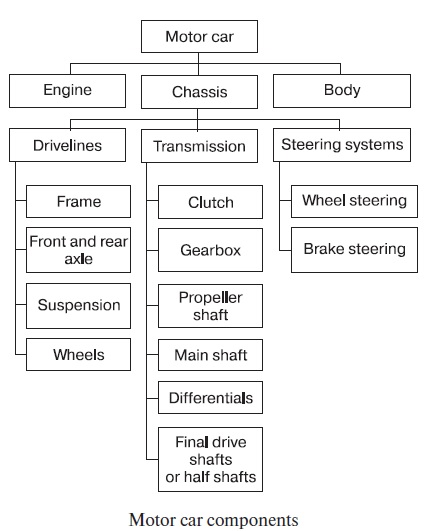 A structure of a vehicle has to fulfil a number of requirements. The prime purpose of the vehicle structure is to provide a location for all the necessary vehicle systems and components. The purpose of the vehicle will also dictate the size and weight of the vehicle systems and components and therefore the structure will be designed accordingly. The main structural components of a motor car are engine, chassis and body. Chassis embraces transmission (clutch, gearbox, propeller shaft, main shaft, differentials, final drive shafts or half-shafts), drive lines (frame, front and rear axles, suspension and wheels) and steering systems (wheel steering and brake steering).
 The usual source of power for a motor car is an internal combustion engine. A petrol (gasoline) engine has traditionally been the most popular for light passenger vehicles. The engine in heavy vehicles is usually a large capacity diesel, the main requirements for which are an ability to produce high levels of pulling power, reliability, and low fuel consumption.
The power of the engine is transmitted through the transmission and drive lines to the drive wheels. For the rear-wheel drive (RWD) layout, the rear wheels act as the driving wheels. Spacing out the main components in this layout makes each unit accessible but a drawback is the intrusion of the transmission components into the passenger compartment. The compactness of the front-wheel drive (FWD) layout has made it very popular on modern cars, especially on small cars. The arrangement of four-wheel drive (4WD) is safer because it distributes the drive to all four wheels and during acceleration it reduces the risks of wheel spin.
The suspension system involving springs, shock absorbers and linkages serves a dual purpose: contributing to the vehicle’s handling for good active safety and driving pleasure, and keeping vehicles occupants comfortable and reasonably well isolated from road bumps, vibrations, etc.
Most modern cars are built with an integral chassis frame and body. This frameless or integral arrangement provides a stiff light construction to the motor car, which is particularly suitable for mass-produced vehicles. A suitable designed body shell can withstand various frame stresses. A lightweight unitary construction contains relatively light vehicle systems and components and provides sufficient space for a driver and passengers.
№7. Agree or disagree with the following statements:
1. To provide a location for all the necessary vehicle systems and components is the prime purpose of the vehicle structure.
2. The usual source of power for a motor car is a diesel.
3. The front-wheel drive layout is rather compact.
4. Most of the modern cars are designed with an integral chassis frame and body.
5. A small passenger vehicle with a light unitary construction doesn’t provide sufficient space for a driver and passengers.
№8. Try to enrich your vocabulary:
a) find words in the text which have the same meanings as the following words:
to perform, some, most important, aim, to construct, integral, enough, major, parts, motor, big, disadvantage, embrace, different;
b) find words in the text whose meanings are opposite to the meanings of the
following words:
external, heavy, low, big, passive, old, frameless, unsuitable, unusual;
№9. Match each word with its correct definition
clutch, gearbox, axle, suspension, transmission
1. The part of the vehicle that takes power from the engine to the wheels.
2. A metal box that contains the gears of the vehicle.
3. A piece of equipment in a vehicle that you press with your foot when
you change gear.
4. The equipment that makes a vehicle move smoothly when it goes over
bumps on the ground.
5. A metal bar that connects a pair of wheels on a car or other vehicle.
№10. Read and act the dialogue:
Customer: Hello, my car is making a strange noise. Can you take a look?
Mechanic: Sure, can you describe the noise?
Customer: It's a sort of whining noise when I accelerate.
Mechanic: Let's start by checking the engine. Could you pop the hood?
Customer: Sure, here you go.
Mechanic: I see, it looks like your serpentine belt is worn out.
Customer: Is it serious?
Mechanic: It needs to be replaced as soon as possible to avoid further damage.
Customer: How long will it take?
Mechanic: It should take about an hour.
Customer: And how much will it cost?
Mechanic: Including parts and labor, it will be around $150.
Customer: Okay, please go ahead and replace it.
Mechanic: We'll get started right away.
№11. Complete the sentences: change the word in capitals at the end of each sentence to form a word that fits suitably in the blank space:
1. The frameless arrangement is … for mass-produced vehicles SUIT.
2. This unitary structure has sufficient space for a … and passengers DRIVE.
3. In the rear-wheel drive layout each unit is … ACCESS.
4. The suspension system involves shock … ABSORB.
5. This integral … provides a stiff light construction to the motor car ARRANGE.
№12. Write and learn the professional lexical material:
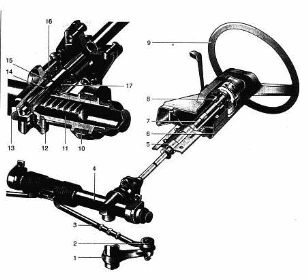 Rack-and-pinion steering (Реечный рулевой механизм)
1 – steering arm – рычаг поворотного кулака
2 – ball joint – сферический шарнир
3 – drug link – рулевая тяга
4 – steering gearbox – картер рулевого механизма
5 – steering shaft bracket – кронштейн крепления рулевого вала
6 – steering column housing – кожух рулевой колонки
7 – steering (pinion) shaft – рулевой вал
8 – bearing part – подшипник
9 – steering wheel – рулевое колесо
10 – supporting bush – опорная втулка
11 – rack – рейка
12 – stop – упор
13 – roller bearing – роликовый подшипник
14 – pinion – шестерня
15 – ball bearing – шариковый подшипник
16 – bearing nut – гайка подшипника
17 – seal ring – уплотнительное кольцо


Вебинар для учителей

🎓 Свидетельство об участии ✨БЕСПЛАТНО!✨



