


Россия, р.п. Красные Баки


СДЕЛАЙТЕ СВОИ УРОКИ ЕЩЁ ЭФФЕКТИВНЕЕ, А ЖИЗНЬ СВОБОДНЕЕ
Благодаря готовым учебным материалам для работы в классе и дистанционно
Скидки до 50 % на комплекты
только до
Готовые ключевые этапы урока всегда будут у вас под рукой
Организационный момент
Проверка знаний
Объяснение материала
Закрепление изученного
Итоги урока

Была в сети 31.10.2026 19:58
Воронина Марина Владимировна
преподаватель английского и немецкого языка, преподаватель информатики
 91 619
 192

Местоположение
Специализация
Методические указания 2 курс 5 часть (ТОР) 2026
Категория:
Английский язык
06.05.2026 10:41

Просмотр содержимого документа
«Методические указания 2 курс 5 часть (ТОР) 2026»
МИНИСТЕРСТВО ЛЕСНОГО ХОЗЯЙСТВА
И ОХРАНЫ ОБЪЕКТОВ ЖИВОТНОГО МИРА НИЖЕГОРОДСКОЙ ОБЛАСТИ
Государственное бюджетное профессиональное
образовательное учреждение Нижегородской области
«КРАСНОБАКОВСКИЙ ЛЕСНОЙ КОЛЛЕДЖ»
(ГБПОУ НО «КБЛК»)
МЕТОДИЧЕСКИЕ УКАЗАНИЯ
по дисциплине «Иностранный язык
в профессиональной деятельности (Английский язык)»
для студентов II курса 5 часть
Тема 2.1. Достижения и инновации в науке и технике и их изобретатели. Отраслевые выставки
для специальности 23.02.07 Техническое обслуживание
и ремонт автотранспортных средств 
Разработали:
преподаватели иностранных языков
Воронина М.В.,
Булкина Т.А.
Красные Баки
2026
Lesson 1
History of the automobile
№1. Read and translate the text. Write out the bold words and translate them:
The history of the automobile goes back several hundred years. One of the earliest attempts to propel a vehicle by mechanical power was suggested by sir Isaac Newton about 1680. It was little more than a toy consisting of a steam boiler supplying a steam jet turned to the rear. However, the credit for building the first self-propelled road vehicle must undoubtedly go to the French military engineer, Nicholas Cugnot (Кюньо). Between 1763 and 1769 two steam-driven carriages were built and tried.
In 1784 the Russian inventor Kulibin built a three-wheeled carriage. In his vehicle he used for the first time such new elements as brakes, rollers and a gear-box. The first Englishman to build a full-size self-propelled vehicle for use on the roads and to obtain practical results was Threvithick (Тревитик). Between 1798-1800 he built several working models. Up to 1860 most of road vehicles were powered by steam engines which ran at slow speeds. In 1860 Lenior (Ленуар) of Paris built an internal combustion engine which ran on city gas, the gas being ignited by an electric spark. In 1866, Otto invented the type of four-stroke cycle engine which is used today.
Slowly but surely the auto industry is perfecting a number of alternatives to the conventional engines found in almost all of today's passenger cars. Two prime factors lie behind the search for different engines - the necessity to reduce air pollution by requiring cleaner auto exhaust and the desire to produce cars that will run farther on a gallon of fuel. While basic research is continuing on electric and steam powered engines, the diesel, turbine and Stirling are current industry favourites.
Diesels get better mileage than gasoline engines, and the fuel is usually cheaper. In 1890's, Rudolf Diesel, invented the engine that bears his name. As air is drawn into the engine and compressed internal temperatures rise, and pressures reach two to three times those in a gasoline engine. The extreme pressures have meant that diesels usually are much larger and heavier than gasoline engines of the same power potential.
The disadvantages of diesels as passengers - car engines are slow performance, noise and smoke. The turbine and Stirling are multifuel engines, capable of running on any liquid that will burn, including such exotic types as peanut oil and perfume. This would be a major advantage if severe petroleum shortages develop.
The turbine cars now operating are handbuilt models that cost more than 1 million dollars each. Alloys of precious metals of high durability are still required for certain vital turbine parts. Engineers believe that progress in ceramics hold the key to making turbines practical alternatives to present-day engines.
The Stirling concept, first offered more than 150 years ago by a Scottish clergyman, involves external instead of internal combustion. In the new design, hydrogen gas is heated by a burner, which can run on virtually all kinds of fuel. Engineers point out that a Stirling engine would be quieter than an equivalent internal combustion engine, would emit less toxic gases, and would use fuel more economically. Yet, there is still opinion in the auto industry that the conventional gasoline powered engine - the type in almost universal use now - will continue to dominate until or unless outside circumstances dictate otherwise.
№2. Answer the questions.
1. Who made an attempt to propel a vehicle?
2. Who built the first self-propelled road vehicle?
3. What kind of carriage did the Russian inventor Kulibin build in 1784?
4. What did Kulibin use in his vehicle for the first time?
5. What were all road vehicles up to 1860 powered by?
6. What did Lenoir built in 1860?
7. How did an internal combustion engine run on?
8. When was the four-stroke cycle engine invented?
9. What are the main factors that are important search for different engines?
10. Why are these factors very important?
11. What are the disadvantages of diesel?
12. When was the Stirling engine invented?
13. Will electric cars replace the conventional vehicles?
14. What kind of engine will dominate in the near future?
№3. Write out from the text:
a) o первых попытках использовать механическую энергию для приведения в движение экипажа;
б) об основных требованиях, предъявляемых к автомобилю.
№4. Continue the sentences:
1. The history of the automobile goes back...
a) a hundred years;
b) a thousand years;
с) several hundred years.
2. Diesels are usually much larger and heavier than...
a) gasoline engines;
b) turbine cars;
c) Stirling engines.
3. The disadvantages of diesels are...
a) low speeds;
b) noise and smoke;
c) heavy weights.
4. The turbine and Stirling are multifuel engines, capable of running on...
a) petrol only;
b) peanut oil and perfume;
c) benzene.
№5. Write out the sentences with the dates from the text:
№6. Translate into Russian:
vehicle, mechanical power, self-propelled, was constructed, a steam-driven carriages, wheels, passengers, motor cars, issued, prosecuted, of gasoline engines, introduced the four-stroke cycle of operation, two-seated cars, efficient, international combustion engine, abolition, automobile industry, collect antique cars, advertisements.
№7. Continue the sentences using the text:
1) In … the Russian inventor Kulibin built a three-wheeled carriage.
2) Diesels get better … than gasoline engines, and the fuel is usually cheaper.
3) Alloys of precious metals of high durability are still required for certain …
4) In the new design, … gas is heated by a burner.
5) One of the earliest attempts to propel a vehicle by … was suggested by sir Isaac Newton.
№8. Make up the text using the words:
the history of the automobile mechanical power, a steam boiler, self-propelled, vehicle steam-driven carriages, brakes, gear-box, steam engines, internal-combustion engine, air-pollution, diesel engines, turbine cars, Stirling engine;
to go back, to propel, to build, to use, to obtain, to be powered by, to invent, to reduce, to produce, to offer, to involve, to dominate.
№9. Match the definitions to the words:
| 1. production
2. to design
3. automobile
4. carriage 5. pollution
6. engine 7. vehicle
8. engineer
9. fuel
10. to combust | a. to make or draw plans for something, for example clothes or buildings b. damage caused to water, air, etc. by harmful substances or waste c. a road vehicle with an engine, four wheels, and seats for a small number of people d. to start to burn e. a substance that is used to provide heat or power, usually by being burned f. the process of making or growing goods to be sold g. a vehicle with four wheels that is usually pulled by horses and was used mainly in the past h. a machine that uses the energy from liquid fuel or steam to produce movement i. a person whose job is to repair or control machines, engines, or electrical equipment j. a machine, usually with wheels and an engine, used for transporting people or goods on land, especially on roads |
№10. Read, translate the text. Are the statements true or false? Correct false ones:
History of the automobile
The Ford Model T and Volkswagen Beetle are among the most mass-produced car models in history. In 1769 the first steam-powered automobile capable of human transportation was built by Nicolas-Joseph Cugnot. In 1808, François Isaac de Rivaz designed the first car powered by an internal combustion engine fueled by hydrogen. In 1870 Siegfried Marcus built the first gasoline powered combustion engine, which he placed on a pushcart, building four progressively sophisticated combustion-engine cars over a 10-to-15-year span that influenced later cars. Marcus created the two-cycle combustion engine. The car's second incarnation in 1880 introduced a four-cycle, gasoline-powered engine, an ingenious carburetor design and magneto ignition. He created an additional two models further refining his design with steering, a clutch and a brake.
The four-stroke petrol (gasoline) internal combustion engine that still constitutes the most prevalent form of modern automotive propulsion was patented by Nikolaus Otto. The similar four-stroke diesel engine was invented by Rudolf Diesel. The hydrogen fuel cell, one of the technologies hailed as a replacement for gasoline as an energy source for cars, was discovered in principle by Christian Friedrich Schönbein in 1838. The battery electric car owes its beginnings to Ányos Jedlik, one of the inventors of the electric motor, and Gaston Planté, who invented the lead–acid battery in 1859. In 1885, Karl Benz developed a petrol or gasoline powered automobile. The automobile was powered by a single cylinder four-stroke engine. In 1913, the Ford Model T, created by the Ford Motor Company five years prior, became the first automobile to be mass-produced on a moving assembly line. By 1927, Ford had produced over 15,000,000 Model T automobiles. At the turn of the 20th century electrically powered automobiles became a popular alternative method of automobile propulsion.
1) The first steam-powered automobile capable of human transportation was built by Nicolas-Joseph Cugnot in 1838.
2) The four-stroke petrol internal combustion engine was patented by Nikolaus Otto.
3) By 1927, Ford had produced over 15,000,000 Model T automobiles.
4) Siegfried Marcus built the first gasoline powered combustion engine 1n 1769.
5) Karl Benz developed an electrical powered automobile in 1885.
6) In 1880 a two-cycle, gasoline-powered engine, an ingenious carburetor design and magneto ignition was introduced.
7) The battery electric car owes its beginnings to Ányos Jedlik
Lesson 2
Simple Tenses
№1. Study the material:
| Simple | ||
| Present | Past | Future |
| Настоящее простое время | Прошедшее простое время | Будущее простое время |
| Обозначает регулярное действие, то, что происходит постоянно, каждый день. | Регулярное действие, факты в прошлом | Действие, относящееся к будущему |
| Указатели времени: usually – обычно every day – каждый день often – часто always – всегда sometimes – иногда | Указатели времени: yesterday – вчера last week(month, year) –на прошлой неделе( месяце, году) two days ago – 2 дня тому назад | Указатели времени: tomorrow – завтра in a week – через неделю next year – в следующем году next time – в следующий раз |
| Вспомогательные глаголы | ||
| do does (в 3-ем лице, ед.ч.) Употребляются только в вопросительных и отрицательных предложениях | did Употребляются только в вопросительных и отрицательных предложениях | shall ( только с I, we) will ( со всеми остальными) Употребляются во всех предложениях |
| Положительное предложение | ||
| V1
3 л., ед.ч. V-s,-es
| V2
V2 = Ved
|
I, We V1
V1
|
| Отрицательное предложение | ||
| V1
3 л., ед.ч. V1
|
V1
| I, We V1
V1
shall not = shan’t will not = won’t
|
| Общий вопрос | ||
| V1 Do 3л. ед.ч. V1 Does | V1 Did | I, we V1 Shall V1 Will |
| Специальный вопрос
| ||
| V1 Wh. do 3л. ед.ч. V1 Wh. does | V1 Wh. did | I, we V1 Wh. shall V1 Wh. will |


 shall

 did not
 shall not
 will not
№2. Write and translate your own sentences using the verbs.
Begin your sentences as: A car mechanic …
repair, have, do, design, replace, wash, make, study, check, try
№3. Write the sentences in Present, Past and Future Simple:
One fly … (to fly), two flies … (to fly).
One girl … (to cry), four girls … (to cry).
Wolves and sheep … (to be) never friends.
Boys … (to fight) and … (to shout).
That boy … (to try) to catch some balls.
These girls … (to try) to run away from an angry turkey.
№4. Write the text in Past Simple:
He ____ (get) up at 7. He _____ (have) his English lesson every day. Не ____ (speak) English to his friends. He _____ (play) board games in the afternoon. Sometimes he _____ (swim) in the lake. He often _____ (go) hiking. He sometimes ____ (sit) by the camp fire in the evenings. He never ______ (go) on a trip without his friends.
№5. Translate the text. Write out all verbs in 3 forms:
Clara had a car accident when she was ten years old. When she grew up she was afraid of cars. Then she met Brad who was a professional racing driver. He wanted to help her and drove her in his car every day. So in five years Clara became a racing driver too. Now she drives 200 km per hour and takes part in sports championships. She really enjoys driving and has a lot of future plans. Next year she will open a driving school. And Clara and Brad will get married quite soon.
№6. Make up special questions:
I lived in London last month. (Where)
Kris speaks English. (What language)
His sister will be a model next year. (Who)
I like my phone. (What)
Masha read magazine two hours ago. (When)
This car was black. (What color)
This shop will open at 9 o’clock tomorrow. (What time)
She was pretty. (Who)
Tom will play football next Sunday. (When)
Marina wore skirts. (What)
№7. Write negative and interrogative sentences:
My friends will go to the zoo next Sunday.
The weather is good.
We took the exam last week.
You went to the park last Sunday.
Ben will be at school in 10 minutes.
He calls me every day.
№8. Write the sentences and open the brackets, translate the sentences:
We … (go) roller-skating last Saturday.
Our granny … (bake) meat-pies every weekend.
We … (write) an essay tomorrow.
I really … (enjoy) the opera yesterday.
How many books they … (bring) tomorrow?
British people … (prefer) tea to coffee.
Where … your husband … (work) five years ago?
Where she usually … (celebrate) her birthdays?
Nina and Nick … (get married) in two weeks.
Newton … (invent) the telescope in 1668.
… you … (have) a big family?
Stanley … (have) two sons and a daughter.
№9. Translate into English using Present, Past or Future Simple (define the time):
1. Механик проверил машину вчера.
2. Она поедет на машине в город завтра.
3. Он каждый день учит правила дорожного движения.
4. В следующем году Михаил сдаст экзамен на права.
5. Каждое лето мы ездим к бабушке в деревню.
6. В прошлом году они ездили в Крым.
7. Вы любите ездить на машине?
8. Кейт пойдёт или поедет на автобусе в колледж завтра?
9. Они не посещают музеи и галереи каждое лето?
10. Ты был в Москве?
№10. Complete the sentences choosing the correct adverb of time:
The students of British schools wear a uniform …
a) usually b) yesterday c) next year d) last year
2. My family lived in the country…
a) every summer b) last summer c) next summer d) soon
3. He will read a book …
a) often b) a week ago c) in a week d) seldom
4. We are at college …
a) every day b) last month c) next month d) suddenly
5. They were in the zoo …
a) sometimes b) yesterday c) always d) tomorrow
Lesson 3
Inventors of the first cars
№1. Translate the words and word-combinations:
advance, advanced, advantage, candle, candle light, chemist, code, Morse code, design, to design, diesel, discovery, dot-and-dash alphabet, due to, engine, steam engine, internal combustion engine, petrol engine, fire, fire bullets, flunk, fuel, run on fuel, horsepower, invent, inventor, invention, patent, penetrate, to perfect, to produce, reliable, rubber, rubber solution, to split, to succeed in
№2. Read and translate the text:
Over the centuries, man’s way of life was changed by a relatively small number of discoveries and inventions. But changes have come more and more often since the steam engine was invented in 1765 by James Watt. In just two hundred years, man advanced from horsepower and candle light to aeroplanes and neon lams. Our ideas about travel have changed completely since Gottlieb Daimler and Charles Benz built their first petrol engine in 1885 and the Wright Brothers made the first flight in 1903.
In 1897 Rudolf Diesel invented a new internal combustion engine. It is known as a diesel and it began a transport revolution in cars, lorries, trains and ships. The main advantage of diesels is that they run on rather cheap fuel.
Charles Rolls was a British aristocrat and businessman, who was especially interested in cars. Once he met another enthusiast of cars Henry Royce, a famous car engineer. They decided to design the most comfortable and reliable car. At the beginning of the 20th century it seemed to be a fantasy. But in 1907 they managed to create the world – famous Rolls – Royce car. It was so comfortable and reliable that one of the models “Silver ghost” hadn’t changed greatly for 20 years since 1907.
Samuel Colt, who was an American, designed and patented a pistol in 1836. It had a revolving barrel and could fire 6 bullets one after the other. It was the first pistol of its kind. Later there came many other pistols with 6 bullets.
Samuel Finley Morse was a portrait painter, who became an inventor. For 12 years he tried to perfect the telegraph and succeeded in inventing the telegraphic dot - and – dash alphabet, now known as Morse code. Though there were some other codes in America in the 19th century, Morse code is used nowadays all over the world.
Charles Makintosh was a chemist by profession. He worked in a textile industry and in 1823 he developed a rubber solution used for raincoat production. Raincoats with this rubber solution didn’t allow water to penetrate. These raincoats were called makintoshes and people use them in rainy weather.
Some people say we live in the age of computers; but it is also correctly described as the atomic age or the space age. Today, a journey from London to Cairo takes hours. Only a hundred years ago it took weeks. Today, men think seriously of going to Mars. 50 years ago they only dreamt about it. Today we produce energy by splitting the atom. A century ago, no one believed it could be split. Due to inventions, technology has advanced so quickly that cars and televisions are out of date only a few years after they were made.
№3. Continue the sentences and translate them:
Changes in the man’s way of life have become more evident since
the discovery of a pistol with 6 bullets;
1765;
the birth of Edison, one of the greatest inventors;
the first patented invention was registered.
An invention is
the case of finding something which existed before but was not known to people. It is often a place or a scientific fact;
a difficulty that needs attention and thought in order to solve it;
something that is finished or gained through skill or hard work;
a useful thing or idea which is produced by scientists for the first time.
The “Silver Ghost” model was
famous for its reliability and comfort;
created by Wright brothers;
one of the best racing cars at the beginning of the 20th century.
named after its creator Tom Silver.
Due to the development of a rubber solution
raincoats were called makintoshes;
a transport revolution began;
the production of waterproof raincoats was quite successful;
raincoats became very popular.
№4. Match the parts of the sentences:
| 1. A steam engine … | a. very popular even nowadays |
| 2. A new internal combustion engine… | b. was the most comfortable and reliable car. |
| 3. The main advantage of diesels is… | c. was invented by Rudolf Diesel. |
| 4. The world famous Rolls Royce car… | d. was invented by James Watt. |
| 5. All the cars produced by the firm “Daimler-Benz”… | e. was a car engineer by profession. |
| 6. Henry Royce…. | f. were called “Mercedes-Benz”. |
| 7. A German engineer Rudolf Diesel… | g. made his famous invention in 1897. |
| 8. Morse code is… | h. that they run on rather cheap fuel. |
№5. Put the sentences in chronological order:
These two inventors managed to design the most reliable and comfortable car for the beginning of the last century.
He invented the first gun with 6 bullets.
This invention got its name after the inventor and is used in rainy weather.
The invention of this engine gave birth to a large number of other discoveries and inventions.
This invention is used nowadays all over the world though there were some other inventions on analogy in the 19th century.
Last century was remarkable for the introduction of the laser, the proliferation of calculators and computers and a revolution in the telecommunication industry
The main advantage of that invention was that it used rather cheap fuel.
№6. Complete sentences using the text:
Changes have come more and more often since…
The main advantages of diesels is …
Charles Rolls was a British aristocrat and businessman…
Some people say we live ….
Today men think ….
Due to inventions ….
№7. Write what these people invented:
R. Diesel
S. Colt
C. Rolls
C. Makintosh
S. Morse
C. Benz
№8. Fill in the blanks by changing the words on the right:
| His … could not be used to protect tall buildings during a storm.
| DISCOVER |
| This … became very popular because it gave off much heat.
| INVENT |
| He persuaded the … to try locomotives.
| DIRECT |
| The … of the colliery bought some engines and began to experiment for himself.
| OWN |
| Samuel Morse was the pioneer of the most widely used electrical … in the world today.
| COMMUNICATE |
| What he needed was a … lamp.
| SAFE |
| Franklin’s … about natural phenomena can be observed from his boyhood.
| CURIOUS |
| At that time people were … afraid of lightning.
| TERRIBLE |
| One day he brought a new … to the laboratory.
| TRANSMIT |
№9. Make the word-combinations and translate them:
| A | B |
| lightning | service |
| metal | power |
| steam | lines |
| railroad | lamps |
| coal | conductor |
| telegraph | light |
| horse | locomotive |
| passenger | gas |
| oil | engine |
| candle | key |
№10. Read and translate the text. Write down the highlighted words with the translation:
Inventors on both sides of the Atlantic discovered during the 1880s that technologies for making self-propelled carriages and wagons had progressed dramatically. Soon sundry vehicles powered by steam, internal combustion engines, and electricity were rolling across Germany, France, and the United States.
The first practical internal combustion engine was built by Etienne Lenoir, a Belgian living in France. Patented in 1860, his water-cooled contraption burned coal gas and was noisy and inefficient; even so, for two decades it had many buyers. Lenoir's engine was a clear proof of concept to other inventors, especially in Europe.
Nikolaus Otto, a German, was one of many inspired by Lenoir's technical and commercial success. Mechanically gifted, Otto sought to improve the Lenoir engine, and in the late 1870s he did. Otto's four-cycle design embodied features that would become standard in gasoline automobile engines.
The cars of that time were very small, two-seated cars with no roof, driven by an engine placed under the seat. Motorists had to carry large cans of fuel and separate spare parts, for there were no repair or filling stations to serve them.
The Otto engine and the many clones it spawned, though intended to replace small steam engines in industry, inaugurated the era of the gasoline-powered automobile. Clearly, the compact internal combustion engine was a most suitable technology for the self-propelled vehicle.
Karl Benz, also a German, employed his own Otto-type engine to power a three-wheel carriage in 1885. These tri-wheelers, with a one-cylinder engine that developed 0.8 hp, were put on the market in 1887, perhaps the earliest commercial automobiles.
In 1891 Benz added a four-wheel motorized carriage to his company's offerings. These automobiles sold well and were widely imitated. In the early 1890s, for example, Planhardet Levassoras well as Pfeugeot in France were peddling cars to the public. Henry Ford, however, was still a long way from building automobiles.
№11. Fill in the blanks in the sentences, using the text and translate the sentences:
1. Inventors on both sides of the Atlantic … during the 1880s that technologies … had progressed dramatically.
2. Patented in 1860, his water-cooled contraption … and was … and … .
3. Otto's four-cycle design … that would become standard in … engines.
4. Motorists had to carry … and separate … , for there were no … or … to serve them.
5. The compact internal combustion engine was a most … for the … .
6. Karl Benz … his own Otto-type engine … a three-wheel carriage in 1885.
№12. Answer the questions:
Who built the first practical internal combustion engine?
Who improved the Lenoir engine?
What era did the Otto engine inaugurate?
Who introduced the First commercial automobile?
Lesson 4
Progressive Tenses
№1. Study the material:
| Progressive | ||
| Present | Past | Future |
| Настоящее длительное время | Прошедшее длительное время | Будущее длительное время |
| Обозначает действие, которое происходит прямо сейчас. | Обозначает действие, которое происходило в определённый момент в прошлом | Обозначает действие, которое произойдёт в определённый момент в будущем |
| Указатели времени: at this moment – в этот момент now - сейчас | Указатели времени: at that time yesterday – в тот момент вчера at 5 o’clock – в 5 часов when he came – когда он пришёл
| Указатели времени: tomorrow at this time – завтра в это время this time next Monday – в это время в следующий понедельник |
| Вспомогательные глаголы | ||
| am ( I ) is (he, she, it ) are (we, you, they )
| was (ед. ч.) were (мн. ч.) | shall be (только с I, we) will be (со всеми остальными) |
| Положительное предложение | ||
| I V4(ing)
3 л., ед.ч. V4(ing)
мн.ч. V4(ing)
| ед.ч. V4
мн.ч. V4
V4 = Ving |
I, We V4
V4
V4 = Ving |
| Отрицательное предложение | ||
| V4
3 л., ед.ч. V4
мн.ч. V4
| ед.ч. V4
мн.ч. V4
| I, We V4
V4
shall not = shan’t will not = won’t |
| Общий вопрос | ||
| V4 Am
3л. ед.ч. V4 Is мн.ч. V4 Are |
ед.ч. V4 Was
мн.ч. V4 Were |
I, we V4 Shall
V4 Will |
| Специальный вопрос | ||
| I V4 Wh. am 3л. ед.ч. V4 Wh. is мн.ч. V4 Wh. are |
ед.ч V4 Wh. was мн.ч. V4 Wh. were |
I, We V4 Wh.shall V4 Wh. will |
№2. Add –ing to the verbs and translate them:
read, write, take, sit, play, look, swim, jump, run, go, do, buy, help, eat, clean, make, speak, sleep, listen, talk, fly, lie, die, come, shop, live, sing, dance, work, have, cry, put, use, stop, drive, win.
№3. Insert auxiliary verb in general questions:
… you going to school now.?
… my friend listening to music at the moment?
… our teacher and we watching an interesting film this lesson?
… they cleaning their teeth today?
… Tom and Tim playing football all day in the park?
… my parents reading comics now?
… my sister scratching her nose when she reads a newspaper?
… you nodding your head at the moment?
… your mother making a sandwich?
… she writing a letter now?
№4. Write sentences using information from table:
| ACTIONS | NAMES |
| read a book | Charlotte |
| swim in the sea | Mr and Mrs Davis |
| play in the sand | Julie and Sam |
| climb a tree | Joe |
| write a letter | Kim |
| lie in the sun | Mandy |
| sit on a towel | Sarah and Charlotte |
| throw a ball | Travis, Fred and Daisy |
| play sand ball | Tom, Paul and Greg |
| eat an ice-cream | Mandy and Sarah |
1) Mrs Davis ______ swimming in the sea.
2) Kim ______ writing a book.
3) Mandy and Sarah ______ eating an ice-cream.
4) Tom and Paul ______ playing sand ball with Fred.
5) Sarah ______ reading a book.
6) Julie and Sam ______ playing in the sand.
7) Mandy ______ lying in the sun but ______ reading a book.
8) Fred and Daisy ______ throwing a ball to Travis.
9) Joe ______ climbing a tree.
10) Sarah and Charlotte ______ sitting on a towel but ______ eating chocolate.
№5. Translate into English, make negative and interrogative sentences:
1. Вчера в 6 часов вечера мы с ребятами играли в футбол.
2. Завтра утром в это время они будут рисовать картину.
3. Я сажала розы вчера в 2 часа.
4. Мы играем в компьютерные игры сейчас.
5. Я шёл в магазин, когда увидел её вчера.
№6. Change sentences into Past Progressive and Future Progressive:
1. Mike is reading an interesting book.
2. Mary is writing a letter to her friends.
3. They are speaking to their teacher now.
4. We are having lunch at the canteen.
5. Wait a minute! I am getting up!
6. Nina is playing the piano.
7. She is brushing her hair.
8. The dog is barking.
№7. Write short positive and negative answers in Present, Past, Future Progressive:
Example: Are they writing the test in English now? –Yes, they are. – No, they are not.
1. Is the secretary typing our papers?
2. Are you helping your mother to cook the dinner?
3. Am I reading your thoughts?
4. Was father reading newspapers at dinner again?
5. Were you wearing this dress at yesterday's party?
6. Was I talking in sleep?
7. Were they quarrelling when you came in?
8. Shall I be carrying my heavy bags myself?
9. Will they be discussing this question at the meeting?
10. Will you be seeing her tomorrow?
№8. Read the text and answer the questions:
Yesterday, it was raining and thundering all day. Ann was playing inside the house. She wanted to be outside. She wasn't playing outside because it was raining. She was feeling tired of being trapped inside the house.
Ann was trying to keep busy inside the house. She was reading her book until the electricity went out. Then, she decided to practice her sewing. She was practicing sewing until lunchtime. After lunch, she sat by the window and watched the rain.
While Ann was watching the rain, the phone rang. Her mother was calling to say she was coming home. She was bringing a new game. Ann and her mother ate ice cream and played the game. While they were playing, the rain stopped! But Ann didn't even notice. She was having such a good time with her mom!
1) Where was Ann playing yesterday?
2) Why wasn't she playing outside?
3) What was Ann doing before the electricity went out?
4) What was she doing until lunchtime?
5) At the end of the story, the rain stopped. What was Ann doing?
№9. Make the next types of sentences:
1) Ann was playing inside the house.
Negative:
Yes/No Question:
WH-Question:
Tag Question:
2) Her mother was calling.
Negative:
Yes/No Question:
WH-Question:
Tag Question:
3) She was bringing a new game.
Negative:
Yes/No Question:
WH-Question:
Tag Question:
4) Ann was watching the rain
Negative:
Yes/No Question:
WH-Question:
Tag Question:
Lesson 5
RUSSIAN AUTOMOBILE ENGINEERING
№1. Read the text. Are these statements true or false? Correct the false once:
The automobile industry in our country has been developed since 1916. Before that time Russia had no automobile industry at all, technical schools had no departments to train specialists in automobile engineering. But in the history of the automobile such names as Shamshurenkov, Blinov, Mamin and other Russian experts in mechanics must be remembered.
The first automobile built by Shamshurenkov, a Russian inventor, was put into motion by the pedalling of the driver himself. Blinov designed and constructed tractor driven by steam engine. Mamin was one of the pioneers in Russian internal combustion engines. Today Russian automobiles are engineered and built in such a manner that they are able to withstand heavy loads for long periods of operation. The modern automobile is much more than a means of riding from one place to another. The passenger’s safety and comfort must be considered as much as the car’s reliable performance and ability to travel on the highways.
The modern automobile must have a steel body and a steel roof and this roof must be insulated against the summer’s heat and winter’s cold. Ventilation is also of great importance. The comfort and convenience of the driver must be taken into consideration too. The automobile must have a heater with special defrosting devices which insure clear vision to the driver. The automobile must have great power for riding, have dependable clutch and brakes, have good riding qualities, good lights, dependable starting and ignition systems, low fuel consumption, as well as long service life.
1) Shamshurenkov, Blinov, Mamin and other Russian experts in mechanics must be remembered.
2) The comfort and convenience of the driver must be taken into consideration too.
3) Mamin designed and constructed tractor driven by steam engine.
4) The first automobile built by Blinov was put into motion by the pedalling of the driver himself.
5) The automobile industry in Russia has been developed since 1916.
№2. Answer the questions:
1. Since what time has the automobile industry been developed in our country?
2. Who are the most famous Russian experts in mechanics?
3. How was the first automobile put into motion?
4. What features of the car's design are important to protect the driver from heat in summer and cold in winter?
5. What should provide good visibility to the driver in winter?
№3. Characterize nouns, give a plural form:
Например: inventor – нарицательное, конкретное, исчисляемое, ед.ч. - inventors
industry, driver, country, convenience, specialist, Blinov, body, life.
№4. Characterize verbs, change into present, past and future progressive:
Например: built – Past Simple Active Voice Irregular Verb – is building, was building, will be building
has been developed, had, are engineered, constructed, was put, is defrosting
№5. Find antonyms in the text and translate them:
Например: black (чёрный) – white (белый)
light, bad, short, little, destroy, reality, the last, death
№6. Characterize adjectives, make 3 degrees of comparison:
heavy, long, modern, good, dependable, important
№7. Read and translate the text. Answer the questions:
The Russian inventor-taught, a creator of the first in the world caterpillar tractor, F.A. Blinov was born in 1827 in the village of Nikolskoye in the family of a serf. In 1840 Blinov received his freedom and began to work on a ship. Soon he became well-known on the Volga as an experienced master for the repairing of equipment. By 1895 Blinov developed the world’s first tractor, in which was installed steam machine. Fyodor Abramovich, the creator of the first in the world tracked tractor was given the rank of “Honorary citizen of the city Balakovo”. Inventors-self-taught Fyodor Abramovich Blinov and Yakov Mamin glorified Balakovo as the birthplace of the world’s first caterpillar tractor, wheel self-propelled gun and Russian diesel engine; the plant of oil engines and tractors Yakov Mamin in 1915 produced 325 diesel engines, with a total capacity of 5100 horsepower.
Leonty Luk’yanovich Shamshurenkov (1687—1758) was a self-taught Russian inventor of peasant origin, who designed a device for lifting the Tsar Bell onto a bell-tower, constructed in 1752 the first self-propelling or self-running carriage (may be regarded as precursor to both quadrocycle and automobile) and proposed projects of an original odometer and self-propelling sledge.
In 1837, Russian army captain Dmitry Zagryazhsky came up with drawings of a caterpillar drive and applied to the Ministry of Finance for a patent for his invention of a “carriage with a flat chain mechanical caterpillar”. He was granted a patent but his invention did not interest manufacturers at that time and the patent was annulled in 1839. This invention gave the green light to production of tractors and, subsequently, of tanks.
The invention of an electrically-powered railway wagon was a precondition for the transport revolution that spurred the development of towns and industrial centres. It all started in 1874-1876, when Fyodor Pirotsky conducted a slew of experiments on transmitting electricity over a distance, with one rail serving as a direct conductor and the other, as a reverse conductor. An electric motor, located one ilometer from the power source, worked. A few years later, he conducted an experiment at a railway spur near Sestroretsk. There were 40 people in the wagon. The first electrified tram line was opened as late as 1881 in a Berlin suburb on the basis of designs by the Russian inventor
Igor Sikorsky was another Russian inventor. In 1910, he created the prototype of a rotor-driven device, which successfully got off the ground. In 1912, he created the first hydroplane in the world and then the first multiple-engine aircraft. After the 1917 Revolution in Russia, he had to emigrate to the US, where he established his own company, Sikorsky Aero Engineering Company, using a contribution from remarkable Russian composer Sergei Rachmaninoff. Sikorsky’s first experimental helicopter designed in the United States got off the ground in September 1939. The design of that machine, which has been considered a classic helicopter design for more than fifty years now, has been used for almost 95% helicopters built around the world. In 1942, Sikorsky created a two-seater helicopter.
1) Who invented the world's first caterpillar tractor and what year did he develop it?
2) What type of engine was installed in the first tractor made by F.A. Blinov?
3) What did Leonty Shamshurenkov construct in 1752 and how can it be related to future transportation developments?
4) How many passengers rode in the first electrically powered railway wagon during its test run?
5) Why wasn't Dmitry Zagryazhsky's patent maintained after receiving it in 1837?
6) How many diesel engines did the factory founded by Yakov Mamin produce in 1915, and what was their combined horsepower output?
7) When did Igor Sikorsky create the first experimental helicopter in the USA, and how influential was its design globally?
№8. Match the definitions to the words:
| 1) inventor | a) a device that warms esp. water or an enclosed space |
| 2) device | b) something that has never been made before, or the process of creating something that has never been made before |
| 3) steam | c) the electrical system in an engine that causes the fuel to burn or explode in order to start the engine |
| 4) diesel | d) an object or machine that has been invented for a particular purpose |
| 5) electricity | e) a device that allows turning movement to be sent from one part of a machine to another |
| 6) heater | f) the hot gas that is produced when water boils |
| 7) clutch | g) a road, esp. a big road that joins cities or towns together |
| 8) ignition | h) a type of heavy oil used as fuel |
| 9) highway | i) someone who has invented something or whose job is to invent things |
| 10) invention | j) a form of energy that can be produced in several ways and that provides power to devices that create light, heat, etc. |
Lesson 6
Perfect tenses
№1. Study the material:
| Perfect | ||
| Present | Past | Future |
| Настоящее завершённое время | Прошедшее завершённое время | Будущее завершённое время |
| Обозначает действие, которое завершилось к данному моменту | Обозначает действие, которое завершилось к данному моменту в прошлом | Обозначает действие, которое завершилось к данному моменту в будущем |
| Указатели времени: today- сегодня this week- на этой неделе already- уже never - никогда | Указатели времени: by 5 o’clock yesterday – к 5 часам вчера by the time when I came –к тому времени когда я приду before he came – до того как он пришёл | Указатели времени: by 3 o’clock, when you come – к 3 часам когда ты придёшь by this time – к тому времени |
| Вспомогательные глаголы | ||
| have has (3 л., ед.ч.) | had | shall have ( только с I, we) will have (со всеми остальными) |
| Положительное предложение | ||
| V3
3 л., ед.ч. V3
V3= Ved | V3
V3 = Ved
| I, We V3
V3
V3 = Ved |
| Отрицательное предложение | ||
|
V3
3 л., ед.ч. V3
|
V3
| I, We V3
V3
shall not = shan’t will not = won’t |
| Общий вопрос | ||
| V3 Have 3л. ед.ч. V3 Has | V3 Had | I, we V3 Shall V3 Will |
| Специальный вопрос | ||
| V3 Wh. have 3л. ед.ч. V3 Wh. has |
V3 Wh. had
| I, We V3 Wh.shall V3 Wh. will |
 shall not have
№2. Write 3 forms of the verbs:
begin, invent, drive, discover, go, produce, build, try, draw, reduce, find, reply, run, apply, break
№3. Open the brackets using Present Perfect.
1. … (you, ever, to be) to any exotic country?
2. It’s not the first time you … (to argue), is it?
3. She … (to hear) a lot about this book but she … (not, to read) it so far.
4. I … (already, to finish) the picture. You may look at it.
5. Where … (you, to be)? — I … (to be) to the bank.
6. This is the most boring holiday I … (ever, to have).
7. I … (to be) so busy this week that I … (not, even, to watch) TV.
8. It’s too early to call him. He … (not, to wake up) yet.
9. I … (never, to see) a sunrise in all my life. It must be beautiful!
10. I … (just, to hear) the news! It’s awful!
№4. Make the sentences as in the example:
the longest poem — to learn … This is the longest poem I’ve ever learnt.
1. the most difficult exam — to take ..........................................................................
2. the most wonderful present — to get ....................................................................
3. the funniest joke — to hear ....................................................................................
4. the most hard-working person — to meet .............................................................
5. the best friend — to have .......................................................................................
№5. Translate into English using Past Perfect.
1. К концу месяца они истратили все деньги.
2. К 28-ми годам она сделала прекрасную карьеру.
3. Когда вернулись родители, друзья Майка уже ушли.
4. Ребенку было очень интересно. Он никогда раньше не был в зоопарке.
5. Я не ожидала, что он придет вовремя. Он уже дважды опаздывал.
№6. Make the sentences in Future Perfect.
have / Jill / she / perfected / will / from / her / by the time / Japanese / comes / Tokyo.
promotion /Melody / have / By December / will / her / received.
gets home / Helen’s / cleaned / By the time / relatives / she / will / the house / have.
to communicate / Steven / he / learned / Will / have / well / Chinese / before / enough / flies to Beijing?
finishes / have / By the time / twenty / taken / Jillian’s father / that course / he / will / online tests.
№7. Change the given sentences into their negative and interrogative forms:
We will have played two games of cricket by 6 o’clock tomorrow.
They will have left the country by next Monday.
She will have returned from the walk by 8 o’clock tomorrow.
We will have done the shopping by 5 o’clock tomorrow.
Martin will have passed all the exams by next Wednesday.
You will have known the results of the test by tomorrow evening.
Angela will have written the essay by Tuesday.
The workers will have finished decorating our house by next month.
The performance will have finished by 8 o’clock.
The weather will have changed by tomorrow evening.
№8. Make special questions to the sentences:
1. Kate has lived in Japan for 20 years. (How long)
2. This week we have watched 5 episodes. (When)
3. They had run out of money by the end of the month. (Who)
4. My sister had finished all her wedding preparation by the end of the spring. (What)
5. I will have cleaned all the rooms by 3 o’clock. (When)
6. By the time we arrive at the station the train will have gone. (Who)
№9. Make up 4 types questions: general, alternative, special and tag-questions:
1) They have repaired his car this week.
2) Kevin had found the car’s troble
3) We shall already have studied English language
№10. Change the sentences into Present Perfect, translate them:
1. The pupils are writing a dictation.
2. My friend is helping me to solve a difficult problem.
3. I am learning a poem.
4. Good manners are going out of fashion.
5. Kate is watching the news.
6. The waiter is putting a bottle of lemonade in front of him.
7. I am eating my breakfast.
8. We are drinking water.
9. He is bringing them some meat and vegetables.
10. You are putting the dishes on the table.
Lesson 7
National and international industry exhibitions
№1. Write new words and make up your own sentences with them:
an exhibition – выставка
to exhibit - выставлять
a fair – ярмарка
to hold in – проводить
to take part – принимать участие
the scope of smth. – масштаб чего-то
the purchase – покупка
goods – товары
a participant – участник
to advertise – рекламировать
the sale – продажа
an achievement – достижение
to be crowded – быть заполненным
to pay the way for smth. – прокладывать путь чему-то
an eye-opening experience – убедиться воочию
to negotiate – устраивать, вести дело
№2. Read and translate the text:
Every year a lot of international, national and specialized exhibitions and fairs are held in different countries of the world. The number of countries and companies which take part in them is growing from year to year and the scope of fairs and exhibitions is becoming larger.
The display during these exhibitions includes a wide range of exhibits which show the latest achievements in different field of industry, science and agriculture of many countries. Usually fairs and exhibitions are crowded with visitors, who show much interest in the exhibits on display.
At international and national exhibitions commercial centres are established where participants can negotiate the sale and the purchase of different goods. Every exhibition helps visitors to see the achievements of different countries. It is also a method to advertise products. Fairs and exhibitions are usually held under various mottoes: people and progress, peace and progress through economic cooperation and so on. International fairs and exhibitions pave the way for the consolidation of friendship among countries and nations.
Last month Stepanov, an engineer from Soyuzimport had instructions to visit an exhibition of electronic equipment which was held at Olympia in London. Soyuzimport was interested in purchasing computers of the latest model. The Model R 800 computer of Witson & Co attracted Stepanov's attention. After he had seen the computer in operation he got in touch with Mr. Adams, the Sales Manager of the company, to start talks for the purchase of computers.
№3. Answer the following questions:
What are held every year in different countries of the world?
What happens from year to year with the number of countries and companies who take part in exhibition and fairs?
What is an exhibition?
What does the display during these exhibitions include?
Are fairs and exhibitions usually crowded with visitors?
What are established for selling and purchasing the different goods?
How are fairs and exhibitions usually held?
What is one of the purpose of the international fairs and exhibitions?
№4. Translate into English:
принимать участие в выставках и ярмарках; масштаб чего-либо; последние достижения в различных отраслях промышленности; участник; устраивать (вести переговоры); рекламировать продукцию; прокладывать путь к чему-либо.
№5. Translate the following speech patterns and memorize them:
Have you been to our pavilion?
We've just seen your display.
The latest models of equipment.
Does the equipment go for export?
Your equipment meets our requirements.
The demand for the equipment.
You are interested in the equipment to set up a joint venture.
It'll be mutually beneficial.
Let's discuss the matter in detail.
We'd like to establish business relations with you.
We'll be glad to cooperate with you.
№6. Read the text and answer the questions:
In the commercial world today trade fairs and exhibitions are very important for business contacts. They offer exporters an opportunity to show what they have for sale, to make contacts and to learn about a market quickly and easily. Russia is a regular participant of almost all international fairs and exhibitions. At the same time Russia arranges international and foreign exhibitions.
Charma: Good morning, Mr. Somov.
Somov: Good morning, Mr. Charma. I'm glad to see you. Have you been to our pavilion?
Charma: Yes, we've just seen your display. It's wonderful. Your latest models of agricultural equipment are particularly good.
Somov: Have you seen them in operation?
Charma: Yes, we have. Does the equipment go for export?
Somov: Yes, we've sold it to many companies.
Charma: Your agricultural equipment meets our requirements. Our government is paying much attention to the development of the agricultural sector of our economy so the demand for the equipment will be high.
Somov: Fine. If you are really interested in our equipment we can set up a joint venture for the production of agricultural equipment in your country. It'll be mutually beneficial.
Charma: An excellent idea!
Somov: Then let's continue our talks in the Director's office and discuss the matter in detail there.
Why are fairs and exhibitions important for business?
What equipment does the Russian company show at the exhibition?
Has Mr. Charma seen Russian display yet?
Which model does Mr. Charma like most?
Does the Russian company export their equipment?
Is the equipment of high quality?
Why does Mr. Charma need this equipment?
What offer does Mr. Somov make to Mr. Charma?
Where are they going to have talks?
№7. Are these statements true or false? Correct the false once:
Trade fairs are very important for business.
At exhibitions businessmen usually make contacts.
Russian firms attend and arrange a lot of exhibitions.
Mr. Charma likes Russian pavilion.
He is particularly interested in electronic equipment.
The Russian company doesn’t show its equipment in operation.
The Russian company sells its equipment abroad.
Russian equipment meets Mr. Charma’s requirements.
The two companies are going to establish business relations.
Mr. Somov and Mr. Charma are going to sign a contract in the Director’s office.
№8. Make word-combinations using words from two columns:
| agricultural commercial demand interested mutually to continue to discuss in to make to meet to pay trade | attention beneficial contacts detail equipment fair for goods in cooperation requirements talks world |
№9. Fill in the gaps with prepositions where necessary. Translate the sentences:
Trade fairs are very important ___ business contacts __ the commercial world.
Do you know what our British partners have ___ sale?
At the exhibition we learnt much ____ your goods.
Have you been ___ Britain this year?
This model doesn’t go ___ export yet.
We pay much attention ___ training ___ our personnel.
The demand ___ this type of equipment is very high ___ Russia.
Are you interested ___ business contacts ___ Doyle&Co?
We organized a joint venture ___ our German partners ____ production ___ chemical equipment ___ Russia.
Have you discussed all the terms ___ the contract __ detail?
№10. Fill in the gaps using the words: attention, details, development, exhibition, interested, mutually, offer, regular, requirements
Mr. Barnaby visited a very interesting _______ last week.
Your equipment is of high quality and meets all our ________.
We pay much ________ to the quality of our goods.
I hope our cooperation will be _______ beneficial.
We invest a lot in _______ of electronic industry.
We can ________ you our new Model A7.
We are particularly ________ in making contacts with White&Co.
Let’s discuss some _______ of the contract.
You are our _______ customer, so we can reduce the price for Model HB9.
Lesson 8
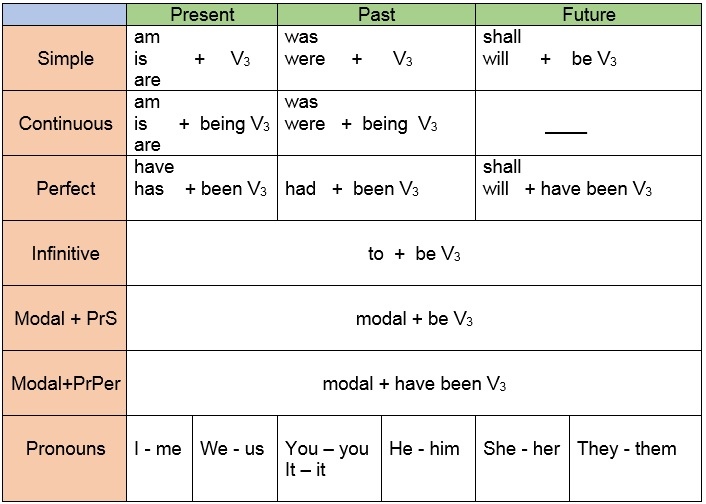
Passive Voice
№1. Study the material:
№2. Write the past participle of the following verbs:
want …………………………
buy …………………………
decide …………………………
marry …………………………
choose …………………………
drop …………………………
make …………………………
draw …………………………
open …………………………
find …………………………
№3. Change the underlined active verbs into the passive form:
Adam hit the ball. - The ball was hit by Adams.
Someone is ringing the bell. - The bell …
Mom washes the carpet. - The carpet … by Mom.
Children should drink milk. - Milk … by children.
I have paid my checks. - Checks … by me.
Tim will write a story. - A story … by Tim.
Tom needs to do this work. - This work needs …
Dina may invite some friends. - Some friends … by Dina.
№4. Change the following sentences from active into passive:
1. The lawyer will give you some advice.
2. Sue asked the policeman for directions.
3. The pirates had found the treasure.
4. Peter is going to take the package later.
5. Someone has already stopped the machine.
6. The coach always encourages the trainees.
7. Meg needs to wipe the floor right now.
8. The employees might suggest new rules.
№5. Change the following negative sentences from active into passive:
1. We didn’t notice the new changes.
2. The store won’t deliver the furniture.
3. They haven’t collected the taxes yet.
4. The students didn’t study the poem well.
5. We don’t accept credit cards here.
6. Tim wasn’t planting trees at seven.
7. You shouldn’t water this plant daily.
8. They are not interviewing the applicants.
№6. Change the following questions from active into passive:
1. Did the driver hit the boy yesterday?
2. Will the police question all the suspects?
3. Have you signed the house contract?
4. Do people speak English in Spain?
5. Who broke the vase in the sitting room?
6. Are you roasting chestnuts now?
7. Can you reach the top of this mountain?
8. Was Jim playing the piano very loudly?
№7. Change the following sentences with two objects from active into passive:
1. The secretary gave Martin some letters.
2. My friend has sent me an invitation.
3. Mike is showing Laura some pictures.
4. Kevin will buy Jane a new car next week.
5. Joe always lends Tom some money.
6. The company will pay him a lot of money.
7. Will the college award Dan a scholarship?
8. The court denies the criminal some rights.
№8. Fill in “by” or “with”:
The fox was hunted ………………… a gun.
Mat will be trained …………… a good teacher.
The book is written …………… a famous author.
He was hit on his head ……………… a stone.
Passports are checked ……………… the police.
The island is surrounded ……………… water.
№9. Change the following mixed sentences from active into passive:
1. People eat a lot of fast food these days.
2. The company will advertise the new product on TV next month.
3. The teacher shouted at Jill at school today.
4. People make salads from different kinds of vegetables.
5. Do you usually feed your chickens corn?
6. Had Mira checked the mail before she went to school?
7. Hundreds of dissidents are seeking refuge in the US embassy.
8. Millions of tourists visit Rome every year.
9. You need to polish the shoes regularly to protect the leather.
10. Wind and rain have eroded the statues into shapeless stones.
11. When did they show the news of the earthquake on TV?
12. Adam hadn’t expected Kate to come on time by the time he got home.
13. Can you tell me the way to the park?
14. Dianne is choosing a new dress right now.
15. Sally was taking care of the children during the interview with the press.
№10. Make the following sentences in Passive Voice, paying attention to the place of the preposition:
E.g. We often speak about her. — She is often spoken about.
1. We thought about our friend all the time. 2. The doctor will operate on him in a week. 3. The teacher sent for the pupil's parents. 4. They looked for the newspaper everywhere. 5. Nobody slept in the bed. 6. The neighbour asked for the telegram. 7. Everybody listened to the lecturer with great attention. 8. The senior students laughed at the freshman. 9. The group spoke to the headmistress yesterday. 10. The young mothers looked after their babies with great care. 11. Nobody lived in that old house. 12. They sent for Jim and told him to prepare a report on that subject.
№11. Form the question.
1. Paper is made from wood.
2. The telephone was invented by Mr Bell.
3. This picture was painted by Peter.
4. The thieves will be arrested by the police.
5. Champagne is made in France.
6. The letters will be sent next week.
7. The animals are fed three times a day.
8. This article was written by Stanley.
9. CDs are made of plastic.
10. The party was organized by Paul.
№12. Rewrite the following passage in the Passive.
My uncle painted this picture. Someone has offered him a lot of money for it. He will deliver the painting tomorrow. When they give him the money, he will tell them the truth. He painted it one night while he was sleepwalking!
№13. Open the brackets using Present, Past or Future Simple Passive:
1. My question (to answer) yesterday.
2. Hockey (to play) in winter.
3. Mushrooms (to gather) in autumn.
4. Many houses (to burn) during the war.
5. His new book (to finish) next year.
6. Flowers (to sell) in shops and in the streets.
7. St. Petersburg (to found) in 1703.
8. Bread (to eat) every day.
9. The letter (to receive) yesterday.
10. Nick (to send) to Moscow next week.
11. I (to give) a very interesting book at the library last Friday.
12. Many houses (to build) in our town every year.

Вебинар для учителей

🎓 Свидетельство об участии ✨БЕСПЛАТНО!✨



