Россия, р.п. Красные Баки


СДЕЛАЙТЕ СВОИ УРОКИ ЕЩЁ ЭФФЕКТИВНЕЕ, А ЖИЗНЬ СВОБОДНЕЕ
Благодаря готовым учебным материалам для работы в классе и дистанционно
Скидки до 50 % на комплекты
только до
Готовые ключевые этапы урока всегда будут у вас под рукой
Организационный момент
Проверка знаний
Объяснение материала
Закрепление изученного
Итоги урока

Была в сети 31.10.2026 19:58

Воронина Марина Владимировна
преподаватель английского и немецкого языка, преподаватель информатики
 91 619
 192

Местоположение
Специализация
Методические указания 2 курс 3 часть (ТОР) 2026
Категория:
Английский язык
21.04.2026 13:44

Просмотр содержимого документа
«Методические указания 2 курс 3 часть (ТОР) 2026»
МИНИСТЕРСТВО ЛЕСНОГО ХОЗЯЙСТВА
И ОХРАНЫ ОБЪЕКТОВ ЖИВОТНОГО МИРА НИЖЕГОРОДСКОЙ ОБЛАСТИ
Государственное бюджетное профессиональное
образовательное учреждение Нижегородской области
«КРАСНОБАКОВСКИЙ ЛЕСНОЙ КОЛЛЕДЖ»
(ГБПОУ НО «КБЛК»)
МЕТОДИЧЕСКИЕ УКАЗАНИЯ
по дисциплине «Иностранный язык
в профессиональной деятельности (Английский язык)»
для студентов II курса 3 часть
Тема 1.3. Значение иностранного языка в освоении профессии
для специальности 23.02.07 Техническое обслуживание
и ремонт автотранспортных средств 
| Разработали: преподаватели иностранных языков Воронина М.В., Булкина Т.А.
|
Красные Баки
2025
Lesson 1
English in the modern world
№1. Write the airport signs and explain what they mean:
1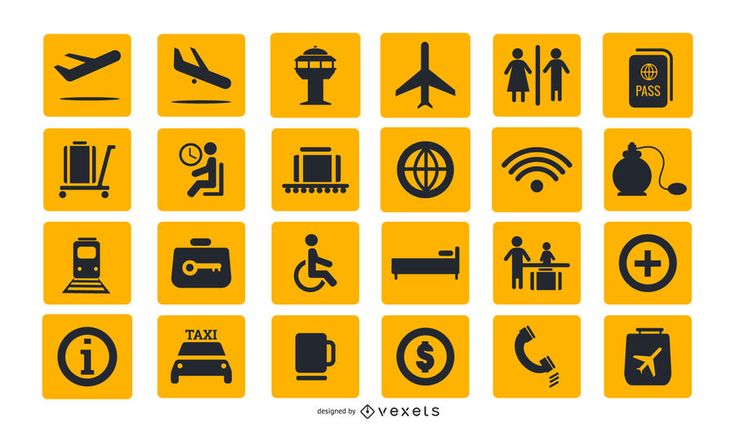
2
3
4
№2. Make a list of English words that we use in our country (5 words for each category):
at college –
at the shop –
at the train station -
at the sport complex –
№3. Read, translate the text and find out the international words. Why do we call them “international”?
There are over two thousand and seven hundred languages in the world, but English today is the most important international language. Four hundred million people speak English as their first language. Six hundred million people speak it either as a second or as a foreign language. That is twenty per cent of the world’s population. English has become a world language, because it is spoken as a mother tongue in all the continents of the world. In the seventeenth century it was brought to North America by the first colonizers. Then in the eighteenth century English was brought to Australia, later on to Africa and India.
Millions of people are learning English today. It is the language of the United Nations. Foreign political leaders usually speak to international journalists in English. The latest discoveries and ideas in all spheres of science and medicine appear in special international journals, of which sixty per cent are in English. Eighty per cent of all information in the world’s computers is in English. Besides, there are a lot of brilliant world-famous English, American, Canadian and Australian writers and poets who gave the world their wonderful works. The reader can fully appreciate them only in the original. And finally, many young people learn English as a foreign language because it is the language of rock and pop music.
English is a world language. It is the language of progressive science and technology, trade and cultural relations, commerce and business. It is the universal language of international aviation, shipping and sports. It is also the major language of diplomacy.
Hundreds and hundreds of books, magazines and newspapers are printed in English and read all over the world. 75% of the world's mail and 60% of the world’s telephone calls are in English. Half of the world's scientific literature is written in English. English is spoken by more than 350 million people. Geographically, it is the most widespread language on earth, second only to Chinese in the number of people who speak it. It is the official language of the United Kingdom of Great Britain and Northern Ireland, of the United States of America, of Australia and New Zealand. English is used as one of the official languages in Canada, the Republic of South Africa and the Irish Republic. It is also spoken as a second language in many parts of India and Africa. The number of second-language speakers may soon exceed the number of native speakers. Besides, millions of people study and use English as a foreign language. In our country English is very popular: it is studied at schools (sometimes even at nursery schools) colleges and universities. Learning a foreign language is not an easy thing. It is a long and slow process that takes a lot of time and patience. But to know English today is absolutely necessary for every educated person, for every good specialist.
№4. Answer the questions:
1) What is your mother tongue?
2) Is it easy to learn foreign languages?
3) How many people speak English?
4) Why has English become a world language?
5) Where is English an official language?
6) Why do young people want to learn English?
7) How long have you been learning English?
8) Why do you learn English?
9) What is the necessity of learning English for a specialist?
10) What is the best way to learn a language?
№5. Are these statements true or false? Correct the false once:
1) Eighty per cent of all information in the world’s computers is in English.
2) Forty hundred million people speak English as their first language.
3) In the eighteenth century English was brought to Austria, later on to Africa and India.
4) The number of second-language speakers may soon exceed the number of native speakers.
5) Learning a foreign language is not an easy thing.
6) Foreign political leaders usually speak to international journalists in foreign languages.
№6. Translate the proverbs and quotes:
1) Who knows the language is at home everywhere.
2) A wise person must know the language, sayings, and tales of his society.
3) Learn a new language and get a new soul.
4) A different language is a different vision of life.
5) If you want people to understand you, speak their language.
6) The more you speak more languages, the more you understand about yourself.
7) Learning another language is not only learning different words for the same things but learning another way to think about things.
№7. Study the information about “false friends” and continue the table with them:
Fabric в английском – это ткань, материал. А фабрика - factory. Magazine – это не «магазин», а журнал! А «магазин» –shop или store (в Америке чаще говорят store).
Слово accurate - точный, правильный. А вот «аккуратный» - neat. Lunatic – это не «лунатик» (тот, кто ходит во сне). Это безумец, сумасшедший. А «лунатик» – это sleepwalker.
| Английское слово | Правильный перевод | Ошибочный перевод | Его английское соответствие |
| Accurate | Точный | Аккуратный | neat |
| Balloon |
|
|
|
| Brilliant |
|
|
|
| Cabinet |
|
|
|
| Clay |
|
|
|
| List |
|
|
|
| Paragraph |
|
|
|
| Products |
|
|
|
| Repetition |
|
|
|
| Servant |
|
|
|
| Sympathy |
|
|
|
№8. Write the sentences with correct words and translate them:
1) The weather / whether will be sunny tomorrow.
2) I’d advise / advice you to give a gift certificate.
3) Everybody turned up at Fiona's party accept / except her exboyfriend.
4) She gave me a nice compliment / complement about my dress at the event.
5) The principal / principle of the school welcomed the new students during orientation.
6) Click hear / here to learn more.
7) The office furniture is stationary / stationery.
8) Please tell me where / wear you’d like me to send the contract.
9) We do not have any vacancies for the weaks / weeks you requested.
10) My favourite desert / dessert is ice cream.
Lesson 2
Adjective Order
№1. Study the material “Adjectives”:
Прилагательные можно разделить на две группы:
Fact adjectives или объективные прилагательные
Opinion adjectives или субъективные прилагательные
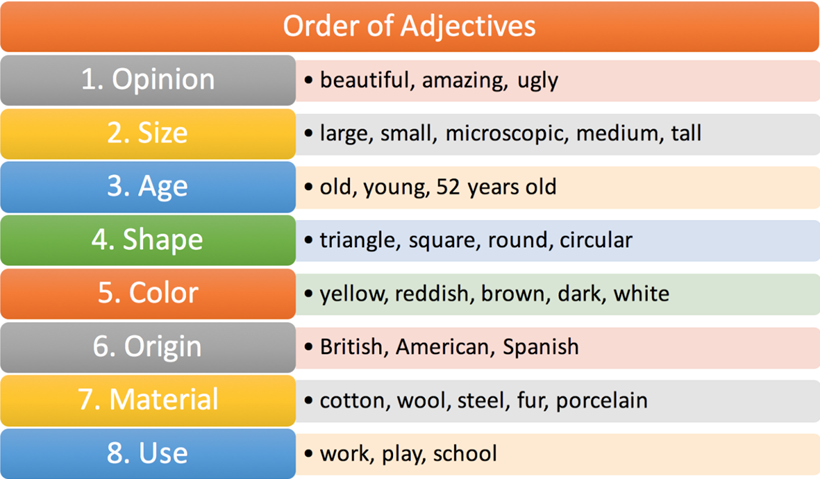
К первой группе относятся такие прилагательные, которые дают объективную оценку предмету. Допустим, мы видим деревянный стул. Он деревянный и это факт. Если вы подойдете к другому человеку и спросите о материале этого стула, он также скажет, что он деревянный. Субъективные же прилагательные выражают ваше мнение. То есть стул этот, по вашему мнению, может быть красивым, однако, другой человек может иметь противоположное мнение. В английской грамматике все прилагательные разделены на 9 категорий для определения их расположения. Прилагательные используются в следующей последовательности:
| 1. Мнение / оценка /впечатление, общие качества | smart – умный, expensive – дорогой, delicious – вкусный |
| 2. Размер | huge – огромный, giant – гигантский, tiny – крошечный, big – большой |
| 3. Свойства материалов | smooth – гладкий, fragile – хрупкий, scabrous – шероховатый |
| 4. Возраст | young – молодой, immature – незрелый, old – старый, antique –старинный |
| 5. Форма | rectangular – прямоугольный, oval – овальный, round – круглый |
| 6. Цвет | orange – оранжевый, turquoise – бирюзовый, white – белый |
| 7. Происхождение | Japanese – японский, Russian –русский, northern – северный |
| 8. Материал | copper – медный, metal – металлический, plastic – пластиковый |
| 9. Предназначение | sleeping – для сна, cooking – для готовки |
Категории возраста и формы могут меняться местами, в каком порядке вы бы их не использовали, оба варианта допустимы.
№2. Put the words in the correct category:
Opinion / Size / Shape / Age / Color / Origin / Material / Purpose
sport, blue, American, short, white, square, beautiful, tiny, steel, Chinese, race, leather, high, turquoise, cotton, five-year-old, French, young, baseball, crimson, national, enormous, amazing, nice, round, wooden, European, antique, golf, wavy, old, triangular, lovely
№3. Write the sentences with the correct adjective order, translate them:
She wore a leather/new/ black pair of gloves.
Helen bought a silk/ beautiful/ French dress.
Jack has a small/ wooden/ round table.
He has a/ an Italian/ old/ silver ring.
Their granny has got a/an old/ beautiful/round mirror.
Harry bought a terrible/ wooden/ second-hand chair.
№4. Arrange the adjectives in the correct order:
1) a / black / old / huge / dog
2) a / vintage / British / red / car
3) a / fur / thick / new / coat
4) a / pink / round / dozen / plastic / plates
5) a / young / pretty / girl
6) a / yellow / beautiful / silk / dress
7) two / wooden / ancient / chairs
8) a / metal / square / clock
9) a / brown / new / wallet
10) a / little / three-year old / cute / girl
№5. Rewrite the sentences with the adjectives in brackets in the correct order translate them:
Example:
He wore a shirt. (blue, denim, fashionable) - He wore a fashionable blue denim shirt
1. The shop assistant put the gift in a bag. (brown, small, paper)
2. They're showing a film at the cinema tonight. Do you want to go with me? (horror, new)
3. I’m going to a party tonight. I bought a dress to wear. (sexy, red, short)
4. The man ran down a street to the police station. (narrow, long)
5. Paul sang a song to his girlfriend. (love, slow)
6. It was so nice to come in from the cold and have a meal. (hot, delicious)
7. She was a beautiful woman with hair. (blonde, straight, long,)
8. I have just bought a car. (sports, German, new)
9. Watch out! There is a dog over there. (black, scary, big)
10. Do you want to play badminton? It’s a sunny day outside. (lovely, bright)
№6. Some adjective orders in the sentences below are wrong. Rewrite each sentence correctly.
I found a golden small round coin.
They built a modern huge beautiful hotel.
She picked a red tiny lovely flower.
He wears a sports black cool jacket.
They sat on a blue narrow old bench.
She painted a square clean white wall.
We admired a silk long green scarf.
I need a cotton soft white pillow.
He cooked a spicy delicious big meal.
She opened a wooden brown small box.
He cleaned a plastic dirty large tray.
I saw a thin ancient silver plate.
He drew a strange scary big face.
She wore a wool grey warm sweater.
They designed a smart metal small robot.
№7. Read each name and imagine the person. Use at least 3 adjectives in the correct order to describe each one.
Example:
Anna → a young tall American woman
Tom → a cheerful short old man
Lily → ______________________________
Mr. Green → __________________________
Mei Lin → ___________________________
Alex → ______________________________
Grandma Ruby → ______________________
Priya → ______________________________
Ahmed → ____________________________
Sam → ______________________________
Lucy → ______________________________
Teacher John → ________________________
Father George → _______________________
Hana → ______________________________
Junaid → ______________________________
Aunt Sally → ___________________________
Diego → _______________________________
№8. Define category of every adjective: short - size
Cheap long red dress
New huge wooden table
Beautiful new brick house
Fantastic green Japanese car
Round Russian silver coin
Nicе blue wooden wall
Sentimental long American song
Short fair curly hair
Lesson 3
Car mechanic
№1. Say if you choose your future profession yourself or you followed somebody’s advice. What arguments did you take into consideration?
№2. Read, translate the text “Car mechanic” and try to understand the meanings of the underlined words and word combinations, translate them:
A car mechanic (or car mechanic in British English and motor mechanic in Australian English) is a mechanic who specializes in automobile maintenance, repair, and sometimes modification. The mechanic may be knowledgeable in working on all parts of a variety of car makes or may specialize either in a specific area or in a specific make of car. In repairing cars, their main role is to diagnose the problem accurately and quickly. They often have to quote prices for their customers before commencing work or after partial disassembly for inspection. The mechanic uses both electronic means of gathering data and their senses. Their job may involve the repair of a specific part or the replacement of one or more parts.
Basic vehicle maintenance is a fundamental part of the mechanic’s job in some countries. Preventative maintenance is also a fundamental part of the mechanic’s job, but this is not possible in the case of vehicles that are not regularly maintained by the mechanic. One misunderstood aspect of preventative maintenance is “scheduled replacement” of various parts, which occurs before failure to avoid far more expensive damage. Because this means that parts are replaced before any problem is observed, many vehicle owners will not understand why the expense is necessary.
With the rapid advancement in technology, the mechanic’s job has evolved from purely mechanical, to include electronic technology. Because vehicles today possess complex computer and electronic systems, mechanics need to have a broader base of knowledge than in the past. The term “auto mechanic” is being used less and less frequently and is being replaced by the title “automotive service technician”. Fading quickly is the day of the mechanic, who needed little knowledge of today’s computerized systems. Most automobile dealerships now provide sophisticated diagnostic computers to each technician, without which they would be unable to diagnose or repair a vehicle.
№3. Match the word with their translation:
| 1) preventive maintenance 2) maintenance 3) repair 4) to diagnose 5) partial disassembly 6) replacement 7) failure | a) диагностировать b) профилактическое обслуживание c) поломка, отказ d) замена e) ремонт f) обслуживание g) частичная разборка |
№4. Put in prepositions where necessary, translate the sentences:
1. A car mechanic specializes … automobile repair.
2. Mechanics should be knowledgeable in working … all parts of cars.
3. This job involve the replacement … some parts.
4. Nowadays mechanics need to have more knowledge than … the past.
5. Most dealerships provide diagnostic computers … each technician.
№5. Find the passages in the text above for which the next word combinations would be the key words:
1. car mechanic’s job
2. electronic technologies
3. vehicle maintenance
№6. Answer the questions:
1. What is a car mechanic called in Australian English?
2. What are the main functions of the car mechanic?
3. Does the mechanic’s job include electronic technology?
4. Do most automobile dealerships now provide sophisticated diagnostic computers to each technician?
№7. Read the text and find in it the words which mean the same:
to get into the first place; a range of cars; to satisfy the needs; the main producer; to fall behind; using little fuel.
Nowadays Japan and the United States are the largest car producers. Japan replaced the United States as the top passenger car manufacturer from 1980 to 1983. It regained the top spot in 1987 and still holds the first place. Other major producers include France, Germany, Great Britain, Italy and Spain. In general, the largest automating countries also have the largest markets for cars. The United States has the biggest car market by far. Such countries as Japan, Italy, and France follow well behind.
The largest U.S. automakers, called the Big Three, are General Motors Corporation, Ford Motor Company, and Chrysler Corporation. Each of the Big Three produces, under different trade names, a variety of cars and light trucks designed to meet the needs, preferences, and incomes of different consumers.
Japan’s major producers include Toyota Motor Corporation, Nissan Motor Company, Honda Motor Company, Mitsubishi Motor Company, and Mazda Motor Corporation. Historically, Japanese cars made for use in Japan have tended to be small, fuel efficient, and of limited power. This is because Japan depends completely on imported oil and many of its streets are too narrow and crowded for big cars. For export, Japan produces a range of models to satisfy variety of buyers. Many European companies make far fewer vehicles than do Japanese or American firms because they target their output to the smaller luxury and sports car markets. Such European producers include Jaguar of Great Britain; Mercedes-Benz, Audi, BMW, and Porsche of Germany; and Saab and Volvo of Sweden. Other European manufacturers produce millions of cars each year. These major producers include Volkswagen of Germany; Peugeot and Renault of France; and Fiat of Italy.
№8. Correct the wrong information in the sentences given below and write down the correct sentences.
1. Nowadays Japan and the USA are the largest car producers.
2. The UK has the biggest car market.
3. The largest U.S. automakers are Jaguar, Audi and BMW.
4. Historically, Japanese cars made for use in Japan have tended to be large and powerful.
5. Germany depends completely on imported oil.
6. Japan holds the second place as a passenger car manufacturer.
№9. Fill in the table with the information from the text.
| The country | The main car manufacturers |
| Japan |
|
| The USA |
|
| France |
|
| Germany |
|
| Great Britain |
|
| Italy |
|
| Sweden |
|
№10. Translate into Russian:
repair, specialize, accurately, to quote prices, customers, gathering data, vehicle, expensive damage, rapid advancement, fading quickly, sophisticated diagnostic computers, car producers, the biggest car market, trade names, the needs, preferences, incomes, a range of models
№11. Match the words with their definitions:
| 1. production
2. to design
3. automobile
4. carriage 5. pollution
6. engine 7. vehicle
8. engineer
9. fuel
10. to combust | a. to make or draw plans for something, for example clothes or buildings b. damage caused to water, air, etc. by harmful substances or waste c. a road vehicle with an engine, four wheels, and seats for a small number of people d. to start to burn e. a substance that is used to provide heat or power, usually by being burned f. the process of making or growing goods to be sold g. a vehicle with four wheels that is usually pulled by horses and was used mainly in the past h. a machine that uses the energy from liquid fuel or steam to produce movement i. a person whose job is to repair or control machines, engines, or electrical equipment j. a machine, usually with wheels and an engine, used for transporting people or goods on land, especially on roads |
Lesson 4
Degrees of comparison of adjectives
№1. Study the material:
| односложные | adjective | adj.+ er | adj.+est |
| strong fat fine busy | stronger fatter finer busier | strongest fattest finest busiest | |
| многосложные | adjective | more + adj. | most + adj. |
| famous | more famous | most famous | |
| исключения | good well | better | best |
| bad badly | worse | worst | |
| little | less | least | |
| many much | more | most | |
| old | older elder | oldest (по возрасту) eldest (по старшинству) | |
| far | farther further | farthest (о расстоянии) furthest (о времени) |
№2. Write the comparative and superlative adjectives:
| 1. light 2. cheap 3. expensive 4. bad 5. hot 6. angry 7. wonderful 8. shy 9. good 10. attractive | 11. pleasant 12. old 13. dangerous 14. little 15. big 16. easy 17. brave 18. cruel 19. surprising 20. few |
№3. Give full answer using comparative degree:
Which is longer: an hour or a minute?
Which is bigger: a ship or a bus?
Which is longer: a sea or a river?
Which is more difficult: to go on foot or to go by train?
Which is more convenient: to ride a horse or to go by Cadillac?
№4. Complete the sentences with the right degree of comparison:
This cake is the …. (good) the one you baked last week.
This exercise is …. (easy) than we expected.
Don’t travel by plane. It’s …. (expensive) than the train.
Are you feeling better now? – No, I am …. (bad). I have a terrible headache.
It’s a long trip to Sidney. It’s …. (far) than I thought.
She is …. (kind) woman I have ever met.
This dress is …. (cheap) that one. They cost the same.
John’s …. (young) nephew married my cousin Alice.
Your coffee is not …. (tasty) as my mother’s.
My mother is much …. (patient) my father. She never loses control of herself.
№5. Write the sentences using information
| large / small
| Moscow (11 million people) London (7 million people) New York (9 million people) |
| old / new | The London Underground opened in 1863 The Moscow Metro opened in 1935 The Berlin Underground railway opened in 1902 |
№6. Make up the sentences and translate them:
most – the Mona Lisa – in – is – painting – the – famous – the – world.
longer – the Don – is – the Volga – than.
more – Spain – Germany – than – beautiful - is.
London – city – in – biggest – the – England – is.
the – team – Adam – is - worst – the – player – in.
№7. Translate the sentences into English:
Это очень легкая задача. Дайте мне более трудную задачу.
Летом дни длинные, а ночи короткие.
22 июня — самый длинный день.
В июле дни короче.
В декабре дни самые короткие.
«Четверка» — хорошая отметка, но «пятерка» лучше.
№8. Write the sentences using the models of the cars and adjectives from the box:
| Ford, Volga, Mitsubishi, Kamaz, Mazda, Niva, Nissan, Granta, Audi, BMW expensive – cheap, fast – slow, dangerous – safe, comfortable, powerful, modern, classic, sporty |
The … is … than …
The … is … the …
№9. Do multiple choice test, find 7 adjectives and write 3 degrees of comparisons:
It is only in the course of the last 1)_______ years that English has become a world 2)__________. In Shakespeare’s time it was a “provincial” language of secondary importance with only 6 million native speakers. Nowadays English has become the World’s most important language in politics, science, trade and cultural relations. In a number of speakers (400 million) it is 3)________ only to Chinese.
English is the 4)_________ language of the United Kingdom of Great Britain and Northern Ireland, of the United States of America, of Australia and New Zealand. English is used as one of the official languages in Canada, the Republic of South Africa and the Irish Republic. It is also spoken as a second language by many people in India, Pakistan, numerous countries in Africa. The number of second-language speakers may soon exceed the number of 5)_______ speakers, if it has not done so already.
Even more widely English is studied and used as a 6)_______ language. In this respect it acquired an international status. It is used for communication across frontiers, 7)________ to broadcasts, 8)________ books and newspapers, in commerce and travel. Half of the world’s scientific literature is in English. English is associated with technological and economic development of the great manufacturing countries and it is the principle language of international aid. It is the language of automation and computer technology. It is not only the universal language of international aviation, shipping and sport, it is a considerable degree the universal language of literacy and public communication. It is the major language of diplomacy, and is the most frequently used language both in the debates in the United Nations and in the general conduct of the UN business.
English has become a 9)______ language because of its establishment as a mother 10)________ outside England, in all the countries of the world. This exporting of English began in the seventeenth century, with the first settlements in North America. Above all, it is the great growth of population in the US, assisted by massive immigration in the nineteenth and twentieth centuries, that has given the English language its present standing in the world.
| 1 | A - million | B - thousand | C - hundred | D - billion |
| 2 | A - tongue | B - language | C - speech | D – way |
| 3 | A - first | B - second | C - third | D – fourth |
| 4 | A - main | B - common | C - official | D – international |
| 5 | A - native | B - mother | C - local | D - foreign |
| 6 | A - native | B - mother | C - local | D – foreign |
| 7 | A - speaking | B - reading | C - listening | D – writing |
| 8 | A - speaking | B - reading | C - listening | D – writing |
| 9 | A - world | B - country | C - village | D – town |
| 10 | A - language | B - speech | C - tongue | D – talk |
Lesson 5
Car mechanic’s skills
№1. Read, translate the words and write 10 your own words with the sounds:
[T] [D]
length thanks other than
think worth their with
thin theme that then
№2. Read the text and try to understand the meaning of the underlined words and word combinations.
Car mechanics repair and maintain cars. Some mechanics work on all parts of any car, while others specialize in one area or on one type of car. The most challenging aspect of car repair is often the mechanic’s favourite part: diagnosing the problem. Speed and accuracy in diagnosis and quoting prices to the customer are crucial if the mechanic intends to keep long-term clients. The mechanic examines the engine while it is running (if possible) to see if his initial assumptions are correct.
Electronic diagnostic equipment is useful but the good mechanic can tell a lot by using eyes, ears, a nose as he searches for problems. Sometimes he repairs parts, but if the part is worn or damaged, he replaces it. Some mechanics compare their field to that of the physician, because most people come to them only when their car is in dire straits. When people come in for an automotive check-up, mechanics often replace worn parts before they become hazardous to the driver, even though drivers can be suspicious of mechanics who recommend the replacement of parts that haven’t stopped functioning.
The best mechanics have mastery of a wide variety of integrated skills: electrical systems (a car’s wiring is more complicated than an average home’s); computerized electronics (a television set seems simple by comparison); fuel system (a car’s “plumbing” is a Byzantine maze of tubes). Car mechanics proudly compare themselves to doctors, since they mainly see people with complaints; but whereas the human body and its problems have remained essentially unchanged for millennia, the designs of cars change every year. As a result, the job requires more preparation than ever before. More and more, cars are controlled by electronic instruments, so mechanics are using computers constantly. “Computers have become as much a part of the tool box as wrenches,” said one mechanic.
Most car mechanics start in an automotive repair school, then work full time at the same dealerships. They read trade papers daily to know about of changes and trends in their industry. As they gain experience they can move into higher-paying, specialized positions. They can also rise to the ranks of supervisor or manager, particularly if they have strong interpersonal skills to calm cranky customers who are displeased by high service bills and inconvenience.
№ 3. Fill in the missing letters in the words.
Rep .. r, me .. anic, diagnos .. , repl .. e, maste .. , t .. l, experien .. , ma .. nta .. n, cl .. nt,
e .. am .. ne, en .. ne, dr .. v .. r.
№4. Using the information from the text, make up the list of operations which
car mechanics must perform. Write them down into your exercise books.
№5. Match the words with their translations:
| a) diagnosis b) long-term clients c) examine d) electronic diagnostic equipment e) worn parts f) replace
g) mastery h) maintain i) fuel system j) wrench k) interpersonal skills l) tool box | 1) топливная система 2) изношенные детали 3) диагностика 4) постоянные клиенты 5) осматривать 6) электронное оборудование для диагностики 7) заменить 8) мастерство 9) обслуживать 10) гаечный ключ 11) коробка с инструментами 12) умения межличностного взаимодействия |
№6. Make the following sentences negative:
1. Teachers repair and maintain cars.
2. If the part is worn, a car mechanic replaces it.
3. The easiest aspect of car repair is diagnosing the problem.
4. Car mechanics compare themselves to painters.
5. Mechanics are using chalk constantly.
№7. Answer the following questions:
1. Which of the operations (exercise 5) can you manage?
2. Do you agree “electronic diagnostic equipment is useful but the good mechanic can tell a lot by using eyes, ears, a nose as he searches for problems”. Explain your point of view.
3. Why do car mechanics compare themselves to doctors? What is similar and what is different in their work?
4. What is the way car mechanics can move into higher-paying positions?
№8. Choose from the list below characteristics, which you consider necessary in your profession, add others if necessary.
Accurate, tolerant, patient, sociable, good-mannered, exact, cautious, attentive, hardworking, scrupulous, sharp, widely-read, competent, organised, impulsive, impatient, balanced.
№9. Read the information below, agree or disagree. Prove your point of view.
Car mechanics can rise to the ranks of supervisor or manager, particularly if they have strong interpersonal skills to calm cranky customers who are displeased by high service bills and inconvenience.
Lesson 6
Word formation (adjectives)
№1. Form adjectives with suffixes -ful и -less, translate the words:
beauty, thank, hope, doubt, care, aim, use, shape, fruit, power, thought, harm, colour.
№2. Complete these sentences with adjectives wit endings –ful or –less:
What a lovely present! That was very … of you. (think)
He's told me … times about how good he is at football. (count)
My best friend is a rich, … lawyer. (power)
You must remember to recharge your phone. Without its batteries, it's … . (use)
Although everybody knows that cigarettes are … to our health, many people still smoke. (harm)
The new sales assistant was really … and rude. (help)
Look at the newborn baby. He’s completely … . (help)
Don't worry, John - this injection will be completely … . (pain)
Thieves broke into the museum and stole a … painting by Van Gogh. (price)
She's really rich, but her clothes are always very … and elegant. (taste)
№3. Form adjectives with suffixes -able, -ible, translate the words:
change, convert, prevent, break, compare, desire, profit, read, comfort, respect, expect.
№4. Fill the table with 5 adjectives with prefixes in each column, translate the words:
| dis- | ir- | un- | im- | in- |
|
|
|
|
|
|
№5. Write the sentences with adjective using prefixes: dis-, ir-, un-, im-, in-:
1. His parents are worried because his school performance has been quite … (regular).
2. Mike was very rude to his parents. I had never seen such a … (respectful) attitude.
3. Teenagers often feel … (secure) about the way they look.
4. Nobody really likes him in school. He is probably the most … (popular) student.
5. It’s very … (probable) that he will talk to his parents about this.
6. It would be very … (responsible) of you to drive under the influence of alcohol.
7. Ben feels so … (happy) – nobody wants to help him with his problem.
8. He is such a … (obedient) teenager – he never does what he is told.
9. Your behavior was absolutely … (moral). You should never have done that.
10. Mary has an … (rational) dislike for younger boys.
№6. Form adjectives with suffixes -al, translate the words:
centre, culture, form, intellect, post, accident, comic.
№7. Form adjectives with suffixes –y, translate the words:
Cloud, dirt, fog, frost, rain, sun, thirst, wind.
№8. Translate into English:
Безоблачное небо, беспомощный ребенок, бесшумная машина, бесчисленные герои, безжизненное тело, беззаботный ребенок, бессердечная женщина, бездомный кот, дерево без листьев, безымянный автор, комната без солнца, бесконечная война, бесцветная жидкость. Была безлунная ночь. Он выглядел усталым после бессонной ночи.
№9. Translate these combinations and write what words the adjectives are formed from:
a washable shirt, a skilful worker, democratic forces, the postal service, groundless suspicions, a humorous story, a gloomy scene, salty ham, professional interest, peaceful labour, a noiseless machine, a courageous soldier, a lucky ticket, a continental climate, a dusty road.
№10. Complete the adjectives with all the possible suffixes below, translate the words: -able -al -ful -ish -less -ly -ous -y
1) furious
2) peace______
3) luck______
4) economic______
5) enjoy______
6) self______
7) week______
8) taste______
№11. Complete the text with the adjectives: careless, sleepy, mysterious, dreadful, courageous, endless, nervous, rainy, foggy, shadowy
One cold (1)________ night Sam was driving home. He felt tired and (2)________. The weather was (3)________. The rain seemed (4)________ and to make it worse it was getting (5)________. Suddenly Sam saw a lonely figure standing at the side of the road. He slowed down to offer a lift to the (6)________ pedestrian. But when he approached the (7)________ figure vanished. Puzzled and a little (8)________ Sam slowly continued his way and hardly had he covered 50 metres as he almost bumped into a big fallen tree lying across the road. He saw it just on time. Sam is a (9)________ man and he doesn’t believe in supernatural, but now he says that he is grateful to the (10)________ ghost that saved him from the accident.
Lesson 7
How to get the profession
№1. Write and translate the words, continue the 5 your own words:
| [k] | [C] | [S] |
| mechanic technical chaos character chronometer | check change charge approach | chassis chauffeur charade chute
|
№2. Say if you like the system of car mechanics training in our country. Try to give some arguments.
№3. Read the text and say which system of car mechanics training among those described in the text you consider the best and why. Write out 7 adjectives with suffixes and 10 nouns with suffixes translate them.
To become a car mechanic in the UK students begin their training by studying car processes in manuals and then work on older cars. Most mechanics find themselves in technical educational programmes after finishing school. All car mechanics are required to be certified.
In the UK there are different routes for people to become qualified. The best route is to serve an apprenticeship with a local garage or dealership while attending a college or a training centre. The apprenticeship is split into 2 levels.
Level 2 is made of the following components:
NVQ (National Vocational Qualification) – this is achieved by the collection of evidence in the workplace that the apprentices can remove and replace components to manufacturers guidelines.
VRQ (Vocational Related Qualification) – this is also sometimes called a “Tech cert” and is a series of tests designed to show that the candidate understands how things work, i.e. engines, transmission, chassis, etc. It is delivered in a variety of ways at a training centre or at a local college.
Key Skills – the skills in key areas: Communications (English), Application of Number (Maths) and I.T. (use of computers and I.T.).
When the candidate has achieved the required components listed above, apprentices are given Apprenticeship certificates to show competence at that level.
UK training differs from American training and general practice in that a U.K. mechanic will be expected to be able to repair all areas of the vehicle (apart from Bodywork and Painting), i.e. engines, suspension (подвеска), brakes (тормоза), electrical, transmission, etc., as these are usually all covered in the same garage or workshop.
This training usually takes 4–5 years, after this term apprentice is said to be “qualified” and works alongside experienced technicians.
In Australia, an apprentice works under one or more qualified mechanics for a period of four years. During that time, they attend a Technical and Further Education (TAFE) college one day per week for three years. In some states, mechanics are required to be qualified to work as a mechanic, and the workshop in which they work is required to have a workshop license. In other states, no such licensing is required.
In the United States there are several programmes and schools that offer training for those interested in gaining competencies as an automotive mechanic. A few of the aspects usually taught are: power train (силовая передача) repair and diagnosis, emission control (отвод выхлопа газов), and suspension. The National Automotive Technicians Education Foundation (NATEF) is responsible for evaluating technician training programmes for certification (accreditation) by ASE, the National Institute for Automotive Service Excellence. While it's not required by law for a mechanic to be certified, some companies only hire or promote employees who have passed ASE tests.
№4. Give the sentences from the text with the following phrases and translate them.
1. The best route is to serve an apprenticeship … .
2. It is delivered in a variety of ways … .
3. Key skills … .
4. This training usually takes … .
5. ... an apprentice works under … .
6. ... mechanics are required to be … .
7. ... licensing is required.
8. .... aspects usually taught are … .
№5. Describe the system of a car mechanic training in Russia, giving some information about:
1) the terms and components of the educational process;
2) the skills required to be certified;
3) final exams.
Example: The training takes 4 years in Russia. To be certified mechanics are expected to be able to repair all areas of vehicles. During the training period pupils attend a college and a workshop.
№6. Fill in the table below. Compare the system of car mechanics training in different countries.
|
Country | Is it required by law for a mechanic to be certified? | Does a car mechanic specialize in one area or work on all parts of any car? |
The terms of training. |
What I like in this system of training. |
What I dislike in this system of training. |
| Russia |
|
|
|
|
|
| The UK |
|
|
|
|
|
| The USA |
|
|
|
|
|
| Australia |
|
|
|
|
|
№7. Answer the questions:
Why did you choose this speciality?
What are the demands for specialists in machinery?
What are the specialized subjects aimed at?
What are the basic mechanical principles?
What does engineering encompass?
№8. Translate the jobs/professions, find and write out:
6 people who work in the field of transportation (aviation and others)
3 people whose work is to rescue people in emergency situations
3 people who work in a bank
5 people who work at school
2 people who work in a shop / a store
6 people who work in a hospital
4 people who work in a restaurant or pizzeria
2 people who work in the field of sports
4 people who work in a circus
7 people whose work is to create
5 people who make films
author, cashier, graphic designer, actor, inventor, general manager, cosmetologist, dentist,
vet, photographer, police officer, pilot, pizza delivery driver, carpenter, psychologist, general practitioner, surgeon, waiter, firefighter, air traffic controller, barista, magician, headmaster / principal, cook, bus driver, chef, lion tamer, artist, CFO (chief financial officer), acrobat, sports coach, film director, flight attendant, receptionist, tour guide, lorry driver, sculptor, journalist, computer programmer, accountant, nurse, nursery school teacher / kindergarten teacher, architect, bank teller, zoo keeper, lifeguard, reporter, shop assistant, editor, stuntman, clown, cab driver / taxi driver, hairdresser, footballer tutor
№9. Read the names of professions and divide them into groups.
photographer, school master, physician (doctor), conductor, bus driver, bricklayer, tailor, forester, mechanic, judge, receptionist, shop-assistant, physicist, manager, accountant, programmer, fashion designer, architect.
| Prestigious jobs | Not prestigious jobs |
| Well-paid | Low-paid |
| Up-to-date | Out-of-date |
| Rare | Widespread |
| Intellectual/mental | Manual |

Вебинар для учителей
🎓 Свидетельство об участии ✨БЕСПЛАТНО!✨