Россия, р.п. Красные Баки


СДЕЛАЙТЕ СВОИ УРОКИ ЕЩЁ ЭФФЕКТИВНЕЕ, А ЖИЗНЬ СВОБОДНЕЕ
Благодаря готовым учебным материалам для работы в классе и дистанционно
Скидки до 50 % на комплекты
только до
Готовые ключевые этапы урока всегда будут у вас под рукой
Организационный момент
Проверка знаний
Объяснение материала
Закрепление изученного
Итоги урока

Была в сети 31.10.2026 19:58
Воронина Марина Владимировна
преподаватель английского и немецкого языка, преподаватель информатики
 91 619
 192

Местоположение
Специализация
Методические указания 1 курс 2 часть
Категория:
Английский язык
18.10.2020 16:16

Просмотр содержимого документа
«Методические указания 1 курс 2 часть»
Государственное бюджетное образовательное учреждение среднего профессионального образования Нижегородской области
«Краснобаковский лесной колледж»
Методические указания к курсу английского языка
для студентов I курса
Тема 4. Описание жилища и учебного заведения
Тема 5. Распорядок дня студента колледжа
Тема 6. Хобби, досуг
Составила:
преподаватель
иностранного языка
Воронина М.В.
Красные Баки
2020 год
Lesson 1
My House
№1. Read the text:
My parents got married in 1983 when the Soviet Union still existed. As you know, at Soviet Union times almost all young couples were given flats free of charge, which looked absolutely similar. The same happened to my parents. They were given a three-roomed flat in one of the sleeping quarters of our town. But my mother tried to make our flat unlike the others.
There are three rooms, a hall, a kitchen, a bathroom, a toilet and two balconies in my flat. When you enter my flat, you appear in a long hall where you can find a set of wardrobes and a big mirror.
On the right hand there is a kitchen. Our kitchen is not very big but it is very cozy. There you can find all the appliances you need in a modern kitchen. There is a fridge, a gas cooker, a microwave oven, a food processor, a mixer, a coffee maker and so on. Also there is modern furniture, a kitchen table and four chairs. The walls are decorated with embroidered pictures. There is a big window in the kitchen and that’s why this room is always full of sunlight. My family likes to spend time in the kitchen because it is the warmest and the most comfortable place in my flat.
Going along the hall, you will enter a living room (also on the right hand). This room is my father’s favourite. He likes to have a rest there, lying on the sofa and watching TV. There is a set of wardrobes and bookcases on the right side of the room. On the left side there is a sofa, two armchairs and a coffee table between them. Also there is a big TV set in front of the sofa. There is a big window and a balcony in this room. My mother likes plants very much and that’s why this room and the balcony are full of plants.
Next to the living-room you can find a children’s room. It used to be my sister’s and my room but as my sister lives separately, this room is mine now. This is the smallest room in the flat but it doesn’t diminish its advantages. There is a wardrobe, a sofa, a bookcase, a desk with a computer on it and a dressing table. There is a fluffy carpet on the floor. There are posters on the walls and pot plants on the windowsill.
Our bathroom is painted in green colours. Our bathtub and a wash basin are yellow. Our towels and bathrobes are of different colours, the rug is blue, so that’s why when you enter this room you have an impression that you are inside a rainbow.
The toilet-room is really very small. There is nothing except a toilet and a small cabinet next to it.
So, let’s move to the last room in my flat. It is at the end of the hall on your left hand. This is my parents’ room. There is a double-bed, two bedside cabinets and a big wardrobe in this room. It is painted in warm colours and it is always a pleasure to rest there, reading a book or watching TV, which is on the wall. There is the second balcony in this room.
As they say, “My home is my castle”. So my home is a real castle for me and I don’t want to have another one.
№2. Answer the questions:
Have you a flat or a house?
Is your house/ flat big or small?
How many floors are there in the house/ flat?
What floor do you live on?
How many rooms are there in your house/flat?
What rooms have you got?
Has your house/flat got a cellar?
Is there a balcony in the house/flat?
Have you got a toilet and a bathroom in the house/flat?
Which room is the largest?
Which room is the smallest?
Where do people take off their coats and shoes?
Where do people cook dinner?
Where do we usually sleep?
Is it convenient to live on the ground floor? …on the top floor?
Is there a lift in your house/flat?
What modern conveniences are there in your flat (house)?
What furniture is there in the kitchen?
You have a room of your own, haven’t you?
Do you like your flat (house)? Why?
№3. Read the description of the rooms and guess what room is about.
The room is small. There is a bed, a mirror and a table there. We sleep there.
In this room there is a desk, a chair and an armchair, a sofa, a TV set and a carpet.
In this room there is a desk, bookshelves, a computer. You can do your homework or play there.
This room is large. In the middle of the room there is a big table. There are some chairs near the table. On the table there are cups, plates and spoons.
In this room you may wash your hands and face, clean your teeth.
There is a refrigerator, a stove and a cupboard in this room. We usually cook there.
This is not a room. There is no table there. There is a telephone and a chair. There is a mirror on the wall.
№4. Which word doesn’t fit:
1) a table, a desk, a sofa, nice, a chair.
2) a hall, a bathroom, a basement, a living room, a picture.
3) to clean the house, to watch TV set, to sweep the floor, to wash the sink in the
kitchen.
4) nice, big, round, square, a piano, cosy.
5) a refrigerator, a stove, a piano, a cupboard, a table.
№5. Divide all the words according to the names of the rooms:
A chair, a sofa, a bed, an armchair, a stove, a TV set, a carpet, flowers, a bookshelf, curtains, a table, a window, a chair, a video, a stereo, a desk, a computer, a wardrobe, a wall unit, a refrigerator, a piano, a mirror, a microwave oven, a balcony, a kettle, a plate, a cup, a spoon, a saucepan, a pan, a telephone, a shelf.
| Living-room | Kitchen | Bedroom | Dining-room | Hall |
|
|
|
|
|
|
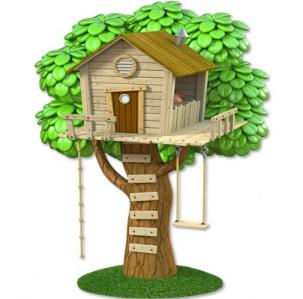
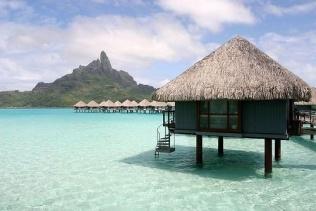
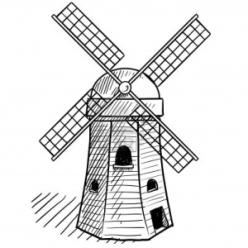
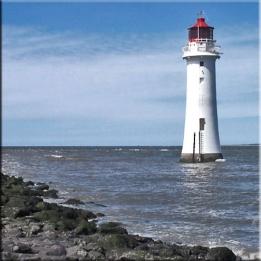
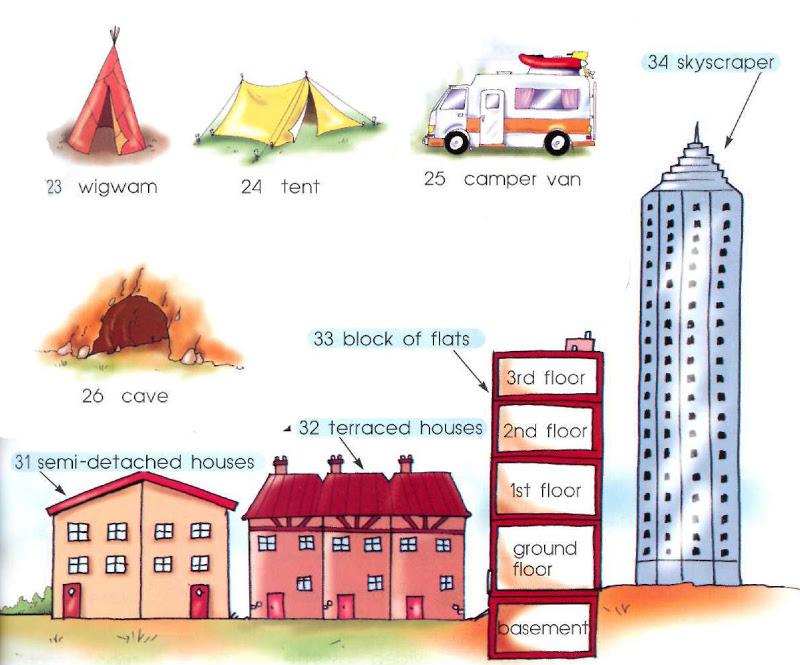
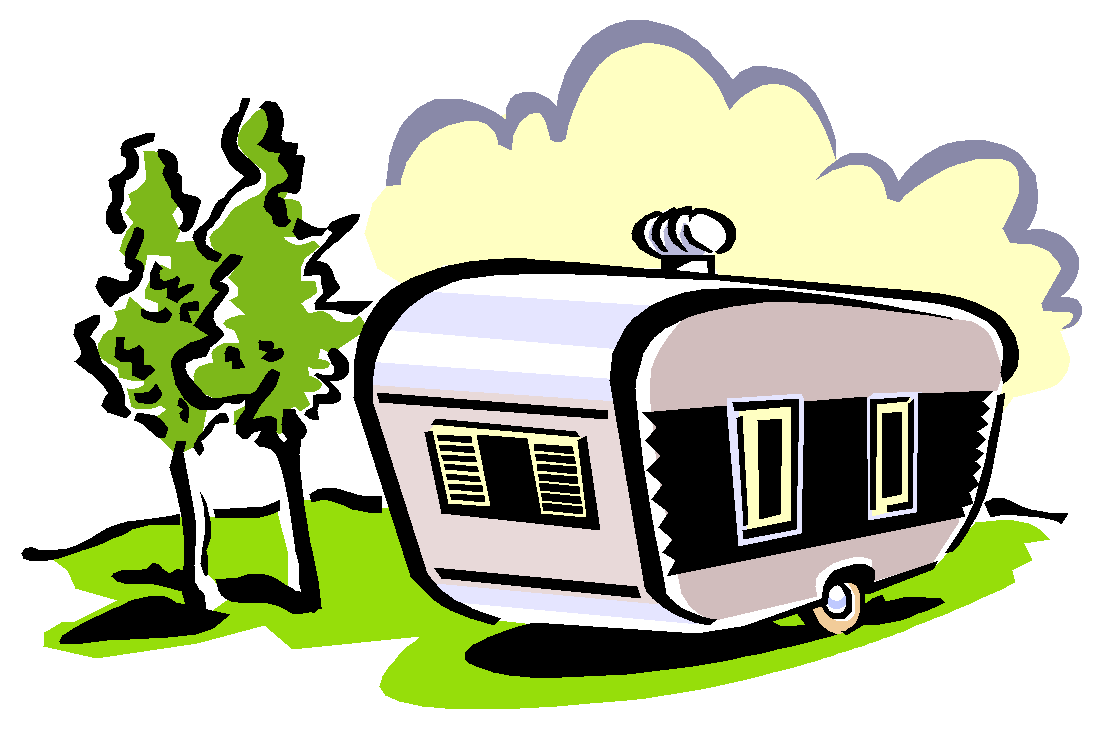
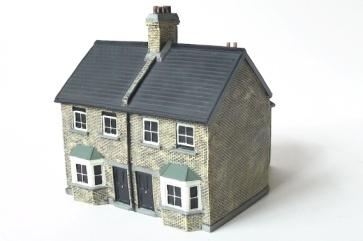
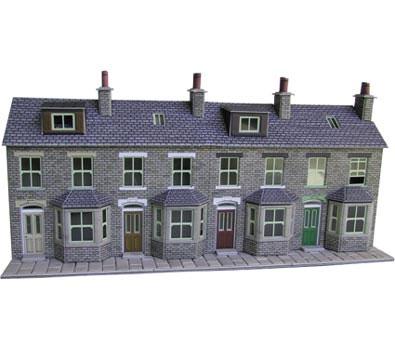
№6. Match the words to the correct houses. Translate the words.
a) a tent b) a camper van/a mobile home c) semi-detached houses d) a detached house
e) a terraced house/a row house f) a caravan g) a house boat
h) a flat / an apartment/a block of flats i) a hut j) a stilt house k) an igloo l) a cottage
m) a villa n) a mansion o) a castle p) a tepee/teepee/tipi q) a chalet r) a tree house
s) a windmill t) a lighthouse
| 1
| 2
| 3
| 4
|
| 5
| 6 | 7 | 8 |
| 9
| 1 | 1 | 1 |
| 1
| 1 | 1 | 1 |
| 1
| 1 | 1 | 2 |




 0
 1
 2
 3
 4
 5
 6
 7
 8
 9
 0
Lesson 2
Оборот there is/ there are
Оборот there с личной формой глагола to be в английском языке употребляется очень часто и имеет значение есть, имеется, находится, т.е. в тех случаях, когда говорящий хочет подчеркнуть факт наличия (отсутствия) какого-либо предмета или явления, а не место, в котором находится.
Глагол to be в этом обороте может употребляться в единственном и во множественном числе, и в разных временных формах:
| Tense | Singular | Plural |
| Present Simple | There is | There are |
| Past Simple | There was | There were |
| Future Simple | There will be | There will be |
Если английское предложение начинается с конструкции There is или There are на русский язык такое предложение следует переводить, начиная с конца:
There are four books in the bag. – В сумке четыре книги.
Если в предложении несколько подлежащих, то выбор формы глагола (is или are) определяется тем подлежащим, которое стоит первым.
There is a pen, two books and a pencil in the bag .
There are two books, a pen and a pencil in the bag.
Виды предложений
|
| Positive | Negative | Interrogative |
| Present Simple | There is a child in the room. | There is not a child in the room. | Is there a child in the room? |
| Past Simple | There was a child in the room. | There was not a child in the room. | Was there a child in the room? |
| Future Simple | There will be a child in the room. | There will not be a child in the room. | Will there be a child in the room? |
Исчисляемые существительные в единственном числе в отрицательной форме употребляется с неопределённым артиклем, а существительное во множественном числе или неисчисляемое существительное – со словом any.
There isn’t a book on the table.
There are not any books on the table.
There is not any water in the bottle.
Отрицательную форму можно образовать также с помощью местоимения no, которое ставится перед существительным. В этом случае существительное употребляется без артикля:
There is no flower in the vase.
There are no cats on the roof.
Exercises
№1. Insert is or are.
There _____ two cups of tea on the table.
There _____ some milk in the cup.
There _____ an orange in the salad.
There _____ six balls in the box.
There _____ some cheese on the plate.
There ______ a blue chair at the door.
There _____ five chicks and a hen on the farm.
There _____ a table and nine desks in the classroom.
There _____ a big window to the left of the door.
There _____ three rooms in our country house.
№2. Make negative and interrogative sentences
There are some new pupils in our group.
There is no book on the table.
There were many old houses in our street.
There are 4 seasons in a year.
There will be a conference next week.
There are many large cities in our country.
There was nobody in the room.
There are 7 days in a week.
There is something on the shelf.
There was much work last week.
№3. Write in Is there or Are there. Give short answers: positive – 1, 3, 5; negative – 2,4,6.
_____________ any sausages in the fridge? _________.
_____________ any sugar in the cupboard?__________.
_____________ any rolls on the table?______________.
_____________ any eggs in the fridge?_____________.
_____________ any jam in the fridge?______________.
_____________ any biscuits in the cupboard?________.
№4. Make up the sentences. Translate them.
1. pears / there / ten / in the / are / bag / .
2. aren’t / pupils / there / classroom / in the / .
3. an egg / on the / there / plate / is / ?
4. on the / there / a / cat / chair / is / white / .
5. a turtle / on / there / isn’t / farm / this / .
6. at the / two / bikes / door / are / there / ?
№5. Write the sentences in Past Simple and Future Simple:
There is much snow in winter.
There are 5 theatres in our city.
There is no lift in our house.
There are many new books in our library.
There is little milk in the bottle.
There are 3 rooms in our flat.
Lesson 3
My college.
№1. New words
vocational education – профессиональное образование
student – студент
teacher – преподаватель
grouptutor - куратор
monitor - староста
department – отделение
full-time – очная форма обучения
part-time/correspondence – заочная форма обучения
specialty – специальность
period (double-lesson, double-class) – пара (сдвоенный урок)
break – перемена
timetable/curriculum – расписание
register – журнал
credit test – зачёт
scholarship – стипендия
hostel – общежитие
canteen – столовая
№2. Read the text.
My name is Alex. I study at the Forest College. I am a full-time student. I am in my first year now.
There are full-time and part-time departments in our college. The academic session lasts 10 months. Our college trains specialists in many branches of knowledge. There are three specialties in the college: “Forest and park management”, “Maintenance and repair of engines, systems and aggregates of cars” and “Hotel business”. Our college is very cosy and spacious. There is a large and light hall, a sport gym, a training room with sport heavy equipment on the ground floor. Many subject classrooms, a rich library and a reading hall are situated on the second floor. All the rooms of our college have modern equipment: computers, TV-sets, DVD-players and interactive boards. Not far from the college it is a hostel. It is a very comfortable and cosy four-storied building for the students. Opposite the college it is a club and a canteen. During the lunch-break we go there to have dinner.
Our periods begin at 8.15 and they are over at 16.25. Our period lasts 90 minutes. As a rule, we have three or four periods every day. We study many subjects at the college. We attend lectures, seminars and have practice. Some students who have only good and excellent marks get a scholarship. We go to college five days a week. Saturday and Sunday are our days off.
Our group consists of 25 students, including our monitor. Some our groupmates live in our hostel. As a rule, almost every student of our group comes to the college before the bell rings. So we can have a chat with each other. We usually have a lot of things to talk about. After periods everybody goes home to do homework. There are many different clubs and societies at our college. I attend a sport club and a dance club.
At the end of each semester we have test, credit tests and exams. When we have passed all the tests we start to prepare for the exams. After the exams a vacation comes.
Now I can’t say that college life is a fascinating, fantastic experience. For the moment I can compare it only with a daily routine.
№3. Answer the questions:
Where do you study?
What specialty do you study?
Are you a part-time or a full-time student?
What year are you in now?
How many students are there in your group?
When do your periods start?
When do your periods finish?
What is your favourite subject?
Do you always attend your lectures?
Do you get a scholarship?
How often do you have exams and credit tests?
Do any of your friends live in a hostel?
№4. Translate the following expressions.
To study at the college, to attend periods, to get a scholarship, to fail at the exam, a part-time student, to take part in social activities, to be at the top of the group, to get excellent marks, to live in a hostel, groupmate, to miss periods, educational institution, to do well in a subject, to get ready for exams, a first-year student, academic session.
№5. Translate the following expressions.
Староста, колледж, среднее профессиональное образование, физическая культура, изучать английский язык, расписание учебных занятий, проводить занятия два раза в неделю, сдать экзамены, выполнять домашнее задание, быть студентом-первокурсником, принимать участие в общественной деятельности.
№6. Give the short affirmative answer (+).
1) Has our college full-time and part-time departments?
2) Do our studies begin at 9 o’clock?
3) Do we usually have 5 periods a day?
№7. Give the short negative answer (-).
1) Is there a small reading-hall in our college?
2) Have our labs old equipment?
3) Will the academic session end in May?
Preposition of place
Английские предлоги места можно поделить на две подгруппы – предлоги, указывающие на месторасположение и на движение.
Предлоги месторасположения:
in – всегда внутри чего-то;
on – на какой-либо (обычно более-менее) горизонтальной поверхности;
at – возле чего-то;
near – возле чего-то;
by – возле- чего-то;
Важно: предлоги at, near, by на первый взгляд имеют одинаковое значение, но at означает расстояние почти вплотную; near – предполагает близость с некоторой отдаленностью; by – подразумевает непосредственную близость, но в нижнем положении по отношению к говорящему.
between – показывает местонахождение между объектами или людьми;
beside – в стороне от чего-то или кого-то;
over и above – практически синонимы и обозначают положение «над»;
under – их антоним и означает «под»;
outside – обычно вне дома или помещения;
inside – внутри дома или помещения;
against – с опорой на что-то;
behind – позади кого-то/чего-то;
in front of – перед чем-то/кем-то;
ahead of – перед чем-то/кем-то (если объекты находятся более-менее на одной линии)
Предлоги, обозначающие движение
to – направление движения, часто с указанием конкретного места, но не вовнутрь;
into – предполагает движение вовнутрь;
from – показывает, откуда начинается движение, но это преимущественно отрытое пространство;
out of – движение из закрытых объектов.
№1. Fill in the spaces with the correct preposition
1) They went _______________ the party. (at, to)
2) The guests are sitting _______ the table. (at, above)
3) He walked ________________ the park. (for, to)
4) I am driving home __________ the bank. (at, from)
5) Keep the dog ______________ the furniture! (in, off)
6) The people are _____________ a party. (in, at)
7) Mary is sitting _____________ John. (at, near)
8) The dog is lying ____________ the floor. (at, on)
9) The man is sitting __________ the woman. (beside, to)
10) Their feet are _____________ the table. (through, under)
№2. Translate the sentences:
Что у тебя под столом?
Посмотри на часы на стене под картиной.
Я стоял в окружении толпы на концерте.
Игрушки лежат на полу.
Его поставили между двух девочек для традиционной фотографии.
Над городом тучи.
Он сейчас занимается в тренажерном зале.
Твоя шляпа на столе.
Lesson 4
Plural of nouns
Способы образования формы множественного числа существительных
1. Прибавлением окончания –s к существительному в единственном числе:
После глухих согласных звуков это окончание произносится [s], а после звонких согласных и после гласных - [z]: boy – boys, girl - girls
2. Прибавлением окончания –es, если существительное в единственном числе оканчивается на –s, -ss, -sh, -ch или –x: class – classes, wish – wishes, inch – inches, box – boxes
3. Если существительное в единственном числе оканчивается на согласную, после которой следует –y, то y заменяется на –i, и добавляется окончание –es: city – cities,
4. Если существительное в единственном числе оканчивается на гласную, после которой следует –y, то добавляется окончание –s (однако данное правило не относится к словам, оканчивающимся на –quy): essay – essay
Однако: soliloquy – soliloquies
5. Если существительное оканчивается на согласную, после которой следует -о то добавляется окончание -es: a potato — potatoes
Исключения:
музыкальные термины: a piano — pianos;
сокращённые слова: a photo — photos, disco - discos
6. Если существительное в единственном числе оканчивается на гласную, после которой следует –o, то добавляется окончание –s: a cuckoo — cuckoos, a radio — radios
7. В существительных, оканчивающихся на –f или –fe, множественное число образуется путем замены f на v, и прибавлением окончания –es: wife – wives
Исключения:
Прибавлением окончания –s к следующим существительным: brief – briefs, belief — beliefs, chief – chiefs, proof – proofs, a roof — roofs, a gulf — gulfs, a grief — griefs, a handkerchief —handkerchiefs, cliff — cliffs, a cuff — cuffs
8. Существительные латинского и греческого происхождения сохранили свою форму множественного числа:
alumnus – alumni (бывший ученик – бывшие ученики)
analysis – analyses (анализ – анализы)
agendum – agenda (повестка дня – повестки дня)
appendix – appendices, appendixes (приложение – приложения)
focus – foci, focuses (фокус – фокусы)
formula – formulae, formulas (формула – формулы)
index – indices, indexes (указатель – указатели)
axis – axes (ось – оси)
basis – bases (основа – основы)
bacterium – bacteria (бактерия – бактерии)
crisis – crises (кризис – кризисы)
criterion – criteria (критерий – критерии)
curriculum – curricula (расписание- расписания)
9. Ряд существительных образует множественное число не по правилам:
a man — men;
a woman — women;
a foot — feet;
a tooth — teeth;
a goose -geese;
a mouse — mice;
a louse — lice;
an ox — oxen;
a child — children.
Так же ведут себя производные от них слова, например:
a businessman — businessmen;
a grandchild — grandchildren.
10. Некоторые существительные имеют одну и ту же форму для единственного и множественного числа:
deer; sheep; swine; trout; cod; grouse;
bellows; series; mews; species; barracks; corps; headquarters; gallows; kennels;
hair; fruit, fish.
Однако, когда речь идет о различных видах фруктов или рыб, слова обретают форму множественного числа – fruits, fishes: In this lake there are fishes of many varieties.
11. Множественное число составных существительных
В составных существительных множественную форму принимает главное слово:
commander-in-chief – commanders-in-chief
father-in-law – fathers-in-law
passer-by – passers-by
looker-on – lookers-on
Если же в составном существительном ни одно из слов, входящих в его состав, не является существительным, окончание множественного числа прибавляется к последнему слову:
merry-go-round – merry-go-rounds (карусель – карусели)
forget-me-not – forget-me-nots (незабудка – незабудки)
grown-up – grown-ups (взрослый – взрослые)
12. В сложных существительных во множественном числе изменяется последний элемент (существительное с основным значением)
schoolgirl школьница — schoolgirls школьницы,
fisherman рыбак — fishermen рыбаки
13. Слова, которые употребляются только в единственном числе:
information, advice, money, news, success, furniture, work, progress, cream, ink, knowledge.
Слова, которые имеют форму только множественного числа:
scissors, trousers, spectacles, scales, clothes, wages, goods, contents, sweepings,
odds, greens, shorts, jeans, pyjamas, tights.
Ну, а в сочетании с неисчисляемыми существительными употребляются такие слова, как бутылка (bottle), кусочек (piece), килограмм (kilo), пакет (packet) и многие другие.
14. Существительные family и team могут означать как единое понятие, так и отдельных членов.
The team is here. Команда здесь. (ед. ч.)
The team are well. Члены команды чувствуют себя хорошо. (мн. ч.)
His family is one of the oldest in the county. Его семья (род) - одна из старейших в стране.
His family are all doctors. В его семье все врачи
15.Наименования всех наук, оканчивающиеся на -ics, совпадая по форме с существительными во множественном числе, всегда употребляются в значении единственного числа: Phonetics фонетика, Economics экономика
16. Слово police - полиция в английском языке всегда употребляется в значении множественного числа (как группа людей)
The police have powers to arrest you anywhere and at any time. Полиция вправе арестовать вас где угодно и в любое время.
Упражнения
1. Напишите данные существительные во множественном числе.
A farmer, a country, a city, a day, a disc, a leaf, an address, an apple, a lemon, a child, a man, a house, a crisis, a mouse, a tooth. a photo, a kilo, a potato, a chef, a fox, a watch, a theatre, a hobby, a bottle
2. Поставьте следующие предложения в множественное число.
1. This is a star. 2. This is a boy. 3. This is a baby. 4. That is a plate. 5. That is a flower. 6. That is a bookshelf. 7. Is this a sofa? 8. Is this a bookcase? 9. Is this a man? 10. Is that a ball? 11. Is that a train? 12. Is that a plane? 13. Is the window open? 14. Is the door closed? 15. Is the boy near the window? 16. That is not a king. 17. That is not a queen. 18. That is not a bus. 19. This isn't a mountain. 20. That isn't a goose. 21. This isn't a mouse. 22. It is a sheep. 23. It is a cigarette. 24. It is a cat. 25. It is not a girl. 26. It isn't a bag. 27. It isn't a tree. 28. It is not a bad egg. 29. It is a good egg. 30. Is that a flower?
3. Соотнесите слова в левом и в правом столбцах.
| 1. a tin of 2. a bottle of 3. a bar of 4. a packet of 5. a loaf of 6. a tube of 7. half a kilo of 8. a jar of 9. a box of 10. a slice of 11. a bunch of 12. a dozen of | a) bread b) biscuits c) milk d) tuna e) eggs f) cheese g) grapes h) wine i) toothpaste j) chocolate k) jam l) meat |
4. Read the poem “Plural” (listen to it: https://youtu.be/kPCoC4V1EeY)
We’ll begin with a box, and the plural is boxes,
But the plural of ox should be oxen, not oxes.
Then one fowl is a goose, but two are called geese,
Yet the plural of moose should never be meese,
You may find alone mouse or a whole nest of mice,
But the plural of house is houses, not hice.
If the plural of man is always called men,
Why shouldn’t the plural of pan be called pen?
The cow in the plural may be cows or kine,
But a bow if repeated is never called bine,
And the plural of vow is vows, never vine.
If I speak of a foot and you show me your feet,
And I give you a boot would a pair be called beet?
If one is a tooth, and a whole set are teeth,
Why shouldn’t the plural of booth be called beeth?
If the singular’s this and the plural is these,
Should the plural of kiss ever be nicknamed keese?
Then one may be that and three would be those,
Yet hat in the plural would never be hose,
And the plural of cat is cats, not cose.
We speak of a brother, and also of brethren,
But though we say mother, we never say methren,
Then the masculine pronouns are he, his and him,
But imagine the feminine she, shis and shim,
So the English, I think, you all will agree,
Is the queerest language you ever did see.
Lesson 5
Student’s Working Day
№1. New words:
to do one's best — делать все от тебя зависящее
goal — цель
radio alarm — радиобудильник
to buzz — звонить, давать сигнал
lazybones — лентяй
to do one's morning exercises — делать утреннюю гимнастику
wealth — достаток
to have a shower — принимать душ;
to get dressed — одеваться
to brush one's hair — причесываться
to take sb some time to do sth — занимать определенное время, чтобы сделать что-либо
to be in the habit of doing sth — иметь привычку что-либо делать
to grab — хватать
to rush — бежать, спешить
to flash by — пролетать
the humanities — гуманитарные науки
to drag — тянуться
to be busy doing sth — быть занятым чем-либо
№2. Read and translate the text
My usual working days look practically the same. But I do my best to make them more interesting and useful. Life is impossible without work. Teachers and parents always say that hard work is the only way to achieve our goals.
My working day usually starts like this. At exactly 6:00 my radio alarm buzzes. Though I am not a lazybones, in winter it is always difficult for me to wake up early. I do my morning exercises every morning. I know that good health is better than wealth. After having a shower, I get dressed and brush my hair. It takes me about 40 minutes. I am in the habit of having only a light breakfast. After breakfast I grab my school bag and rush for college. Unfortunately, I live far from the college. It takes me about one hour to get there.
Sometimes my mood depends on what classes I have. On some days lessons flash by very quickly, especially if they are on the humanities or Maths, which I like most, but they drag more slowly if they are on Chemistry or Biology and especially when we have to write tests on them. Our classes start at 8:20. Usually we have seven lessons a day. Each lesson lasts 45 minutes, but the breaks are too short: only 5 or 10 minutes. Fortunately, we have a large break in the middle of the day which lasts 45 minutes. During this break we go to the canteen.
At 3 o'clock, when the classes are over, I sometimes stay at college to play football with my groupmates. In the evenings I am busy doing my homework. If I have some free time left, I go for a walk with my friends, read or watch TV. At about 8 o'clock all our family have supper. At 11:30 I take a shower and go to bed.
№3. Complete the sentences with the appropriate words and phrases from the box.
Buzzes, wealth, busy, goal, hard, takes a shower, lazybones, cold water, canteen, gathers, flash by, to organize, health, lasts, to stay in bed
1. Life is impossible without……………….work.
2. Alexander tries……………… his working day well.
3. At 6:15 my alarm clock……………………
4. I usually …….as long as possible. Am I a…………………. ?
5. Good ……...is better than……..
6. I wash my face with………………..
7. In a common school every lesson……………… 40 minutes.
8. This weekend I am…………doing my project.
9. At dinner all our family…………… at the kitchen table.
10. At 11 o'clock he……………..and goes to bed.
№4. Are these statements true or false? Correct the false ones.
1. Alexander's working day starts at 6:30.
2. He is in the habit of having a big breakfast.
3. Alexander's favourite subject is Maths.
4. In the middle of the day the students go to the canteen.
5. Alexander likes to play football.
6. In the evenings he goes for a walk with his friends.
№5. Talk about your working day using the following prompts:
1) My usual working day starts...
2) I get up at...
3) It takes me...
4) My classes start at...
5) We usually have...lessons a day.
6) At...o'clock our classes are over.
7) I come back home at...
8) At home i...
9) If i have time, I...
10) I go to bed at...
№6. Раскройте скобки, употребите глагол в Present Simple:
1. Andrew (watch) some educational programmes in English.
2. This team (play) like a champion.
3. Parson (catch) the ball and (pass) to Roberts.
4. The seminar (finish) at 12:00.
5. Emma (dream) at the lesson.
6. Ivan (leave) school next year.
7. I le (grab) his bag and (rush) to the bus stop.
8. I often (forget) my lunchbox at home.
9. My group mates (say) that 1 (dress) fashionably.
Lesson 6
Numerals
Числительное – это часть речи, обозначающая количество или порядок предметов. В английском языке, как и в русском, есть два вида числительных, порядковые (ordinal) и количественные (cardinal).
Количественные числительные обозначают число предметов (отвечают на вопрос «сколько?»). Порядковые числительные обозначают порядок предметов (отвечают на вопрос «который?»).
| 1 | one | first | 22 | twenty-two | twenty-second |
| 2 | two | second | 23 | twenty-three | twenty-third |
| 3 | three | third | 24 | twenty-four | twenty-fourth |
| 4 | four | fourth | 25 | twenty-five | twenty-fifth |
| 5 | five | fifth | 26 | twenty-six | twenty-sixth |
| 6 | six | sixth | 27 | twenty-seven | twenty-seventh |
| 7 | seven | seventh | 28 | twenty-eight | twenty-eighth |
| 8 | eight | eighth | 29 | twenty-nine | twenty-ninth |
| 9 | nine | ninth | 30 | thirty | thirtieth |
| 10 | ten | tenth | 40 | forty | fortieth |
| 11 | eleven | eleventh | 50 | fifty | fiftieth |
| 12 | twelve | twelfth | 60 | sixty | sixtieth |
| 13 | thirteen | thirteenth | 70 | seventy | seventieth |
| 14 | fourteen | fourteenth | 80 | eighty | eightieth |
| 15 | fifteen | fifteenth | 90 | ninety | ninetieth |
| 16 | sixteen | sixteenth | 100 | one hundred | hundredth |
| 17 | seventeen | seventeenth | 500 | five hundred | five hundredth |
| 18 | eighteen | eighteenth | 1000 | one thousand | thousandth |
| 19 | nineteen | nineteenth | 100 000 | one hundred thousand | hundred thousandth |
| 20 | twenty | twentieth | 1 000 000 | one million | millionth |
| 21 | twenty-one | twenty-first | 1 000 000 000 | one billion | billionth |
Цифра ноль в английском языке в зависимости от контекста может читаться по-разному: zero, o, nil.
Ноль произносится как «zero», когда ноль используется в дробях, процентах, телефонных номерах и в определенных выражениях.
O (читается, как английская буква o [əu]) – используется в обозначении годов, времени, в адресах, иногда в телефонных номерах.
Nil – используется в счете спортивных матчей.
Иногда в британском варианте английского языка встречается слово naught или nought в значении «ноль», «нуль», «ничто». Сейчас его использование в качестве цифры считается устаревшим и само слово чаще всего используется в фразеологизмах.
При счете используя сотни, тысячи, миллионы и т.д. к числительным не прибавляется окончание -s, указывающее на множественное число. Окончание -s используется, когда числительные выступают в качестве существительных (кто? что?), то есть в сочетаниях dozens of (дюжины, много), hundreds of (сотни), thousands of (тысячи) в значении «очень много».
Что нужно знать об употреблении английских числительных
Когда мы хотим сказать о номере страницы, дома, упражнения, автобуса мы можем использовать как количественные числительные, так и порядковые. Однако, при употреблении количественного числительного, числительное следует за определяемым им существительным, причем существительное употребляется без артикля.
Пример: lesson two (урок второй), page seventeen (страница семнадцатая) Когда мы употребляем порядковые числительные, порядковое числительное ставим перед существительным, и существительное уже приобретает определенный артикль the.
Пример: the second lesson (второй урок), the seventeenth page (семнадцатая страница).
Годы в английском языке обозначаются количественными числительными. Четырехзначные годы при чтении делятся пополам и эти половинки читаются как два отдельных числа. Однако, миллениумы (тысячелетия, например, 2000 г.) читаются тысячами. Годы, состоящие из трех чисел, могут также делиться и читаться как однозначное и двузначное числа, или же они могут читаться как обычное трехзначное число. Годы нынешнего столетия могут читаться как обычные четырехзначные числа.
BC – Before Christ – до Рождества Христова, до нашей эры.
AD – Anno Domini – после Рождества Христова, наша эра.
2000 BC – two thousand BC
1825 – eighteen twenty-five
1660 BC – sixteen sixty BC
1901 – nineteen o one
33 AD – thirty-three AD
2000 – two thousand
1003 – ten o three
2016 – twenty sixteen, two thousand sixteen
Проценты (percentages) в английском языке обозначаются словом percent (процент). После числительных слово percent никогда не принимает окончание множественного числа -s, так как с французского языка это слово дословно переводится как «из сотни», «на сотню».
Пример: 1% – one percent, 10% – ten percent
Для счета денег в английском языке сначала произносится число, а потом название валюты. Если число состоит из десятичной дроби, то произносится целая часть, название валюты, после которой десятичная часть (копейки) произносится как обычное число. В конце может добавляться название монеты, если оно существует.
Пример: $2 – two dollars, €14,99 – fourteen euros ninety nine (cents, euro cents), £204 – two hundred and four pounds
Номера телефонов, счетов, карт и т. д. читают не сотнями-десятками, как на русском, а отдельными цифрами:
555-757-23-11 – five, five, five, seven, five, seven, two, three, one, one.
Двойные и тройные цифры иногда называют double и triple:
555-757-23-11 – triple five, seven, five, seven, two, three, double one.
При арифметических действиях глагол to be или to equal (равняться) в большинстве случаев употребляется в форме единственного числа.
2 + 1 = 3 – two plus one is three.
5 – 4 = 1 – five minus four equals one.
20 х 2 = 40 – twenty multiplied by two is forty.
30 : 6 = 5 – thirty divided by six equals five.
В случае сложения глагол может стоять также в форме множественного числа. Также может использоваться глагол to make.
3 + 21 = 24 – three and twenty-one are twenty-four.
5 + 100 = 105 – five plus hundred equal one hundred five.
7 + 3 = 10 – seven and three make ten.
Простые дроби (fractions) в английском языке часто пишутся словами и через дефис, если в числителе или знаменателе не используется свой дефис. Для того, чтобы правильно произнести дробь на английском языке, нам надо знать и порядковые, и количественные числительные. Для числителя (numerator) используются количественные числительные, а для знаменателя (denominator) – порядковые. Знаменатель, принимает окончание множественного числа -s, если числитель больше единицы.
Пример: 1/5 – one fifth, 4/7 – four sevenths, 2 ¼ - two and one fourth/quarter
Десятичные дроби (decimals) в английском языке читаются с помощью слова point (точка), после которой все цифры читаются отдельно. Это правило не относится к счету денег.
Пример: 0.5 – zero point five, 43.75 – forty-three point seventy-five
Упражнения
№1. Преобразуйте количественные числительные в порядковые.
two, eighty-three, seven hundred and sixteen, twelve, eleven, twenty-five, ninety-six, thirty-eight, ten, two thousand and nine.
№2. Напишите словами по-английски указанные ниже года:
1. 1943.
2. 2085.
3. 1950.
4. 1812.
5. 1689.
6. 1238.
7. 1909.
8. 1701.
9. 2010.
10. 3004.
№3. Переведите предложения на английский язык.
1. Мы читаем урок шестой, упражнение пятое.
2. Джон пишет сегодня четвертое письмо.
3. Сегодня одиннадцатое декабря.
4. Вчера было девятое января 2013 года.
5. Джек должен выучить сорок семь слов.
6. Сегодня шестьсот двадцать третий день с начала шоу.
7. Джейн родилась в 1980 году.
8. Это была вторая попытка Джеймса сдать этот экзамен.
№4. Напишите дроби словами.
½ 5. 9/10
5/8 6. 11/12
1/3 7. 2/5
4/7 8. 3/4
№5. Решите пример и напишите ответ словами.
sixty-two + fourteen = …
fifteen + two hundred and forty-six = …
ninety + ten = …
thirty-one + nineteen = …
seventy-three + eighty-two = …
three thousand one hundred and twelve + ninety-nine = …
№6. Translate the college subjects:
Russian, Literature, English, Maths, IT, Physics, Social Science, Natural Science, Geography, Biology, Chemistry, History, Astronomy, PE, Life Safety
№7. Make up your timetable.
Lesson 7
My working day
1. New words
get up – вставать
to switch (off) the radio – включить (выключить) радио
to do morning exercises – делать утреннюю гимнастику
to clean teeth – чистить зубы
to pick smb up – подвезти кого-либо
to consist of – состоять из
course – блюдо
for the first course – на первое
strong (weak) tea – крепкий (слабый) чай
stewed fruit – компот
to wash up dishes – мыть посуду
go to bed – ложиться спать
2. Read and translate the text
I get up at a quarter to seven. I jump out of bed, switch my tape-recorder and do my morning exercises to the music. Then I go to the bathroom, wash myself and clean my teeth with a tooth-brush. It does not take me much time, not more than ten or fifteen minutes. Then I dress and sit down at the table to have my breakfast. I usually have a cup of tea or coffee, an egg and bread and butter.
After breakfast I go to the college. As I live far away, I go by bus or by my father’s car. It takes me more time to go by bus. If I have little time, I ask my father to pick me up and to drive me to the doors of our college building.
My lessons begin at 8 o’clock. We have six or eight lessons every day. At 11.20 we have a lunch hour.
As I cannot get home for lunch I take it at the canteen of our college. It is situated near our college. For lunch I have meat or fish with potatoes and a cup of strong tea or coffee with a pie. At 16.20 the lessons are over and I go home. When I get home from the college, I have dinner. My dinner usually consists of three courses.
For the first course I have some soup, then some meat or fish. For dessert I have stewed fruit or ice-cream. After dinner I help my mother to wash up the dishes. Then I do my home tasks. It usually takes me about two hours.
At eight o’clock I have supper. I have some salad, a slice of sausage and bread, sour milk or cereal.
In the evening I listen to the music or radio or watch TV. If the programme is not interesting, I go for a walk with my friends. We talk about different things and usually have a good time.
At 11 o’clock I go to bed.
Answer the questions.
1. When do you get up?
2. What do you do when you get up?
3 How much time does it take you to do your morning exercises, to wash and dress?.
4. When do you leave home?
5. How do you get to your college?
6. How much time does it takes you to get to your college?
7. How many lessons have you every day?
8. When are your lessons over?
9. When do you come home?
10. What do you do at home?
11. How do you spend your free time?
12. At what time do you go to bed?
4. Study the picture and write the time:
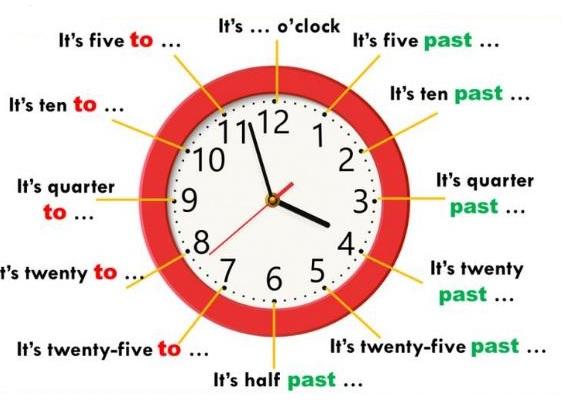
10:03, 2:59, 10:00, 15:25, 3:06, 4:15, 11:55, 8:45, 16:20
5. Translate the following phrases into Russian:
a quarter to seven, five o’clock, half past eight, one a.m., twenty to three, a quarter past six, five past eleven, ten thirty p.m.
6. Translate the following phrases into English:
половина девятого, без пятнадцати шесть, два часа ночи, пятнадцать минут восьмого, двадцать минут одиннадцатого, без двух минут четыре
Prepositions of Time
on
- days (of the week) & dates:
on Sunday; on May 1st; on Christmas Eve; on my mark; on the weekend (AmE.)
in
- months / seasons / year
in summer / in July / in 2017
- part of the day
in the evening
- after a period of time
in an hour; in the future
at
- a specific point of time
at 11:15 p.m.; at half past six
- exceptions (when?)
at noon; at night; learned English at 42; at the weekend (BrE.); at first glance
since
- from a specific point in time until now (past till now)
since 1980; since yesterday
for
- over a certain period of time
for the first time in forever; for 3 years
ago
- from now to a specific point in the past (now till past)
a second ago; a decade ago; a while ago
during
- throughout the course or duration of smth.
during summer; during the vacation; during the discussion
before
- previous to in time; earlier than
before winter; before dawn; I have to talk to the client before I call my manager
after
- Subsequent in time; at a later time than
after midnight; after tomorrow
until (till)
- up to a certain point in time
until Monday; I’ll wait to call my manager until I hear from the client
to / past
- telling the time
ten to two (1:50) / ten past two (2:10)
from / to
- a starting point / an end point
from the beginning; from now to eternity
by
-not later than
by 12 o'clock; by next week
1. Fill in the missing preposition:
1. __ spring
2. __ 2012
3. __ Monday
4. __ Christmas Day
5. __ Easter
6. __ Sundays
7. __ January
8. __ the evening
9. __ Tuesday morning
10. __ December 31st
11. __ 10 o’clock
12. __ September
13. __ the afternoon
14. __ Wednesday
15. __ midnight
16. __ Saturday afternoon
17. __ noon
2. Fill in the missing preposition of time:
It was one of my usual days. I got up _1_ 7 o’clock _2_ the morning, washed, dressed and had breakfast _3_ 7.30. Then I went to my office. There I worked with the documents till 1 o’clock _4_ the afternoon. Then I had lunch _5_ 1.30. After that I looked at my diary and saw that I had an important meeting with my companions _6_ 3 p.m. in the cafe _7_ Mon-day afternoon. I was short of time. I was in a hurry and forgot to take some important documents with me. I was forced to return to my office. As you could guess I was late. It was awful! I came to the café _8_ 20 minutes. Luckily my companions were still there. I apologized for my being late and explained what had happened. Then we discussed some questions about the company. It was a hard day
Learn by heart
My Working Day
I get up at 7 o’clock
When I hear Mother’s knock.
Then I wash and make my bed,
Then I have breakfast – tea and bread.
At 8 o’clock I go to school,
My bag is heavy. It is very full.
Lessons begin at quarter past 8,
Sometimes I come to school too late.
(I never come to school too late).
We have 4 periods every day,
“It’s hard to learn”, the students say.
At 4 o’clock the school is over,
It’s time for us to go home.
And after dinner I go for a walk,
With the friends I have a talk.
Then we play the games we like,
Very often we ride a bike.
I always do my home task
And answer well when (the) teachers ask.
Late at night I go to bed,
The day is over. It wasn’t bad.
Lesson 8
Hobbies
1. Read the text. Make a list of all the people’s activities mentioned in the text.
Alexander thinks that he has too many hobbies and too little time. He wants to share his concern with his friend Peter from Poland. As Peter is coming to Moscow only in two months’ time, Alexander decides to write him. But before writing an email, he puts his ideas in his diary:
“Nowadays it’s hard to name all the activities, entertainment and hobbies practiced by people in their free time. A growing number of people prefer watching films, performances, sporting events on TV to attending them. There exist quite different sorts of leisure activities which give thousands of people a sense of excitement and expectation. There are various pursuits that people choose to pass their free time. Today people spend hours watching Different informative, educational or environment programmes. Other popular occupations are surfing the Internet, playing computer games, listening to the radio, reading books (e-books), painting and so on. Many people prefer to go in for different kinds of sports and lead an active way of life. Sometimes they participate in competitions or contests and have a very good past time. There are people that prefer a calm way of spending their free time. They are fond of walks in parks or gardens. More serious people prefer to visit museums, art galleries or theaters.
Aerobics and shopping are two of the most popular pursuits for women. Cooking is also a very widespread activity among them. But nothing can be compared to your favorite hobby. A hobby is a special interest or activity that you do in your free time. Some people have animals as hobbies. They keep rabbits, or go fishing, or train dogs to do tricks. Some people are crazy about plants. They try to grow cacti or tropical flowers in their kitchens and sitting-rooms. Others are mad about their cars and motorbikes. They spend their Saturdays and Sundays washing them, painting them or buying new parts to make them go even faster. Many people make things as a hobby…
2. Are these statements true or false? Сorrect the false ones.
Alexander writes in his diary a list of all activities, entertainments and hobbies practiced by people in their free time.
Alexander has no hobby and wants to select one.
He meets with his friends to discuss the problem.
Hobbies give people a sense of excitement and expectation.
Today people spend a lot of time watching different informative, educational or environment programmes.
Women prefer aerobics, shopping and cooking.
A hobby is an active pastime lie sport or training dogs.
In order to relax most people prefer a calm way of spending their free time.
Animals can also be a hobby.
People prefer ready-made things to hand-made ones.
3. Put the words under the following headings:
| knitting and sewing | drawing | cooking |
|
|
|
|
Watercolors, spoon, exhibition, wool, salt, album, frying pan, canvas, pattern, gas cooker, pencil, needle, food processor, sewing machine, cutting board, button, brush, scissors, knife, fabric, forceps, eraser, measuring tape, fork, mannequin, sketch, cotton, pepper, thread, paper, catalogue.
4. Divide into 3 groups hobbies which are more suitable for men, for women and for both:
playing chess, mountain climbing, astrology, reading, model trains collecting, animal communication, playing football, knitting, horse riding, photography, yoga, parachuting, riding motorbikes, cooking, exploring volcanoes and underwater caves, sewing, travelling, dancing, fishing, computers, fashion, windsurfing, playing the piano, aerobics in the water, collecting postcards, diving.
5. Talk about your favourite hobby using the following prompts.
I have … (many, several, a few, only one) hobbies/ hobby.
My favorite hobby is …
I enjoy …
It is … (expensive, cheap, free).
I do it … (alone, in a company).
This hobby is done … (inside, outside).
I love it because it’s … (funny, relaxing, intellectual …).
The best thing about my hobby is that …
But I don’t like …
6. Guess what hobby is:
1. a sport in which you sail across water by standing on a board and holding onto a large sail
2. studying the movements and positions of the sun, moon, planets, and stars in the belief that they influence human behavior
3. an activity in which people jump head first into water, or move down under the water with special breathing equipment
4. a set of physical and mental exercises, originally from India, intended to give control over the body and mind
5. the skill or activity of making or repairing clothes or other things made from cloth
6. the act of making a picture with a pencil or pen
7. the activity of buying goods, especially from a store
8. activity of growing and taking care of the plants, and keeping it attractive
Lesson 9
Infinitive
Инфинитив (the Infinitive) – это неличная форма глагола, которая называет действие. Инфинитив является основной (или I) формой глагола и представляет глагол в словаре. Признаком инфинитива является частица to:
to help – помогать, to read – читать.
Инфинитив употребляется без частицы to в следующих случаях:
You had better go now. – Лучше уйди / иди сейчас.
I must see you at once. – Мне надо сейчас же встретиться с тобой.
Формы инфинитива
| Forms | Active | Passive |
| Indefinite | to write | to be written |
| Continuous | to be writing | – |
| Perfect | to have written | to have been written |
| Perfect Continuous | to have been writing | – |
Инфинитив в форме действительного залога обозначает действие, произведённое лицом, выраженным в предложении подлежащим, а в страдательном залоге – действие, направленное на это лицо.
I like to help. – Я люблю помогать.
I like to be helped. – Я люблю, когда мне помогают.
Инфинитив в Indefinite Active обозначает действие, не уточняя характер его протекания. Инфинитив в Continuous Active подчеркивает длительность действия.
She likes to write letters. – Она могла писать письмо.
She must be still writing. – Она, должно быть, все еще пишет.
Неперфектный инфинитив выражает действие, одновременное с действием глагола-сказуемого (или следующее за ним).
Перфектный инфинитив выражает действие, предшествующее действию, выраженному глаголом-сказуемым.
I am glad to study at the College. – Я рад, что учусь в колледже.
I am glad to have studied at the College. – Я рад, что учился в колледже.
После глаголов love, like, dislike, hate, start, begin, continue, stop и др. может употребляться как инфинитив, так и глагол с окончанием –ing.
Например: I love to watch / watching actions films.
He likes to play / playing football.
She hates to wash / washing the dishes.
| NB! | They enjoy reading. I am finishing reading this book. |
|
| |
| to stop doing smth – not to continue an activity to stop to do smth – to stop what are you doing in order to do smth |
1. Translate the sentences:
1. I’d like to go home early today.
2. It’s nice to be sitting here.
3. I’m glad to have left school.
4. He doesn’t like to be interrupted while he’s working.
5. I remember to have been asked this question.
6. I’d like to have been sitting there when she walked in.
7. She asked me not to forget to post the letter.
8. I was sorry not to have phoned you.
9. We must make careful plans.
10. I would rather go by myself.
2. Open the brackets
1. I (to love, to read) and (to listen) to the music.
2. He (not to like, to play) chess.
3. We (to like, to correspond) with each other very much.
4. Bob (to hate, to wash the dishes).
5. We (to enjoy, to travel) round our country.
6. They (to like, to chat) with each other in the evenings.
7. Mary and her Mum (to love, to do shopping).
8. My parents (not to like, to go) to the theatre.
3. Define the forms of the Infinitive (Passive or Active; Indefinite, Continuous, Perfect or Perfect Continuous) in the following sentences.
I want to see your design.
It can be done.
The mistake must be found.
We knew him to be working in the room.
They are likely to be being served now.
I remember to have seen her somewhere.
We thought the mistake to have been found.
He must have been working all night.
She appeared to have been leading a very busy life before.
It’s nice to be sitting here with you.
It’s good to have finished work for the day.
I’m sorry not to have come on Friday.
I appear to have made a small mistake.
I didn’t expect to be invited.
There is a lot of work to do.
There is a lot of work to be done.
4. Write the sentences, underline the infinitive and translate each sentence:
1. I was surprised to see that you were here.
2. I did not forget to cancel that appointment.
3. With Roger here, I am never going to finish my work.
4. I wish that I could afford to get my hair cut.
5. I may decide to forgo dessert this evening.
6. If Ken remembers to buy tissues, it will be a miracle.
7. I have always wanted to learn how to cook.
8. He neglected to stir the pudding, and now it’s burnt.
9. He has decided not to pursue a career in the law.
10. The kids really like to play on the Wii.
11. The turtle I found refused to emerge from its shell.
12. My plan is to read to the class in the morning.
13. My fear is that it will continue to rain all weekend.
14. That girl loves to ride the big palomino horse.
15. We will all get good grades if we commit to study.
5. Answer the questions using Infinitive and the words: exhibition, play, picture, profession, travel leaflet, mushrooms, book, bread, magazine, movie.
Example: 1) Why are you going to the baker’s? To buy some bread.
2) Why are you going to the bookshop?
3) Why is he going to the travel agent’s?
4) Why are they going to the post office?
5) Why is she going to the forest?
6) Why are we going to the museum?
7) Why is he going to the gallery?
8) Why are they going to the theatre?
9) Why is she going to the cinema?
10) Why is he going to the college?
Lesson 10
My hobby / interests
1. Read the text:
My name is Luke. My favourite hobby is photography. When I have time I take my camera and take lots of pictures. I photograph the world around me. I take photos when I’m at my grandparents’. They live in the country, near the forest and have a big garden. It’s an ideal place for me. I get up in the morning and go to the garden or the forest. Sometimes I encounter some animals. I try to take a picture of them. At home, my Dad helps me to choose the best photos. I send them to magazines. I won a photo competition once. I’ve got a beautiful album called “wonders of the World”. Dad says we are going to our grandparents’ for the weekend. I can’t wait! I will be able to take lots and lots of photos.
I also like both computer games and board games. We have one computer at home but sometimes Dad brings home his laptop and we can play a network game.
My favourite computer games are strategy, sport and adventure games. I got my first computer two or three years ago and my first game was FIFA 2003. This is a game where you play different football teams. It was great. My favourite adventure game is Broken Sword III. As for strategy games, I like Command Conquer best.
Sometimes I have enough of my computers. But I have my board games. I can play Monopoly or Scrabble with Dad or Mum. I also have Trivia quizzes or the Millionaire. These re my favourite games that have cards with lots of questions about sport, people and the world around us. They are great!
When I’m outside with my friends we also play certain games. Not the silly games for little children, like hide-and-seek or piggy-in-the middle, but more serious things. We play pirates, who fight with each other to get the treasure or the Lord of Ring – I like to be Aragon best. And of course there is nothing better than good game of football played with your friends!
From: Kompedium Szóstoklasisty, Papilon
2. Match the halves to make phrases using the text
1. board ……… a. a games
2. hide …….. b. enough of smth
3.piggy ……… c. team
4.play ……… d. around us
5. have ………. e. other
6. three ……… f. and seek
7.football ……… g. course
8.world ……… h. in-the- middle
9.each ……… i. game
10.of ……… j. years ago
3. Read and decide TRUE or FALSE
1. His favourite hobby is playing games. ……..
2. His grandparents live in the village. ……..
3. He took part in a competition. ……..
4. He doesn’t like board games. ……..
5. They have two computers at home. ……..
6. He is never bored with computer games. …..
7. He likes playing hide-and–seek. ……..
8. He play pirates with his parents. ……..
9. He enjoys being Aragon. ……..
10. He doesn’t like playing football. ……..
4. Fill in the blanks with the words: cycling, singing, kayaking, fishing, watching movies
1. John often goes to the cinema. He likes ____________________.
2. Angela joins in the school choir. Her hobby is _______________.
3. Brian likes to go to the lake with his fishing rod. He likes __________.
4. William likes to go ______________ with his canoe.
5. Carl likes ________________. He owns a bicycle.
5. Match according to the equipment they need.


(a) (b) (c) (d) (e)
1. They need a net and a ball.
2. John needs a video player and a movie.
3. Josh needs a piano.
4. Paul needs a backpack and a tent.
5. Rob needs a fishing pole and a worm.
6. Look at Cheryl’s fact file and complete the following paragraph.


What do I like doing in my spare time? Well, it depends on the weather… When it’s a fine day, I like ______. Sometimes we go to the ______ and when there is a nice play or a _________ we never miss it. I also like _______. It’s ______ and it keeps me fit.
When the weather is not so good, we have to stay inside. I enjoy _________ and ______. It’s fun and _______. I also ___________ everyday… when I don’t go jogging, that is….
Favourite hobbies: Fine weather: going out with my friends (cinema/theatre/concert) going to the beach, jogging.
Bad weather: chatting with
my friends, playing computer games, doing aerobics.
Reasons: entertaining, exciting, fun, interesting, healthy...
How often: every day, once a week....
Humour
Mike: I hear that you went fishing last week. Did you get anything?
Sid: Yep. Sunburned and mosquito bites.
Вебинар для учителей
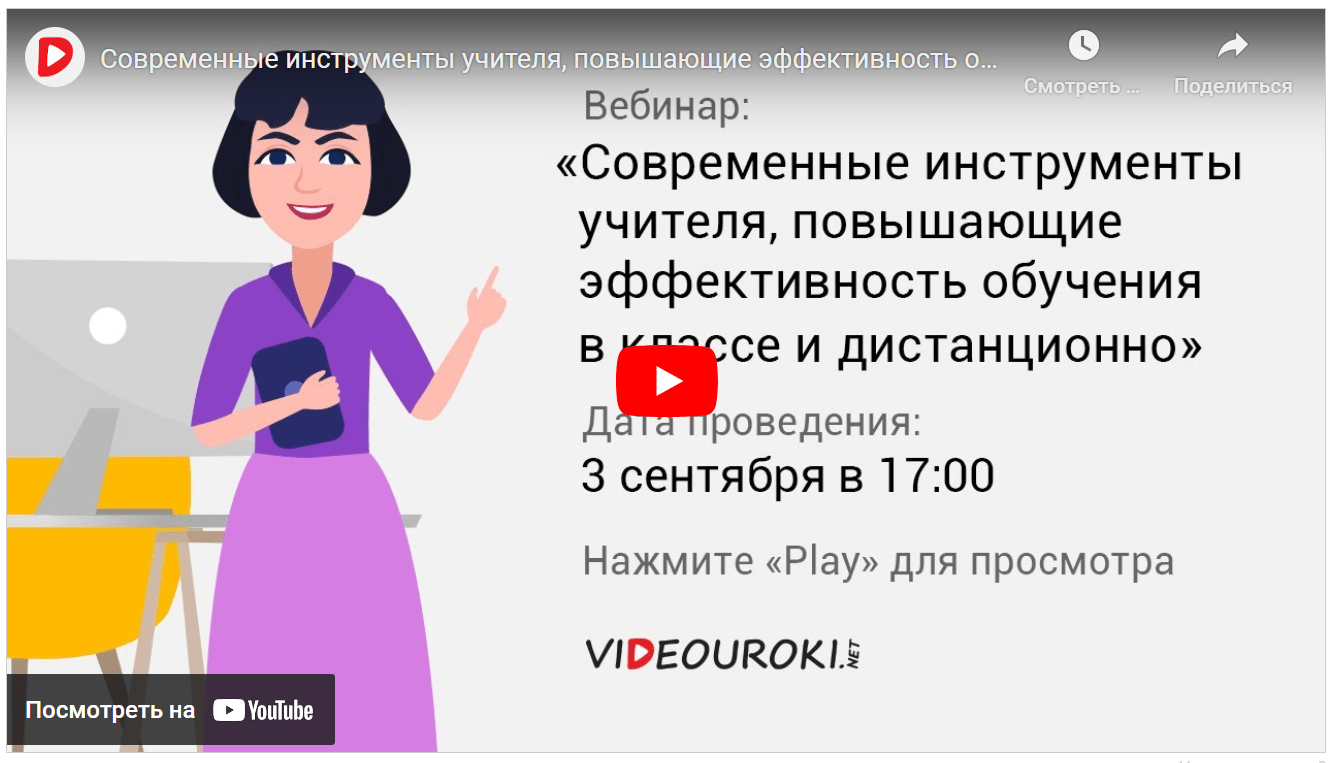
🎓 Свидетельство об участии ✨БЕСПЛАТНО!✨