Россия, Иваново


СДЕЛАЙТЕ СВОИ УРОКИ ЕЩЁ ЭФФЕКТИВНЕЕ, А ЖИЗНЬ СВОБОДНЕЕ
Благодаря готовым учебным материалам для работы в классе и дистанционно
Скидки до 50 % на комплекты
только до
Готовые ключевые этапы урока всегда будут у вас под рукой
Организационный момент
Проверка знаний
Объяснение материала
Закрепление изученного
Итоги урока

Была в сети 28.01.2022 20:42

Ледович Елена Стефановна
преподаватель иностранного языка
 1 216
 58 162

Местоположение
Специализация
"История ткани"
Категория:
Английский язык
17.01.2022 18:20

Просмотр содержимого документа
«"История ткани"»
11
History of Textile FabricsHistory and origin of fabrics, the introduction of various textile fibers to mankind each from natural and man-made categories.
Museum of Fine Arts Boston [Public domain
The fabric is woven into humanity and has touched so many lives—beginning in ancient times when primitive peoples used flax fibers, separated into strands and plaited or woven into simple fabrics colored with dyes extracted from plants. Given the intimate history of people and fabric, it is hard to imagine that the industry or “art” of making fabric has evolved into one that adversely affects the environment. The fabric business is often used to symbolize the transformation of manufacturing brought about by the industrial revolution, as it was one of the first industries to benefit from the energy produced by the steam engine powered by fossil fuel. With industrialization, the fabric industry transformed from one grounded in nature to one that relies heavily on synthetic materials and chemicals.
For thousands of years before the introduction of synthetic fibers, the four great fibers in the fabric industry were flax, wool, cotton and silk, all products created from natural, rapidly renewable and abundant sources. Innovators developed synthetic fabrics to overcome some of the inherent limitations of natural fibers: cotton and linens wrinkle; silk requires delicate handling, and wool shrinks and can be irritating to the touch. Rayon, the first man-made fiber produced to emulate silk, became commercially available in 1910. Nylon, “the Miracle Fiber,” came to market in 1939 as one of the first synthetic fibers created from petrochemicals. It established an entirely new world of synthetic fibers—including thread and women’s hosiery—and quickly replaced silk in a range of applications. Nylon became the dominant fiber for tents and parachutes in World War II. Nylon’s successful adaptation opened the door for other synthetic fibers.
At the time nylon was introduced, cotton was the king of fibers, making up 80 percent of all fiber production. By 1945, cotton production had decreased to 75 percent and its use in the home furnishings market continued to decline. Synthetic fibers made up 15 percent of the balance of the market, with wool and other fibers making up the remaining 10 percent. As more synthetics were developed, however, the manmade cellulose-based fibers like rayon, and the new fossil fuel fibers and films—acrylic, nylon, polyester, and polyvinyl chloride (See sidebar “Discovering Vinyl Film”)—continued to replace natural fibers. Synthetics delivered greater comfort, soil release, broader aesthetic range (for example, special dullness or luster could be achieved), dyeing capabilities, improved fiber cross-section and longitudinal shape, tensile strength, abrasion resistance, colorfastness and better blending qualities, as well as lower costs.
The man-made fibers and films, and a steadily growing palette of synthetic additives made it possible to add flame-retardancy, wrinkle and stain resistance, antimicrobial properties and a host of other performance improvements. By the mid-1960s, synthetics increased in market share to over forty percent. In the 1970s, a wave of greater consumer awareness and recognition of increasing product liability stimulated market demand for flame resistance in children’s sleepwear, carpet, and other products, including upholstery fabrics. For some, manufactured fibers meant “life made better.”
Fabrics made from Natural FibersNatural fibers have been used for apparel and home fashion for thousands of years, with the use of wool going back over 4,000 years.
| EST. DATE | FIBER | BACKGROUND AND PRODUCTION |
| 5,000+ BC | FLAX | Generally considered being the oldest natural textile fiber. Fine linen was used as burial shrouds for the Egyptian pharaohs Largest producer Soviet States; other large producers include Poland, Germany, Belgium, and France. Largest exporters are Northern Ireland and Belgium. |
| 3,000+ BC | COTTON | Earliest use estimated between 3,000 BC to 5,000 BC. Worn by Egyptians earlier than 2,500 BC. Eli Whitney’s invention of the cotton gin in 1793 revolutionized the processing of cotton. The development of the power loom in 1884 brought significant improvements and variations to cotton fabrics. Major producers United States, Soviet States, China, and India. Lessor producers include Pakistan, Brazil, Turkey, Egypt, Mexico Iran, and Sudan. |
| 3,000 BC | WOOL | Used by people of the Late Stone Age, There are 40 different breeds of sheep, which produce approximately 200 types of wool of varying grades. Major producers include Australia, New Zealand, Soviet States, China, South Africa, and Argentina. |
| 2,600 BC | SILK | Believed discovered by a Chinese princess. Silk is made from two continuous filaments cemented together and used to form the cocoon of the silkworm. Silk culture began about 1725 BC, sponsored by the wife of China’s emperor. Secrets of cultivation and fabric manufacturing were closely guarded by the Chinese for about 3,000 years. There is a story that two monks smuggled seeds of the mulberry tree and silkworm eggs out of China by hiding them in their walking sticks. India learned of silk culture when a Chinese princess married an Indian prince. The major producer and exporter of silk are Japan. |
It is important to understand that all manufactured fibers are not alike. Each fiber has a unique composition and it’s own set of physical properties. The U. S. Federal Trade Commission has established generic names and definitions for manufactured fibers, including acetate, acrylic, lyocell, modacrylic, nylon, polyester, polypropylene (olefin), rayon, and spandex.
| DATE | FIBER | FIRST COMMERICAL PRODUCTION |
| 1910 | RAYON | The first man-made fiber. The first commercial production of rayon fiber in the United States was in 1910 by the American Viscose Company. By using two different chemicals and manufacturing techniques, two basic types of rayon were developed. They were viscose rayon and cuprammonium rayon. Today, there are no producers of rayon in the U.S. |
| 1924 | ACETATE | The first commercial production of acetate fiber in the United States was in 1924 by the Celanese Corporation. |
| 1939 | NYLON | The first commercial production of nylon in the United States was in 1939 by the E. I. du Pont de Nemours & Company, Inc. It is the second most used man-made fiber in this country, behind polyester. |
| 1950 | ACRYLIC | The first commercial production of acrylic fiber in the United States was in 1950 by E. I. du Pont de Nemours & Company, Inc. |
| 1953 | POLYESTER | The first commercial production of polyester fiber in the United States was in 1953 by E. I. du Pont de Nemours & Company, Inc. Polyester is the most used man-made fiber in the U.S. |
| 1954 | TRIACETATE | The first commercial production of triacetate fiber in the United States was in 1954 by the Celanese Corporation. Domestic Triacetate production was discontinued in 1985. |
| 1959 | SPANDEX | The first commercial production of spandex fiber in the United States was in 1959 by E. I. du Pont de Nemours & Company, Inc. It is an elastomeric man-made fiber (able to stretch at least 100% and snap back like natural rubber). Spandex is used in filament form. |
| 1961 | POLYOLEFIN/ POLYPROPYLENE | The first commercial production of an olefin fiber manufactured in the U.S. was by Hercules Incorporated. In 1966, polyolefin was the world’s first and only Nobel-Prize winning fiber. |
| 1989 | MICRO FIBERS/ MICRODENIER | The first commercial production of microfiber in the U.S. was in 1989 by E. I. du Pont de Nemours & Company, Inc. Today microfibers are produced in a variety of synthetic fibers (i.e. polyester, nylon, acrylic, etc.) The true definition of a microfiber is a fiber that has less than one denier per filament. Micro Fiber is the thinnest, finest of all man-made fibers. It is finer than the most delicate silk. To relate it to something more familiar–A human hair is more than 100 times the size of some microfibers |
| 1993 | LYOCELL | The first commercial production of lyocell in the U.S. was in 1993 by Courtaulds Fibers, under the Tencel¬ trade name. Environmentally friendly, lyocell is produced from the wood pulp of trees grown specifically for this purpose. It is specially processed, using a solvent spinning technique in which the dissolving agent is recycled, reducing environmental effluents. |
Innovators developed synthetic fabrics to overcome some of the inherent limitations of natural fibers. Cotton and linens wrinkle, silk requires delicate handling, and wool shrinks and can be irritating to the touch. Synthetics delivered greater comfort, soil release, broader aesthetic range, dyeing capabilities, abrasion resistance, colorfastness, and lower costs.
The man-made fibers--and a steadily growing palette of synthetic additives--made it possible to add flame-retardancy, wrinkle and stain resistance, antimicrobial properties and a host of other performance improvements.
Blue Jeans and Denim Fabric
Levi Strauss and Jacob Davis in 1873 invented blue jeans in response to the need for laborers for durable men's workwear. The traditional fabric used in blue jeans is denim, a durable cotton twill textile. Historically, denim was made of silk and wool in Nimes, France (hence the name "de Nim"), and not of the all-cotton variety we are familiar with today.FoxFibre®
In the 1980s, Sally Fox's passion for natural fibers led her to reinvent the naturally colored cotton used in cotton fabrics, mostly as a response to the pollution caused via the bleaching and dying processes performed in coloring cotton fabrics. Fox crossbred brown cotton, which also produced green cotton, with the aim to develop longer fibers and richer colors.
In turn, Fox's organic discoveries help to preserve the environment and can be found in everything from underwear to bed sheets.
GORE-TEX® GORE-TEX® is a registered trademark and the best-known product of W. L. Gore & Associates, Inc. The trademarked product was introduced in 1989. The fabric, based on a Gore-held patent for a membrane technology, is specifically engineered to be breathable water and wind-proof material. The phrase "Guaranteed to Keep You Dry®" is also a Gore-owned registered trademark, part of the GORE-TEX® warranty.
Wilbert L. and Genevieve Gore founded the company on January 1, 1958, in Newark, Delaware. The Gores set out to explore opportunities for fluorocarbon polymers, especially polytetrafluoroethylene. The current CEO is their son Bob. Wilbert Gore was posthumously inducted into The Plastics Hall of Fame in 1990
Kevlar®
American chemist Stephanie Louise Kwolek in 1965 invented Kevlar, a synthetic, heat-resistant material that is five times stronger than steel--and strong enough to stop bullets. It's also used to make boats. Kwolek was researching lighter material to use in tires that would give cars better fuel economy when she discovered Kevlar.
A distant cousin of nylon, Kevlar is made only by DuPont and comes in two varieties: Kevlar 29 and Kevlar 49. Today, Kevlar is used in armor, tennis racquet strings, ropes, shoes and more.
Waterproof Fabric
Scottish chemist Charles Macintosh in 1823 invented a method for making waterproof garments when he discovered that coal-tar naphtha dissolved india rubber. He took a wool cloth and painted one side with the dissolved rubber preparation and placed another layer of wool cloth on top. The Mackintosh raincoat created from the new fabric was named after him.
Polyester
British scientists John Whinfield and James Dickson in 1941--along with W.K. Birtwhistle and C.G. Ritchiethey--created Terylene, the first polyester fabric. The durable fiber was once known as uncomfortable to wear but inexpensive. With the addition of microfibers that make the fabric feel like silk--and the rising price tag because of it--polyester is here to stay.
Rayon
Rayon was the first manufactured fiber made from wood or cotton pulp and was first known as artificial silk. Swiss chemist Georges Audemars invented the first crude artificial silk around 1855 by dipping a needle into liquid mulberry bark pulp and gummy rubber to make threads, but the method was too slow to be practical.
In 1884, French chemist Hilaire de Charbonnet patented an artificial silk that was a cellulose-based fabric known as Chardonnay silk. Pretty but very flammable, it was removed from the market.
In 1894, British inventors Charles Cross, Edward Bevan, and Clayton Beadle patented a safe practical method of making artificial silk that came to be known as viscose rayon. Avtex Fibers Incorporated first commercially produced artificial silk or rayon in 1910 in the United States. The term "rayon" was first used in 1924.
Nylon And Neoprene
Wallace Hume Carothers was the brains behind DuPont and the birth of synthetic fibers. Nylon--which was patented in September 1938--is the first completely synthetic fiber to ever be used in consumer products. And while the word "nylons" became another word for hosiery, all nylon was diverted to military needs only when the United States entered World War II. The synthesis of polymers that led to the discovery of nylon led to the discovery of neoprene, a highly resistant synthetic rubber.
Spandex
In 1942, William Hanford and Donald Holmes invented polyurethane. Polyurethane is the basis of a novel type of elastomeric fiber known generically as spandex. It is a man-made fiber (segmented polyurethane) able to stretch at least 100% and snap back like natural rubber. It replaced the rubber used in women's underwear. Spandex was created in the late 1950s, developed by E.I. DuPont de Nemours & Company, Inc. The first commercial production of spandex fiber in the United States began in 1959.
VELCRO®
Swiss engineer and mountaineer George de Mestral noticed upon his return from a hike in 1948 how the burrs had clung to his clothing. After eight years of research, Mestral developed what we know today as Velcro--a combination of the words "velvet" and "crochet. "It's essentially two strips of fabric--one made up of thousands of tiny hooks, and the other with thousands of tiny loops. Mestral patented Velcro in 1955.
Vinyl
Researcher Waldo L. Semon in 1926 invented a way to make polyvinyl chloride (PVC) useful when he created vinyl--a synthetic gel that was remarkably similar to rubber. Vinyl remained a curiosity in the laboratory until it was first used as shock absorber seals. Flexible vinyl was also used on American synthetic tires. Further experimentation led to its use in World War II during the natural rubber shortage, and it is used now in wire insulation, as a waterproofing element and more.
Ultrasuede
In 1970, Toray Industries scientist Dr. Miyoshi Okamoto invented the world's first microfiber. A few months later, his colleague Dr. Toyohiko Hikota succeeded in developing a process that would transform these microfibers into an amazing new fabric: Ultrasuede--an ultra-microfiber often called a synthetic substitute for leather or suede. It's used in shoes, automobiles, interior furnishings, juggling balls and more. The composition of Ultrasuede ranges from 80% non-woven polyester and 20% non-fibrous polyurethane to 65% polyester and 35% polyurethane.
Types of Fabrics
Fabrics which are used by the textile industries to make apparels and other furnishing materials can be broadly divided into two categories viz., natural and synthetic. Natural fabrics are derived from animal coats, plant seeds, stems and leaves, and silkworm cocoons. The fabrics which are derived from plants are cotton, linen, jute and ramie. All these fabrics possess certain unique physical properties, for example cotton is the perfect material to make undergarments and sportswear and summer apparels as it is extremely breathable. There are some popular fabrics which are drawn from the hair, skin and other body parts of certain animals also. The most widely used protein-fiber fabrics used in clothing are silk and wool. However, synthetic fabrics like nylon, rayon and polyester are also getting equally popular these days. Understanding and identifying these fabrics can be quite a task to master. To assist you in the endeavor, here is a detailed account of most commonly used fabrics and their nature as well as their sources.
Different Types of Fabrics
Angora
Angora can be divided into two types. One is Mohair, which is derived from the Angora goat. The other is Angora Rabbit Hair which is made from the fur of Angora rabbit. Generally, Angora rabbit hair is known as Angora and the fiber derived from Angora goat is known as Mohair. The wool which is derived from the rabbits is extremely light, soft and somewhat silky in texture. It keeps your body much warmer than common wool and thus makes for fine winter wear. As a very small quantity of fiber can be drawn from angora rabbits, the angora fabrics often come blended with other fibers.
Cashmere
This fabric is extremely expensive and is commonly referred to as the fiber of Kings. The major suppliers of cashmere fabric include China, Mongolia, Tibet, Turkey, Afghanistan, Iraq, Iran, Australia and New Zealand. These fabrics are light, soft and extremely warm.
Wool
Wool is the most popular fabric in clothing and other home furnishings. Wools are light, cozy and wrinkle free. These are also highly durable and possess great elasticity. Merino wool is the finest wool which is derived from Merino sheep. Nowadays, wools are used to make a wide variety of textile products.
Silk
The protein fiber of silk mainly constitutes of fibroin which is secreted from the silkworm larva. Silks are lustrous and exude white or cream color. Silk can quite easily be dyed but exposure to sunlight can make it loose the color.
Fabrics from Plants
Cotton
Cotton is one of the most commonly used fabrics in the world and is derived from the cotton plant. Cottons are extremely comfy and make for great fabric for summer apparels. Apart from apparels, cotton fibers are also used in home furnishings, medical and surgical accessories as well as in automobile décor.
Linen
This plant fiber is derived from the stalks of the flax plants. Linen is the strongest fiber derived from plants. The best feature of this fabric, apart from its strength, is that is can be dyed quite easily. Fabrics made from linen are extremely comfy and posses a natural lightness and luster. However, it is very prone to wrinkles and possesses low elasticity.
Jute
The jute fibre is extremely soft, yet strong. Fabrics made of jute are commonly used to make items such as bags, painting canvas, ropes, jute yarn, sacks, twine and backings for carpets. They, when mixed with other fabrics, also make for durable apparels.
Ramie
Ramie fiber, commonly referred to as china grass, is one of the sturdiest plant fibres. Fabric derived from Ramie fiber is white in color and has a great natural luster which makes it highly popular. It possesses high absorbing properties and its strength increases manifold particularly when it’s wet. However, it is much more prone to breakage as compared to other fabrics. It is commonly available blended with other fibers like cotton or wool.
Synthetic Fabrics
Polyamide (Nylon)
Nylon is a synthetic version of silk. This particular fabric is light, strong and extremely durable. Nylon is the sturdiest manmade fiber and is used to make a number of furnishing items apart from apparels.
Polyester
Polyester is one of the strongest fabrics, with low elasticity and is highly resistant to shrinkage and stretching. This fabric is highly durable and can be washed quite conveniently. This fabric can be mixed with cotton and wool and is widely used to make clothing and home furnishing items.
There is a wide variety of fabrics which have been used to make clothing and other furnishing items. Aforementioned is all the necessary information on different types of fabrics. Hope it helps you the next time you go shopping!
Generally, a set number of yarns are used for the formation of fabrics. Also, a number of techniques are used for producing fabrics such as weaving, knitting, and felting. The type of fabrics varies by the fibres, the fabric formation techniques, machinery used for producing them, and finishing techniques. Fabrics can also be made differently based on the end-usage.
However, certain fabrics although uses a particular fiber 100% or uses a blend of different fibers may be termed otherwise and are named depending on weaving patterns, texture, and the processes, etc. such as Organza fabrics were often used to produce with Silk, but even though they started using it with alternate fibers, it continued to be called as Organza Fabric.
Each fabric carries a unique name in order for it to be identified among others based on their textures, designs, weaving patterns, aesthetic values, fiber source, the place where the fabrics are originated, etc.
Basic/Simple Weaves 1. Plain Weave
P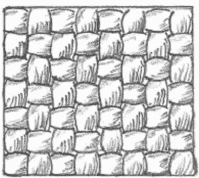 lain weave, also called taffeta. Filling yarns pass over and under alternate warp yarns. Other plain weaves are broadcloth, muslin, batiste, percale, seersucker, organdy, voile, and tweed.
Simplest weave requiring a 2 harness loom, formed by yarns at right angles whereby each warp yarn interlaces with each weft yarn Properties: least expensive to produce, reversible unless surface design, wrinkles more, firm & wears well, less absorbent, abrasion resistant, used as background for printing/ embroidery
Rib Weave fabrics: Rib effect is produced by using heavy yarns in the filling direction or by more warp than
filling yarns per inch. Eg Bengaline, ottoman, faille, poplin, broadcloth, taffeta.
Basket Weave fabrics: Basketweave is made by treating two or more yarns as one in either the warp or weft or both the directions and interlacing them in plain weave. It is not as firm as plain weave, have more yarn slippage, shrinks easily. Eg 2X1, 2X2, 2X4, 3X2, 4X4. Oxford cloth is 2X1 & monk cloth is 4X4. Flat duck, hopsacking, Panama are other examples.
2. Twill Weave
 Twill weave. Filling yarns pass over two warp yarns and under a third, and repeat the sequence for the width of the fabric. The next filling yarn repeats the sequence but shifts one warp yarn sideways, creating a diagonal pattern. Herringbone, serge, jersey, foulard, gabardine, worsted cheviot, and drill are twill weaves.
Each warp or weft yarn floats across two or more weft or warp yarns with a progression of interlacing by one to the right or to the left, forming a distinct diagonal line or wale.
The direction of diagonal may be formed from right to left, from left to right or a combination of both. Soil resistant, softer & pliable, good wrinkle recovery, durable & wears well. The direction of the twill on the back of the cloth is opposite to the twill line on the face. 3 harness is required for twill weave.
Right Hand Twill – diagonals run upwards to the right
Left Hand Twill – diagonals run upwards to the left.
Balanced Twill – the same number of warp pass over filling yarns. It is reversible. 2X2, 4X4
Unbalanced Twill – have an uneven warp or filling yarn. It has a right or wrong.
Broken Twill – combines right or left-hand twills
Herringbone Twill – a series of inverted V’s are formed resembling the backbone of the herringbone fish. Most commonly used in suiting fabrics.
Twill Angles – according to the angles of the diagonal line, Regular twill – 45°
Reclining twill – with smaller angles, Steep twill – with larger angles. E.g.: denim, herringbone, houndstooth
3. Satin Weave
S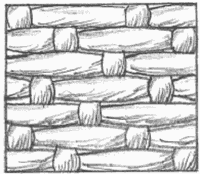 atin weave. Filler yarns pass over a number of warp yarns, four in this illustration, and under the fifth. Damask, sateen, and crepe satin are satin weaves. Exposed yarns reflect light and give the weave its sheen.
Each warp/ filling yarn floats over 4 filling/ warp yarns & interlaces with 5th filling/ warp yarn, with a progression of interlacing by 2 to right or left (warp-faced/ weft faced). Luster (long floats), firm, durable (yarns packed closely together), pliable, wrinkle resistant,
yarn slippage. Satin is warp faced. Sateen is weft-faced. 5 harness is required for a satin weave.
Read the text and translate it in writing.
Fabrics
Natural fabrics. These fabrics are chiefly Cotton, Linen, Silk, Wool. Cotton and Linen come from plants. Silk is the fine thread made by a silk-worm. Wool is the softcoat of a sheep.
Cotton is the cheapest of these fabrics, and it is used by people in almost every country in the world. The surface of the cotton fabric has very fine hairs all over it. These can only be seen if it is held up to the light. Cotton fabric is often white, but to make it pretty it is often coloured, either all over or in a pattern. It is usually better to wear coloured materials, for colour helps to make people feel happy.
Linen looks like cotton, but it is stronger, firmer and often heavier. The threads are very smooth and round. No fine hairs can be seen on the surface. Linen is cooler to wear and more expensive than cotton. It can be used for clothing such as dresses or men’s coats, but it is more often used for such articles as tablecloths.
Silk is a beautiful fabric. It is soft and shiny. The threads of silk are so fine that it is hard to see each one separately. Silk is expensive fabric. It is cool to wear and looks very beautiful.
Wool is the best material to wear, for it is the warmest. Wool is very soft and springy. The surface of the fabric is covered with very fine hairs. Wool is also much thicker and heavier than cotton, so that it keeps out the cold. But it is not so easy to wash as cotton. When it is washed badly, the springiness is lost and the wool is then hard and uncomfortable to wear.
Man-made fabrics. For thousands of years people used natural fibres. Then people learned to make fibres themselves.
Cellulose fibres. Scientists wanted to find a fibre that would look and act like silk. Their study resulted in the production of a fibre called rayon. Most rayon and acetate fabrics are made from wood pulp. Rayon dyes well and, if treated chemically, it does not wrinkle much.
Non-cellulose fibres are made entirely by chemical processes. Nylon was the first noncellulose fibre. It is made from chemicals and petroleum products. Today, nylon has almost as many uses as cotton has. It iswrinkle-resistened, does not shrink and repels water.
Nylon is used for rainwear, camping clothes and equipment, parachutes. But it is not comfortable to wear in hot weather.
Blended fibres.
Chemical processes are also used to combine two or more fibres into one fabric. Since cotton has a tendency to wrinkle, combining it with a nonwrinkling fibre reduces this tendency. Cotton for example, is often combined with polyester. It makes a fabric that looks like cotton and is cool to wear like cotton. But, like polyester, this fabric does not wrinkle easily. Fibers combined in this way are called blends. Blended fibres and fabrics can take advantage of each fibres' good qualities.
Answer the questions:
1.What natural fibres do you know?
2.What are main properties of linen?
3.What are the main characteristics of silk?
4.What are the main man-made fibres?
5.How do man-made fibres differ from natural fibres?
6.What are blends? Describe their advantages?
Match the words and learn them
fabric cotton linen silk wool thread firm fine soft springy rayon wrinkle
IV Math each noun and its definition. Make up sentences using the correct form of the verb to be. Follow the example: A garment is an article of clothing.
V Use the required form of the Infinitive and translate the sentences into Ukrainian:
1. Jeans fabric …. widely since the sixteenth century for working clothes due to its hard wearing quality.
a) used b) has been used c) is using
2. Flax ….. in many parts of the world
a) is grown b) grown c) were grown
3. A special technique of spinning …. for the flax yarns.
a) applying b) is applied c) will apply
4. Since 1950 overcoats have been shorter and with the increasing use of the motor car …. less, being replaced by the car coat.
a) is worn b) have been worn c) wearing
5. The worsted yarn …. from long fibres.
a) is spun b) spin c) spinning
6. In considering style fabric should also …. into account
a) take b) took c) be taken
7. Figures with broad shoulders should …. too tight or voluminous tops
a) avoid b) avoided c) be avoided
8. Style, figure and fabric must …. together.
a) be considered b) considering c) to consider
9. To reduce the amount of wrinkling, linen can … chemically.
a) treat b) be treated c) treating
10. Light hear is emphasized by dark colours; it may …. faded with colours that are extremely bright.
a) appeared b) appear c) appears
VI Write a summary of the text. Be ready to render it.
The discovery of natural fibres. As people learned more and more about spinning and weaving, they looked around for fibres they could use. A fibre is a slender, elongated strand that can be twisted to form a strong, tight length of yarn. Since the first weaving began, only five natural fibres have been widely used. They are wool, linen, cotton, silk, and ramie. Other fibres, such as cashmere from goats, and camel's hair from camels are sometimes used. For the most part, these other fibres are too scarce or too expensive to be used often. All five natural fibres are still used today. Each fibre was developed in different part of the world and comes from different sources. Every natural fibre can be used to make almost every item of clothing that is worn today.
Wool from Sumeria. The Sumerians, who lived in the valleys of the Tigris and Euphrates rivers, were great traders. Wool, which comes from animal hair, was one of their great exports. At first, the Sumerians wore sheep and goatskins. Eventually, they learned that the hair or fibre of these animals could be spun into yarn and woven into cloth. Like wool today, most of the Sumerian wool was made of sheep's hair.
Silk from China. Silk was discovered in China thousands of years ago. A legend says that silk was found when Emperor Huand-Tisent his wife to find out what was damaging the mulberry bushes. She accidentally dropped some silkworm cocoons into a basin of water and the threads slowly separated into long strands of silk. The production of raw silk by raising silkworms, was a part of the agricultural practices of Shang Dynasty (c. 1500 - 1000 B.C.). The practice of growing silkworms became a regular part of early Chinese society. Because silk has such lovely luster and can be dyed into deep, rich colours, it was considered rare and valuable from the time of its discovery. For well over 3,000 years, the Chinese guarded their secret to control the world silk trade.
Read the text and translate it in writing.
Fabrics and their properties
There are five natural fabrics commonly used: cotton, linen, wool, silk and ramie. Cotton, linen and ramie come from plants, and wool and silk come from animals. Cotton, which grows from the seed pot of the cotton plant, has many uses. It is used for everything, from baby’s clothes to heavy denim jeans.
Cotton is soft, absorbent and comfortable to wear in hot weather. Because cotton takes dyes very well, it is often colourtreated. Cotton is often combined with other fabrics. Its one disadvantage is that it wrinkles easily. Manufactures have learned to treat cotton or to blend it with other fabrics in order to reduce wrinkling.
Linen is made from flax plants. It is a cool, strong and absorbent fabric, much like cotton but not quite as soft. Linen wrinkles even more easily than cotton. To reduce wrinkling, it can be treated chemically.
Wool is the most commonly used animal fibre. It comes from sheep. Wool is warmer than linen and cotton. The surface of the fabric is covered with very fine hairs. When soaked in water, wool fibres weaken and the fabric may shrink. Wool is often combined with other fibres to prevent shrinking in water.
Silk comes from silkworms. Silk fibres have a natural shine. They are soft and smooth, but also very strong fibres. Silk takes dyes very well. It also wrinkles, but modern fabric manufacturers have found ways to lessen this somewhat. Like wool, silk requires some special care. It is best cared for by hand washing or by dry cleaning.
Ramie is a strong plant fibre used in clothing today. Ramie is blended with other fabrics because it is brittle.
Man-madefabrics. For thousands of years, people had no choice but to use natural fibres. Then people learned to make fibres themselves. Manufactured fibres are made by chemically changing cellulose or combining two or more chemical compounds.
Cellulose fibres. Scientists wanted to find a fibre that would look and act like silk. Their study resulted in the production of a fibre called rayon. Most rayon and acetate fabrics are made from wood pulp. Rayon dyes well and, if treated chemically, it does not wrinkle much.
Non-cellulose fibres are made entirely by chemical processes. Nylon was the first noncellulose fibre. It is made from chemicals and petroleum products. Today, nylon has almost as many uses as cotton has. It iswrinkle-resistened does not shrink and repels water.
Nylon is used for rainwear, camping clothes and equipment, parachutes. But it is not comfortable to wear in hot weather.
Blended fibres.
Chemical processes are also used to combine two or more fibres into one fabric. Since cotton has a tendency to wrinkle, combining it with a nonwrinkling fibre reduces this tendency. Cotton for example, is often combined with polyester. It makes a fabric that looks like cotton and is cool to wear like cotton. But, like polyester, this fabric does not wrinkle easily. Fibers combined in this way are called blends. Blended fibres and fabrics can take advantage of each fibres' good qualities.
Answer the questions:
1.What natural fibres are derived from plants?
2.What two natural fibres are derived from animals?
3.What are main characteristics of cotton?
4.What properties of wool do you know?
5.How are silk fibres prodused?
6.What man-made fabrics do you know? What are their advantages?
III Match the words and learn them
Blend absorbent wrinkling wool fabric rayon shrinking smooth soft linen fibre cotton
IV Math each noun and its definition. Make up sentences using the correct form of the verb to be. Follow the example: A garment is an article of clothing
| 1. wool | a) the property of fabric that shows whether the fabric |
|
| can absorb perspiration from the body |
| 2. hand | b) fibres from lambs, sheep, and certain other animals |
| 3. absorbency | c) the property of fabric related to how the fabric feels |
|
| next to the skin |
| 4. dyeing | d) the property of fabric which enables it to resist and |
|
| recover from wrinkling |
| 5.crease-resistance | e) a process of colouring fibres, yarns or fabrics with |
|
| natural or synthetic dyes |



Вебинар для учителей

🎓 Свидетельство об участии ✨БЕСПЛАТНО!✨