

Узбекистан, Ташкент


СДЕЛАЙТЕ СВОИ УРОКИ ЕЩЁ ЭФФЕКТИВНЕЕ, А ЖИЗНЬ СВОБОДНЕЕ
Благодаря готовым учебным материалам для работы в классе и дистанционно
Скидки до 50 % на комплекты
только до
Готовые ключевые этапы урока всегда будут у вас под рукой
Организационный момент
Проверка знаний
Объяснение материала
Закрепление изученного
Итоги урока

Была в сети 22.01.2021 20:21

Хакимова Райхон Иноятовна
учитель английского языка
 930
 72 494

Местоположение
Education in Great Britain
Категория:
Английский язык
27.01.2020 14:05

Просмотр содержимого документа
«Education in Great Britain»
Unit 3 Education
Theme: Education in Great Britain
Aims:
Educational - To form and fix knowledge about schools, types of schools in Great Britain.
- To fix knowledge of use of topical vocabulary on the theme.
Developing - To develop reading, work over the text and writing skills, logical thinking, memory, abilities of comparing and generalizing of items.
- To practice communicative skills in discussions.
Upbringing - To bring up the interest to the education system in Great Britain.
Form of lesson - lesson – discussion.
Equipment - Presentation, cards
T h e p r o c e d u r e o f t h e l e s s o n
I. The beginning of the lesson
1. Greetings
-Good morning
-Sit down
-who is on duty today?
-Who is absent today?
-What day is it today?
-What is the weather like today?
2. Checking up the homework:
II. The main part of the lesson
1. New theme:
1. Brainstorming
Teacher: Stand in a circle with one pupil in the center. (pupils go around and listen to the music, when it stops, they answer questions):
1. Is your school large or small?
2. How many floors does your school have?
3. What subjects do you study?
4. Do you wear a uniform?
5. What is your favourite subject?
6. Do you like your school?
7. How many lessons do you have?
Teacher: We speak about the education system in Great Britain. You do some activities, read the text, fill the blanks, make up texts and projects. Let’s divide in 4 groups.
 2
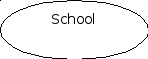 . Give me your ideas about the word school.
 Make up the sentences using the words from this cluster.


3. Make phrases with the word 'school', and try to guess their meaning.
e.g. nursery school – детский сад
primary school – начальная школа
infant school – начальная школа (5-7 лет)
junior school – начальная школа (8-11 лет)
comprehensive school – общеобразовательная школа
grammar school – средняя школа для одаренных детей
public school – частная школа (Британия), государственная школа (Америка)
4. Practise reading for specific information and inferring meaning from context. Exercise 1b page 29.
Education in England and Wales
There are four types of schools in the English and Welsh education system – nursery, primary, secondary and private schools. Scotland has its own education system, which is different.
Children start school at the age of five, but there is some free nursery-school education before that age. The state nursery schools are not for all. They are for some families, for example for families with only one parent. in most areas there are private nursery schools.
Parents who want their children to go to nursery school pay for their children under 5 years
old to go to these private nursery schools.
Primary school is divided into infant school (pupils from 5 to 7 years old) and junior school
(from 8 to 11 years old). in some areas there are middle schools instead of junior schools, which take pupils from 9 to 12 years old. Primary schools have from 50 to 200 pupils.
Secondary schools are usually much larger than primary schools and most children – over
80 per cent – go to a comprehensive school at the age of 11. These schools are for all. Pupils
do not need to pass an exam to go to these schools. These schools are large. They have from 1,200 to 2,500 pupils. School lasts all day in the UK, so there is only one shift. in some areas there are grammar schools. Pupils must pass special exams to go to these schools.
Some parents prefer private education. in England and Wales, private schools are called public schools. They are very expensive. Only 5 per cent of the school population goes to public schools. Public schools are for pupils from 5 or 7 to 18 years old. Some public schools are day schools, but many public schools are boarding schools. Pupils live in the school and go home in the holidays.
5. Answer the questions with the help of the text. Exercise 1c page 29.
Key:
1. Nursery, primary (infant and junior), secondary, private
2. 5 years old
3. Infant and junior
4. PP have to pass an exam to go to grammar schools
5. Public schools
6. Match parts of the text in groups.
Children in Britain start school when they are five. They stay at school until they are 16 or older. Children attend nursery school from the age of about 3, but these schools are not compulsory. Compulsory education begins at the age of 5, when children go to primary school. Primary education lasts for six years. Then pupils go to secondary school.
They study subjects: English, mathematics, science, geography, history, art, music, physical education and a foreign language. Most secondary schools teach Spanish, German, Italian and Russian. Pupils take exams at the age of 7, 11 and 14. After 5 years of secondary education they take the GCSE examination. Secondary education ends at 16. Some pupils stay at school and other pupils go to colleges. Higher education begins at 18 and lasts 3 or 4 years.
Some parents send their children to private schools. State education is free.
7. Make up 5 questions for each group and ask them.
8. Describe and draw your school using these words:
It is located, a wide school yard, primary school, floor, many interesting books, during the break, widespread language, native language, at the lessons.
9. Present your projects
III. The end of the lesson
1. Assessment
2. Homework: to make up crossroad
Complete the crossword: clue – ключ к разгадке
Clues - down: 1. lyceum 2. public 3. primary 4. boarding 5. elementary
Clues - from left to right: 6. university 7. middle
Clues-up: 8. infant 9. high 10. college
Clues - from right to left: 11. nursery 12. private 13. junior
“kindergarten” is the word for the marked place.
Conclusion
What did you like and what didn’t you like at the lesson today, what was easy/difficult.

Вебинар для учителей

🎓 Свидетельство об участии ✨БЕСПЛАТНО!✨



