


россия,


СДЕЛАЙТЕ СВОИ УРОКИ ЕЩЁ ЭФФЕКТИВНЕЕ, А ЖИЗНЬ СВОБОДНЕЕ
Благодаря готовым учебным материалам для работы в классе и дистанционно
Скидки до 50 % на комплекты
только до
Готовые ключевые этапы урока всегда будут у вас под рукой
Организационный момент
Проверка знаний
Объяснение материала
Закрепление изученного
Итоги урока

Была в сети 23.10.2026 07:27
Татарова Аюна Дашиевна
учитель английского языка
 6 179
 10 040

Местоположение
Специализация
Conditionals придаточные предложения
Категория:
Английский язык
25.11.2020 09:28

Просмотр содержимого документа
«Conditionals придаточные предложения»

Antonyms
Antonyms are words belonging to the same part of speech, identical in style, expressing contrary of contradictory notions.
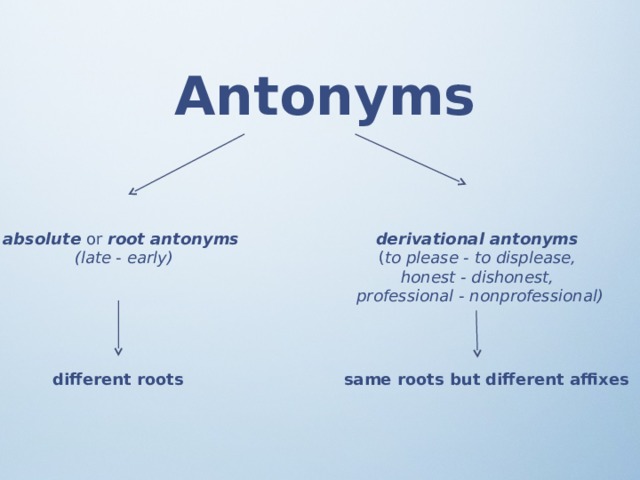
Antonyms
absolute or root antonyms
derivational antonyms
(late - early)
( to please - to displease,
honest - dishonest,
professional - nonprofessional)
different roots
same roots but different affixes

1. Negative prefixes (un-; dis-; non-) form antonyms:
Un-: un true
Dis-: dis like
Non-: non reactive
2. Sometimes they are formed by means of antonymous suffixes -ful and -less
-ful: pain ful
-less: pain less
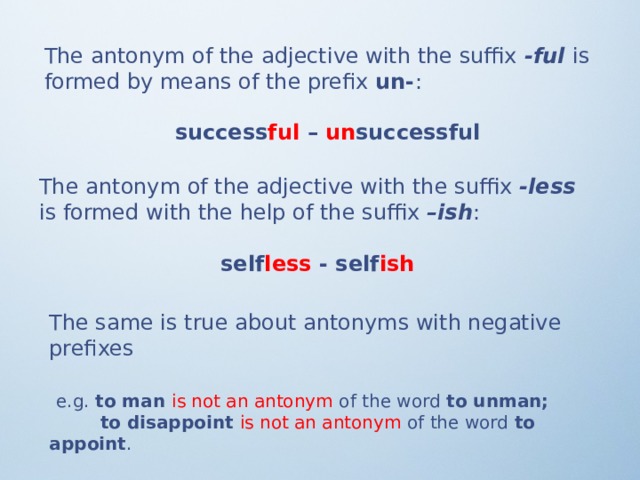
The antonym of the adjective with the suffix -ful is formed by means of the prefix un- :
success ful – un successful
The antonym of the adjective with the suffix -less is formed with the help of the suffix –ish :
self less - self ish
The same is true about antonyms with negative prefixes
e.g. to man is not an antonym of the word to unman;
to disappoint is not an antonym of the word to appoint .
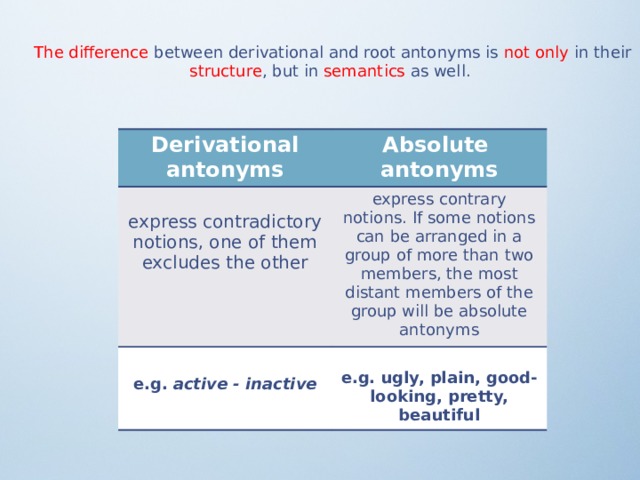
The difference between derivational and root antonyms is not only in their structure , but in semantics as well.
Derivational antonyms
Absolute
antonyms
express contradictory notions, one of them excludes the other
express contrary notions. If some notions can be arranged in a group of more than two members, the most distant members of the group will be absolute antonyms
e.g. active - inactive
e.g. ugly, plain, good-looking, pretty, beautiful

Leonard Lipka in the book Outline of English Lexicology describes different types of oppositeness, and subdivides them into three types:
- complementarity, e.g. male - female, married – single;
- antonyms, e.g. good – bad
- converseness, e.g. to buy - to sell.
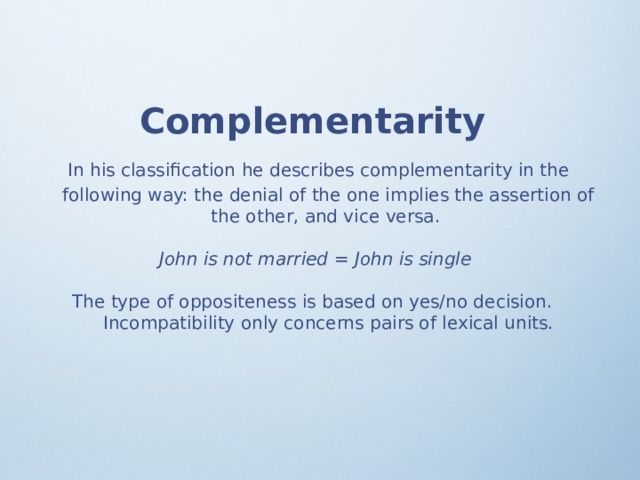
Complementarity
In his classification he describes complementarity in the following way: the denial of the one implies the assertion of the other, and vice versa.
John is not married = John is single
The type of oppositeness is based on yes/no decision. Incompatibility only concerns pairs of lexical units.

Antonyms
It's distinguished from complementarity by being based on different logical relationships . The assertion containing one member implies the negation of the other, but not vice versa.
John is good = John is not bad
John is not good ≠ John is bad
The negation of one term doesn't necessarily implies the assertion of the other.
An important linguistic difference from complementaries is that antonyms are always fully gradable , e.g. hot, warm, tepid, cold.

Converseness
- Converseness is mirror-image relations or functions:
e.g. husband – wife, pupil - teacher, precede - follow, above - below,
before - after etc.
Jonh bought the car from Bill = Bill sold the car to John
2.. Also in the comparative form:
Y is smaller than X = X is larger than Y.
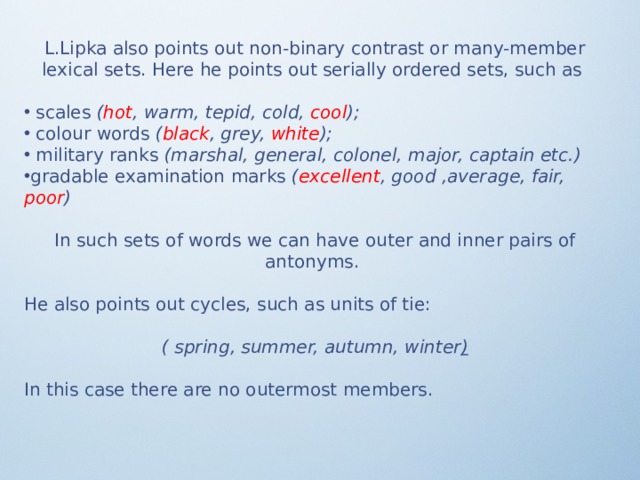
L.Lipka also points out non-binary contrast or many-member lexical sets. Here he points out serially ordered sets, such as
- scales ( hot , warm, tepid, cold, cool );
- colour words ( black , grey, white );
- military ranks (marshal, general, colonel, major, captain etc.)
- gradable examination marks ( excellent , good ,average, fair, poor )
In such sets of words we can have outer and inner pairs of antonyms.
He also points out cycles, such as units of tie:
( spring, summer, autumn, winter )
In this case there are no outermost members.
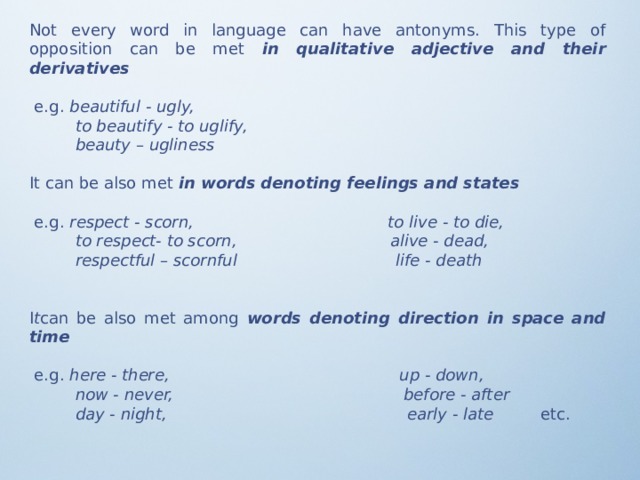
Not every word in language can have antonyms. This type of opposition can be met in qualitative adjective and their derivatives
e.g. beautiful - ugly,
to beautify - to uglify,
beauty – ugliness
It can be also met in words denoting feelings and states
e.g. respect - scorn, to live - to die,
to respect- to scorn, alive - dead,
respectful – scornful life - death
I t can be also met among words denoting direction in space and time
e.g. here - there, up - down,
now - never, before - after
day - night, early - late etc.
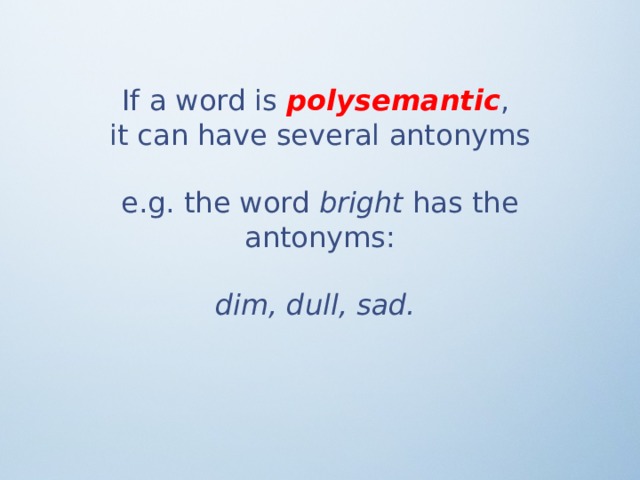
If a word is polysemantic ,
it can have several antonyms
e.g. the word bright has the antonyms:
dim, dull, sad.

Thank you for your attention!



Вебинар для учителей

🎓 Свидетельство об участии ✨БЕСПЛАТНО!✨



