

Россия, Видное


СДЕЛАЙТЕ СВОИ УРОКИ ЕЩЁ ЭФФЕКТИВНЕЕ, А ЖИЗНЬ СВОБОДНЕЕ
Благодаря готовым учебным материалам для работы в классе и дистанционно
Скидки до 50 % на комплекты
только до
Готовые ключевые этапы урока всегда будут у вас под рукой
Организационный момент
Проверка знаний
Объяснение материала
Закрепление изученного
Итоги урока

Была в сети 30.09.2026 18:49
Силина Маргарита Юрьевна
Учитель английского языка
 2 908
 24 796

Местоположение
Специализация
Conditional sentences from If to What if
Категория:
Английский язык
24.05.2026 11:16

Просмотр содержимого документа
«Conditional sentences from If to What if»
Conditional Sentences: From "If" to "What if?"
A concise visual guide to English conditionals — how we express possibilities, hypotheses and counterfactuals. Use this deck to explain structure, meaning and common variations with clear examples.

What is a conditional sentence?
Conditional sentences are complex clauses where a subordinate clause (the condition) determines the main clause (the result). They express real possibilities, hypothetical scenarios, past regrets and logical consequences.
Core idea
A condition (If‑clause) triggers a consequence (Main clause).
Uses
Predictions, advice, hypotheses, regrets and logical outcomes.

Real conditions — the simple case
Use conjunctions like if or when to describe real or likely situations. The condition is plausible and the result follows naturally.
Example
If the weather is good tomorrow, we will go for a walk.
Note
Present simple in the if-clause + future simple or imperative in the main clause.
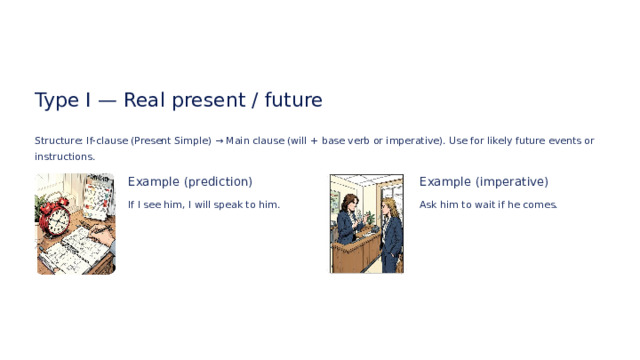
Type I — Real present / future
Structure: If-clause (Present Simple) → Main clause (will + base verb or imperative). Use for likely future events or instructions.
Example (prediction)
Example (imperative)
If I see him, I will speak to him.
Ask him to wait if he comes.

Type II — Hypothetical / unlikely present or future
Structure: If-clause (Past Subjunctive / past simple form) → Main clause (would + infinitive). Use for imagined, unlikely or counterfactual situations now or in the future.
Example
If I got rich, I’d travel round the world.
Tip
Although the if-clause uses past form, it refers to present unreality, not past time.

Inversion in Type II — elegance without "if"
In formal or literary style you can drop if and invert the auxiliary verb. This creates a concise, slightly elevated tone.
Examples
- Were she at home, she would ring me up.
- Had I time, I would help you.
When to use
Great for formal writing, conditional clauses in literature and rhetorical emphasis.

Type III — Counterfactuals about the past
Structure: If-clause (Past Perfect) → Main clause (would have + past participle). Use to imagine different outcomes from past events — often expresses regret or explanation.
Example
If I had known you were coming, I would have baked a cake.
Usage
Used for missed opportunities, apologies and hypothetical reconstructions of past events.
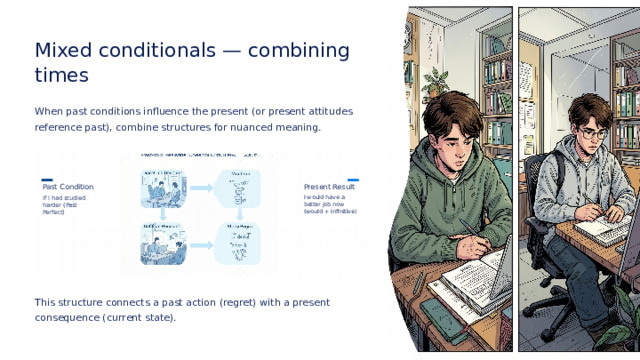
Mixed conditionals — combining times
When past conditions influence the present (or present attitudes reference past), combine structures for nuanced meaning.
Past Condition
Present Result
If I had studied harder (Past Perfect)
I would have a better job now (would + infinitive)
This structure connects a past action (regret) with a present consequence (current state).
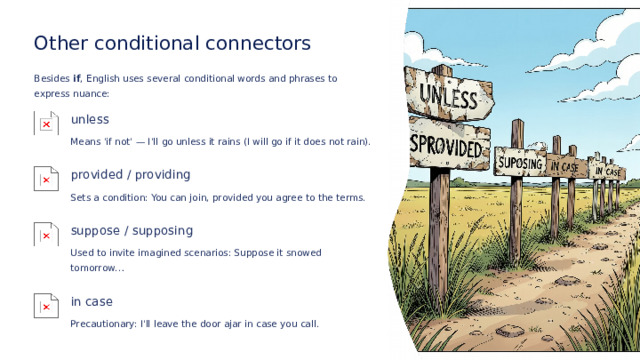
Other conditional connectors
Besides if , English uses several conditional words and phrases to express nuance:
unless
Means 'if not' — I'll go unless it rains (I will go if it does not rain).
provided / providing
Sets a condition: You can join, provided you agree to the terms.
suppose / supposing
Used to invite imagined scenarios: Suppose it snowed tomorrow…
in case
Precautionary: I'll leave the door ajar in case you call.
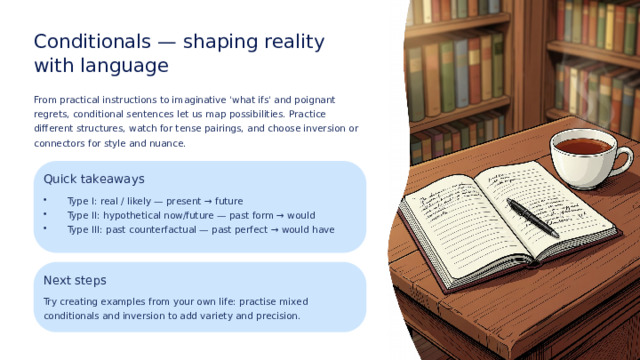
Conditionals — shaping reality with language
From practical instructions to imaginative 'what ifs' and poignant regrets, conditional sentences let us map possibilities. Practice different structures, watch for tense pairings, and choose inversion or connectors for style and nuance.
Quick takeaways
- Type I: real / likely — present → future
- Type II: hypothetical now/future — past form → would
- Type III: past counterfactual — past perfect → would have
Next steps
Try creating examples from your own life: practise mixed conditionals and inversion to add variety and precision.








Вебинар для учителей

🎓 Свидетельство об участии ✨БЕСПЛАТНО!✨



