


Россия, Казань


СДЕЛАЙТЕ СВОИ УРОКИ ЕЩЁ ЭФФЕКТИВНЕЕ, А ЖИЗНЬ СВОБОДНЕЕ
Благодаря готовым учебным материалам для работы в классе и дистанционно
Скидки до 50 % на комплекты
только до
Готовые ключевые этапы урока всегда будут у вас под рукой
Организационный момент
Проверка знаний
Объяснение материала
Закрепление изученного
Итоги урока

Был в сети 01.11.2026 00:38

Орлов Олег Игоревич
Учитель биологии
 5 317
 12 137

Местоположение
Специализация
Chemical phantoms of ligands in pharmaceuticals
Категория:
Биология
11.01.2023 18:36

Просмотр содержимого документа
«Chemical phantoms of ligands in pharmaceuticals»
Chemical phantom ligands in pharmaceuticals -2
O. I. Orlov, R.O. Orlov
(The authors, the empirical results of their studies of 2000-2006 are currently interpreted not from the standpoint of torsion interactions, but within the framework of classical ideas about electromagnetic radiation in the infrared (IR) sense).
1. Physicochemical properties and phenomenology of information infrared radiation:
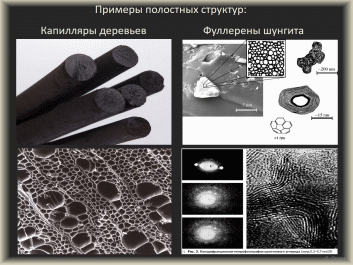
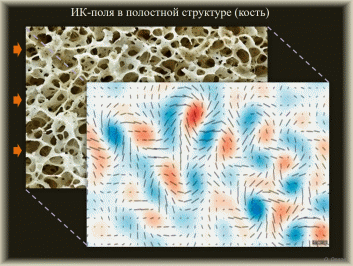
Selective shielding. Radiation classified as "energy information" has a specific penetrating power. It has been found that the frequency spectra of data emitters effectively provide or reflect protection with specialized polymer films (mirrors) adsorbed on surface layers, cavities, chambers, small cells and structural materials of the resonator, which at the same time remain radio-transparent for standard electromagnetic waves.
Phenomenon of aftereffect (phantom effect): A characteristic feature of radiations is their ability to induce stable changes in the objects of influence - the cell, organ, body system, body and persisting for a certain period of time after the removal of the primary physical source. Potential information transfer: Exogenous drugs generate wave radiation or, in another way, the amplitude-frequency profile of the ligand, or, in another way, the "chemical phantom," isomorphic in nature to the electromagnetic. This property determines the theoretical possibility of imprinting (transfer and fixation) of therapeutic characteristics of drugs.
2. the concept of "Chemical phantoms":
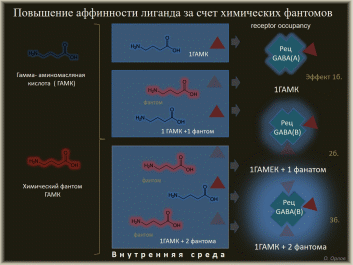
In the first ligand-receptor interaction, to increase the amplitude-frequency profiles of BAV ligands, we verified and used the term "chemical phantoms" (CP), described in the work "Chemical phantoms of BAV-2" (2007).
Physical mechanism: The formation of CP, due to the generation in the physical environment of the measurement of the measured frequency profile ("portrait") of a substance, which makes it possible to determine it not only as an information, but also as an energy model (EC). The review process is reversible and allows retransmission of the energy copy to the material substrate.
Biological activity: A spectral copy of CP-biological active substance capable of acting as a functional surrogate ligand. Interacting with cell receptors, CP induces energy information exchange processes in biosystems, partially or completely reproducing the effects of native compounds.
3. biochemical aspects of ligand-receptor interaction according to the classical canons of molecular biology and chemistry (in particular, according to the materials of academic literature), the mechanisms of interaction in the ligand-receptor system are characterized by patterns:
Conformational dynamism: Binding a ligand to the active site of a macromolecule changes its spatial (three-dimensional) configuration - the conformation. It modulates the functional state of the protein: activates or inactivates receptor/enzymatic complexes, induces subunit dissociation, triggers ion channels, or triggers autophosphorylation cascades.
Specificity and complementarity: Selectivity of tracking the spatial and chemical interaction (complementarity) of receptors of the active center of a sequential ligand. In this case, amino acid radicals forming a topologically isolated active center can be removed from each other in the last protein sequence.
Induced compliance: Due to the conformational lability (flexibility and activity) of the protein matrix, the active center of scientists on microconformational rearrangements for stable "fitting" under the ligand with impaired fixation due to non-covalent bonds.
Affinity and microenvironment: Binding strength (affinity, or affinity) is determined not only by the termini of intermolecular contacts, but also by the polar microenvironment (solvent-water molecules, as well as lipid bilayer membranes and partner proteins). Ligand polymorphism: Organic and inorganic compounds of different molecular weights (including substrates, antigens, agonists, antagonists, inhibitors) can appear in ligand rollers. Power with large endogenous ligands, modules of receptor systems are twisted by minor exogenous agonists, showing activity in subnanomolar and picomolar concentrations, to the ratio of probabilities and states - "chemical phantoms." However, if large agonists are taken most often in the form of tablets, then chemical phantoms constantly, while on the body resonator, continue to constantly cause an accumulation effect.
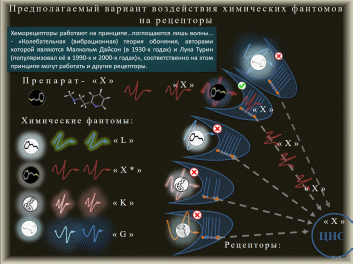
4. The mechanism of action of the main phantoms on chemoreceptors (according to the principle of the GABA-ergic system) The exact biophysical profile of CP, which determines their ability to activate the regulatory centers of proteins in the absence of ensuring the affinity of the native ligand, remains controversial at the moment. A hypothesis is proposed according to which chemoreceptors function according to the principle of frequency-resonance by…








Вебинар для учителей

🎓 Свидетельство об участии ✨БЕСПЛАТНО!✨



