

Россия, Дмитриев


СДЕЛАЙТЕ СВОИ УРОКИ ЕЩЁ ЭФФЕКТИВНЕЕ, А ЖИЗНЬ СВОБОДНЕЕ
Благодаря готовым учебным материалам для работы в классе и дистанционно
Скидки до 50 % на комплекты
только до
Готовые ключевые этапы урока всегда будут у вас под рукой
Организационный момент
Проверка знаний
Объяснение материала
Закрепление изученного
Итоги урока

Была в сети 11.03.2026 10:47
Ковалева Галина Ивановна
Преподаватель, педагог-психолог
 981
 69 370

Местоположение
Специализация
Автомобиль, тип кузова
Категория:
Английский язык
29.10.2019 10:48

Просмотр содержимого документа
«Автомобиль, тип кузова»
Car. Bodywork. Types of bodies .
Ковалева Г.И., преподаватель ОБПОУ «Дмитриевский сельскохозяйственный техникум»

Pioneer of autostructure
Karl Friedrich Benz is a German mechanic and entrepreneur, a pioneer of automotive engineering, officially recognized as one of the creators of the first car. He was born on November 26, 1844 in Ladenburg. A graduate of the "Ecole Polytechnique" in Karlsruhe. He worked as a photographer, watchmaker, worker, draftsman and mechanic. In 1871, he decided to found a company for the construction of internal combustion engines developed by himself. In 1879, Benz tried to patent his engine, but it turned out that such an engine is already patented in the UK. Nevertheless, he received a patent, however, only for the fuel supply system used in his engine. In 1883, Benz founded in Mannheim "Benz and co Reiniche of Gasmotorenfabrik" and began to conduct experiments on the construction of the engine crew in his home workshop.
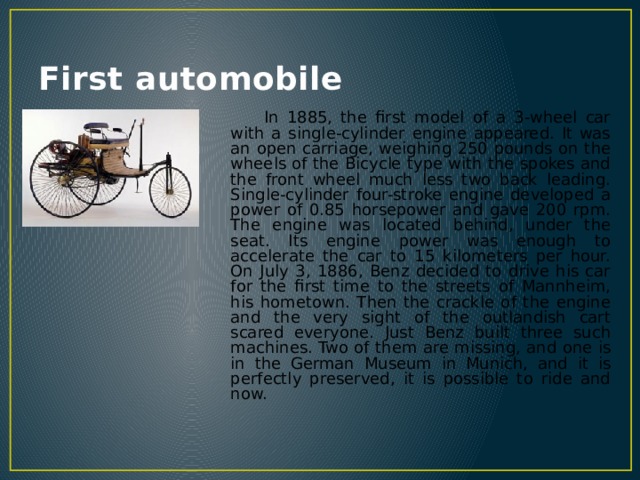
First automobile
In 1885, the first model of a 3-wheel car with a single-cylinder engine appeared. It was an open carriage, weighing 250 pounds on the wheels of the Bicycle type with the spokes and the front wheel much less two back leading. Single-cylinder four-stroke engine developed a power of 0.85 horsepower and gave 200 rpm. The engine was located behind, under the seat. Its engine power was enough to accelerate the car to 15 kilometers per hour. On July 3, 1886, Benz decided to drive his car for the first time to the streets of Mannheim, his hometown. Then the crackle of the engine and the very sight of the outlandish cart scared everyone. Just Benz built three such machines. Two of them are missing, and one is in the German Museum in Munich, and it is perfectly preserved, it is possible to ride and now.

Description of the main properties of the car
- Reliability — the property of the car, in which it is able to perform the specified functions, keeping in time the values of the established performance indicators within the specified limits, corresponding to the specified modes and conditions of use, maintenance, repairs, storage and transportation. Performance — the property of the car, in which it is able to perform the specified functions, keeping the values of the specified parameters within the limits set by the regulatory and technical documentation. Reliability — the ability of the car to continuously maintain performance for some time or some operating time
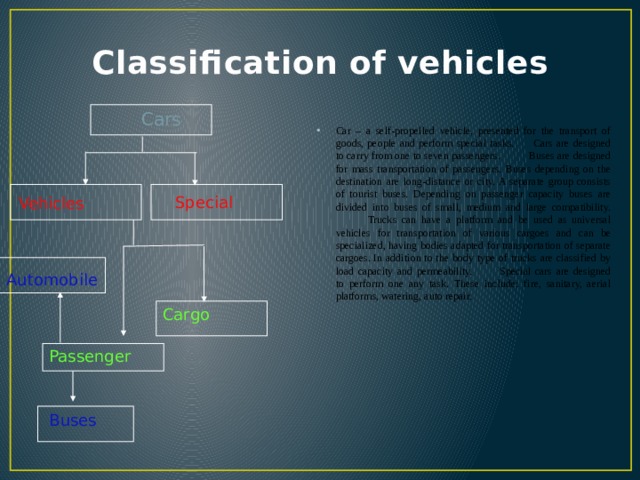
Classification of vehicles
- Car – a self-propelled vehicle, presented for the transport of goods, people and perform special tasks. Cars are designed to carry from one to seven passengers. Buses are designed for mass transportation of passengers. Buses depending on the destination are long-distance or city. A separate group consists of tourist buses. Depending on passenger capacity buses are divided into buses of small, medium and large compatibility. Trucks can have a platform and be used as universal vehicles for transportation of various cargoes and can be specialized, having bodies adapted for transportation of separate cargoes. In addition to the body type of trucks are classified by load capacity and permeability. Special cars are designed to perform one any task. These include: fire, sanitary, aerial platforms, watering, auto repair.
Cars
Special
Vehicles
Automobile
Cargo
Passenger
Buses
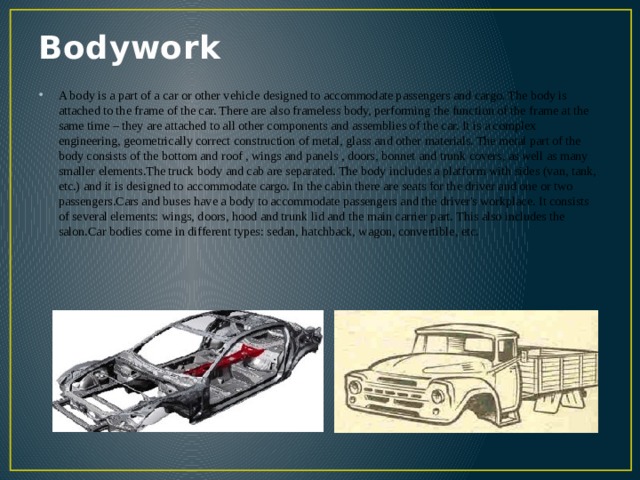
Bodywork
- A body is a part of a car or other vehicle designed to accommodate passengers and cargo. The body is attached to the frame of the car. There are also frameless body, performing the function of the frame at the same time – they are attached to all other components and assemblies of the car. It is a complex engineering, geometrically correct construction of metal, glass and other materials. The metal part of the body consists of the bottom and roof , wings and panels , doors, bonnet and trunk covers, as well as many smaller elements.The truck body and cab are separated. The body includes a platform with sides (van, tank, etc.) and it is designed to accommodate cargo. In the cabin there are seats for the driver and one or two passengers.Cars and buses have a body to accommodate passengers and the driver's workplace. It consists of several elements: wings, doors, hood and trunk lid and the main carrier part. This also includes the salon.Car bodies come in different types: sedan, hatchback, wagon, convertible, etc.
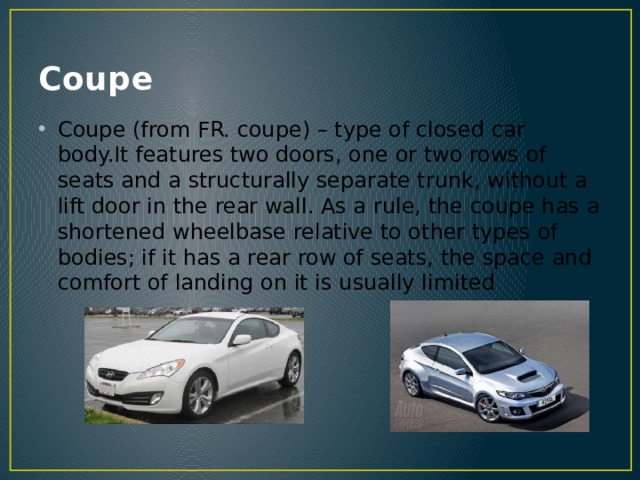
Coupe
- Coupe (from FR. coupe) – type of closed car body.It features two doors, one or two rows of seats and a structurally separate trunk, without a lift door in the rear wall. As a rule, the coupe has a shortened wheelbase relative to other types of bodies; if it has a rear row of seats, the space and comfort of landing on it is usually limited

Sedan
Sedan - closed car body with trunk, structurally separated from the
passenger compartment without a lift door in the rear wall.

Stretch.
Stretch - type of the closed body of the car executed By means of a physical insert into the body of the additional section, Located between the front and rear doors, which contributes to cabin elongation

Hatchback
- Hatchback or hatchback – the name of the car body with one or two rows of seats, a door in the rear wall and a shortened rear overhang.

Estate
- Universal – type of closed car body with a door in the rear wall, the trunk, combined with the cabin, and the roof of the trunk extended to the rear dimension.

Cabriolet
- Convertible – a type of car body with a convertible soft or hard top and two doors. Number of seats more than two.

Roadster
- Roadster – body type of a two-seater sports car without a roof or with a hard roof, has no more than two seats.
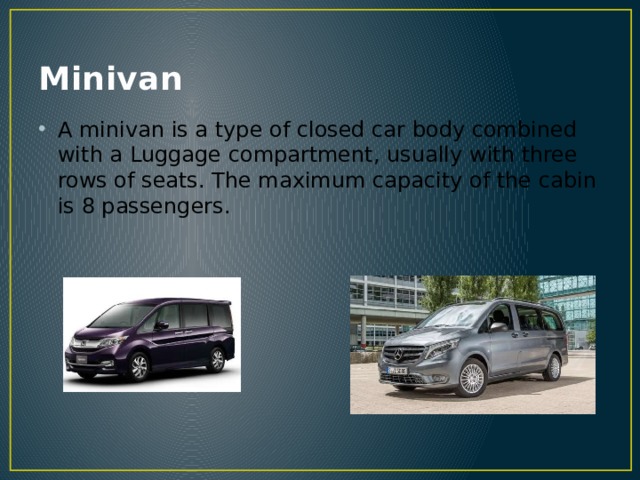
Minivan
- A minivan is a type of closed car body combined with a Luggage compartment, usually with three rows of seats. The maximum capacity of the cabin is 8 passengers.
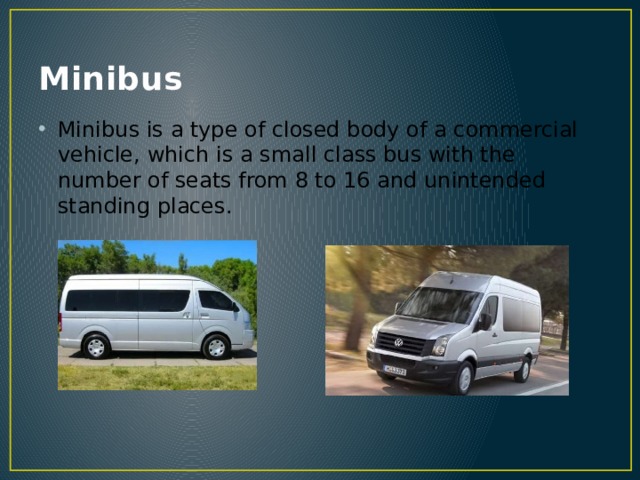
Minibus
- Minibus is a type of closed body of a commercial vehicle, which is a small class bus with the number of seats from 8 to 16 and unintended standing places.

Targa
- Targa – a type of car body, which is a kind of sports 2-seater Roadster with a rigidly fixed windshield, rear seat safety arc, removable roof and rear glass.

Van
- A van is a type of closed car body intended for transportation of goods or people. There are several types of vans. According to the purpose of the vans are divided into universal and special, designed to carry various equipment.
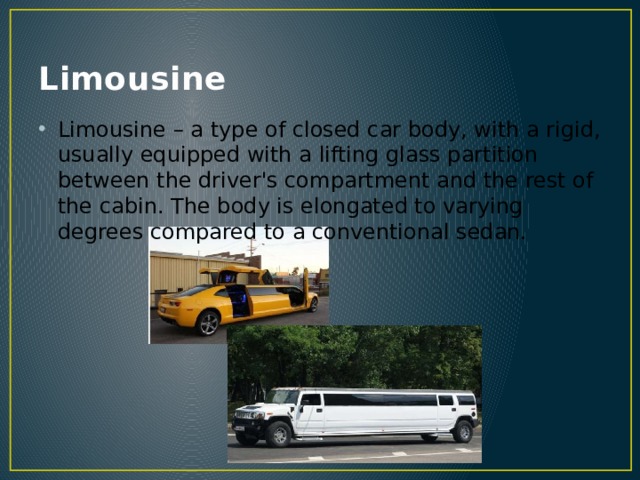
Limousine
- Limousine – a type of closed car body, with a rigid, usually equipped with a lifting glass partition between the driver's compartment and the rest of the cabin. The body is elongated to varying degrees compared to a conventional sedan.
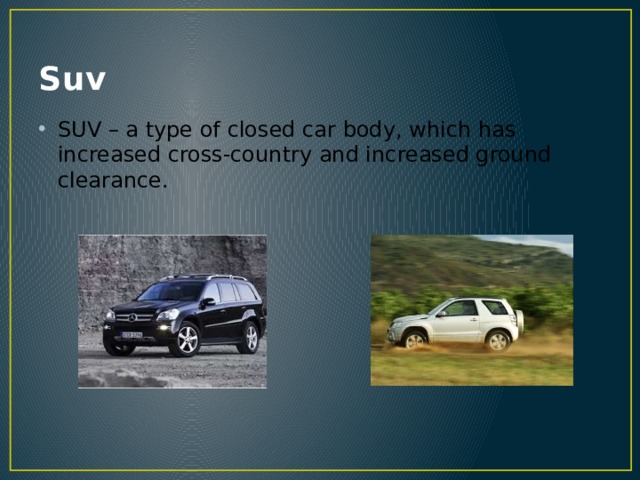
Suv
- SUV – a type of closed car body, which has increased cross-country and increased ground clearance.

Pickup
- Pickup – body type of a two-seater with an open cargo platform.

end








Вебинар для учителей

🎓 Свидетельство об участии ✨БЕСПЛАТНО!✨



