


Узбекистан, Ташкент


СДЕЛАЙТЕ СВОИ УРОКИ ЕЩЁ ЭФФЕКТИВНЕЕ, А ЖИЗНЬ СВОБОДНЕЕ
Благодаря готовым учебным материалам для работы в классе и дистанционно
Скидки до 50 % на комплекты
только до
Готовые ключевые этапы урока всегда будут у вас под рукой
Организационный момент
Проверка знаний
Объяснение материала
Закрепление изученного
Итоги урока

Была в сети 30.06.2020 16:55

Мухамедова Нигина Абдуджалаловна
учитель английского языка
 468
 115 000

Местоположение
Специализация
About - Great Britain
Категория:
Английский язык
22.06.2020 21:27

Просмотр содержимого документа
«About - Great Britain»

ABOUT GREAT BRITAIN
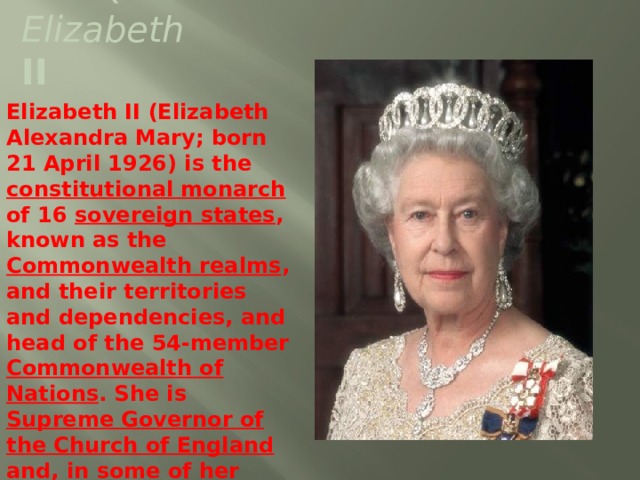
The Queen Elizabeth II
Elizabeth II (Elizabeth Alexandra Mary; born 21 April 1926) is the constitutional monarch of 16 sovereign states , known as the Commonwealth realms , and their territories and dependencies, and head of the 54-member Commonwealth of Nations . She is Supreme Governor of the Church of England and, in some of her realms, carries the title of Defender of the Faith as part of her full title.

On her accession on 6 February 1952, Queen Elizabeth became Head of the Commonwealth and queen regnant of seven independent Commonwealth countries: the United Kingdom, Canada, Australia, New Zealand, South Africa, Pakistan and Ceylon. From 1956 to 1992, the number of her realms varied as territories gained independence and some realms became republics. At present, in addition to the first four aforementioned countries, Elizabeth is Queen of Jamaica, Barbados, the Bahamas, Grenada, Papua New Guinea, the Solomon Islands, Tuvalu, Saint Lucia, Saint Vincent and the Grenadines, Belize, Antigua and Barbuda and Saint Kitts and Nevis. Her reign of 61 years is currently the second longest for a British monarch; only Queen Victoria has reigned longer at 63 years 7 months.

Elizabeth was born in London and educated privately at home. Her father acceded to the throne as George VI in 1936 on the abdication of his brother Edward VIII , from which time she was the heir presumptive . She began to undertake public duties during the Second World War , in which she served in the Auxiliary Territorial Service . In 1947, she married Prince Philip, Duke of Edinburgh , with whom she has four children: Charles , Anne , Andrew , and Edward . Her coronation service took place in 1953 and was the first to be televised .

The political centre of London is Westminster
The political centre of London is Westminster. It is the part of London where there are a lot of offices. If you go down Whitehall from Trafalgar Square on the right you will see a small street where the British Prime Minister lives. He lives at number 10 Downing Street. Whitehall is a wide street leading to Parliament Square. This square is very large. On the left you can see a long grey building with towers which are the Houses of Parliament.
The large clock in one of the towers is Big Ben. Big Ben is the name of the clock and the bell of the clock tower of the Houses of Parliament. You can hear the sound of Big Ben every hour in London. The clock and the bell got their names after Sir Benjamin Hall. He was a tall man, whose nickname was Big Ben. So people know the clock as Big Ben. The Thames is behind the Houses of Parliament and the bridge across it is a Westminster Bridge.


On the other side of Parliament Square is Westminster Abbey. It is one the most famous and beabtiful churches in London. It is very old too. It is more than nine hundred years old. There are so many monuments and statues there. Many English kings and queens are buried there. Westminster Abbey is famous for its Poet's Comer too. Many great writers are buried there: for example, Charles Dickens and Rudyard Kipling.
The Queen of England lives in Buckingham Palace. It is a wonderful building with a monument in front of it which is the Queen Victoria Memorial. It takes twenty minutes to get from Trafalgar Square to Buckingham Palace

Big Ben
Big Ben is one of London's best-known landmarks, and looks most spectacular at night when the clock faces are illuminated. You even know when parliament is in session, because a light shines above the clock face. The four dials of the clock are 23 feet square, the minute hand is 14 feet long and the figures are 2 feet high. Minutely regulated with a stack of coins placed on the huge pendulum, Big Ben is an excellent timekeeper, which has rarely stopped. The name Big Ben actually refers not to the clock-tower itself, but to the thirteen ton bell hung within. The bell was named after the first commissioner of works, Sir Benjamin Hall.

During the second world war in 1941, an incendiary bomb destroyed the Commons chamber of the Houses of Parliament, but the clock tower remained intact and Big Ben continued to keep time and strike away the hours, its unique sound was broadcast to the nation and around the world, a welcome reassurance of hope to all who heard it. There are even cells within the clock tower where Members of Parliament can be imprisoned for a breach of parliamentary privilege, though this is rare; the last recorded case was in 1880. The tower is not open to the general public, but those with a "special interest" may arrange a visit to the top of the Clock Tower through their local.

Thank you for watching.Please now listen a national anthem of Great Britain .


Вебинар для учителей

🎓 Свидетельство об участии ✨БЕСПЛАТНО!✨



